

Loading…
Loading…
Loading…
OCR GCSE Psychology · J203
OCR J203 · Concepts in Psychological Problems Check the specification (PDF) (opens in a new tab)
Mental health concerns psychological well-being: how someone feels, copes with stress and manages everyday life. It is not simply the absence of a diagnosed disorder. Someone without a diagnosis may still struggle, while a person with a diagnosed condition may function well with support.
Defining good mental health is difficult because personal experience, social circumstances and cultural expectations differ. For example, independence may be valued particularly strongly in one culture, while reliance on family may be normal in another. A definition based on one set of expectations may therefore judge other people unfairly.
In 1958, Marie Jahoda proposed an ideal model of good mental health. It identifies positive qualities rather than merely looking for symptoms of illness:
This gives a broad picture of well-being, but it sets a demanding standard. Few people meet every characteristic all the time. Temporarily lacking confidence or finding stress difficult does not necessarily mean that someone has a mental disorder.
A clinical approach instead considers whether symptoms meet diagnostic criteria and cause significant distress or difficulty functioning. This is useful for identifying people who may need treatment, but a diagnostic category does not capture every aspect of their well-being.
The mental health continuum treats mental health as a spectrum rather than two fixed boxes labelled ‘healthy’ and ‘ill’. People's position can change as circumstances, stress and their ability to cope change.
For example, someone under pressure may feel worried and need support without having a mental disorder. If difficulties become more persistent and seriously disrupt everyday life, professional help may be needed. With support or treatment, their mental health may improve again.
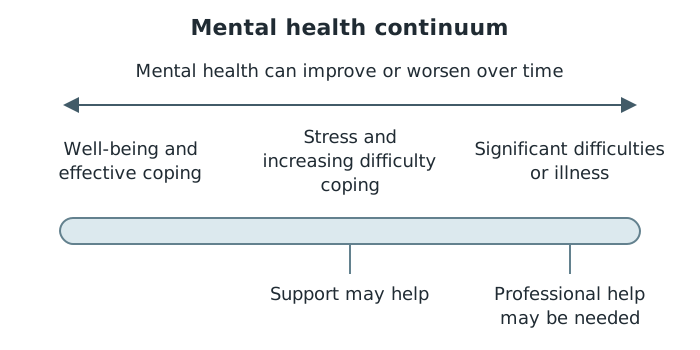
Mental health can vary in degree and change over time; the continuum is a model, not a diagnostic test.
The continuum recognises degrees of difficulty and movement in both directions. It does not mean that everyone will inevitably become ill, or that a diagram alone can diagnose someone.
Prevalence measures how many people have a condition at a particular time or during a stated period. Incidence measures new cases arising during a period. Someone whose condition began several years ago can contribute to current prevalence without being a new case this year.
The Adult Psychiatric Morbidity Survey (APMS) uses structured interviews to estimate mental health conditions in the population. Its common mental health conditions include depression, generalised anxiety disorder, panic disorder, phobias and obsessive-compulsive disorder. These conditions cause emotional distress and interfere with daily functioning.
Survey estimates are not simply counts of professional diagnoses. Some people meet the interview criteria despite never having received a diagnosis. Conversely, a statistic about common conditions does not measure every possible mental disorder.
In the 2023/4 APMS, 20.2% of adults in England had a common mental health condition: approximately one in five. Generalised anxiety disorder affected 7.5%, and depression affected 3.8%. A further category, common mental health condition not otherwise specified, affected 8.6%; this includes clinically significant difficulties that do not meet the criteria for the specific conditions assessed.
The survey found differences between groups:
| Comparison | Prevalence of a common mental health condition in 2023/4 |
|---|---|
| Women | 24.2% |
| Men | 15.4% |
| Adults aged 16–24 | 25.8% |
| Adults aged 75 and over | 10.2% |
Women had a higher prevalence than men, by 8.8 percentage points. Young adults also had a substantially higher prevalence than adults aged 75 and over. These are patterns across groups, not predictions about every individual within them.
Group differences show associations, not causes. These comparisons alone cannot explain why the differences occur or establish that age or gender directly causes a mental health condition.
Sexual orientation concerns patterns of sexual attraction; it is not itself a mental health problem. However, surveys find differences in mental health between sexual-orientation groups.
The 2023 and 2024 Health Surveys in the Netherlands compared adults aged 18 and over using the same measure: whether they had experienced feelings of anxiety or depression in the past four weeks.
| Sexual-orientation group | Percentage reporting feelings of anxiety or depression |
|---|---|
| Heterosexual | 41.5% |
| Gay or lesbian | 54.7% |
| Bi-plus | 67.0% |
Bi-plus refers to people attracted to more than one gender. This group reported the highest prevalence of these feelings, followed by gay or lesbian adults. These are recent symptoms, not necessarily diagnosed disorders, and the figures describe the Netherlands rather than the UK.
Age and gender can complicate comparisons: the gay, lesbian and bi-plus groups were younger on average than the heterosexual group, and the bi-plus group included more women. However, these characteristics explained only a limited part of the differences in this survey.
One possible explanation is minority stress: additional stress linked to discrimination and negative social attitudes towards a minority group. This can help explain poorer mental health without treating sexual orientation itself as an illness. Survey associations alone cannot prove a single cause or predict an individual's mental health.
For comparable long-term figures, the APMS focuses on 16–64-year-olds, because the earliest survey did not include older adults. The prevalence of common mental health conditions rose from 15.5% in 1993 to 17.6% in 2007, 18.9% in 2014 and 22.6% in 2023/4.
More severe difficulties also increased. Among 16–64-year-olds, 11.6% met the survey threshold for severe common mental health symptoms in 2023/4, compared with 9.3% in 2014. This symptom-severity measure is distinct from the percentage meeting criteria for a common mental health condition.
A similarity across time is that anxiety and depression remain common problems. A difference is the higher proportion experiencing common conditions in recent surveys.
Interpreting change requires care. A higher prevalence can reflect more new cases, longer-lasting problems, or both. Records of new diagnoses are also affected by whether people seek help and whether their difficulties are recognised. Self-reports can be affected by memory and willingness to disclose symptoms. Consequently, rising recorded diagnoses cannot automatically be treated as an equivalent rise in the underlying incidence of illness.
Research on schizophrenia in south-east London between 1965 and 1997, reported by Boydell and colleagues, found a substantial increase in incidence, particularly among younger people. The increase was not specific to one gender.
The researchers examined first contacts with psychiatric services for psychosis, rather than counting hospital admissions alone. They checked that people had no previous psychiatric-service contact for psychosis and applied consistent diagnostic criteria across the period. This matters because a fall in hospital admissions might reflect a change in treatment arrangements rather than fewer new cases.
The increase appeared whether schizophrenia was defined broadly or narrowly. Total psychosis cases also increased, while the proportion classified as schizophrenia remained stable. This makes a simple shift of cases into the schizophrenia category an unlikely explanation for the increase.
Nevertheless, the findings came from one part of London and relied on past clinical records. People who never contacted services could not be counted, and changes in referral patterns could affect the results. The findings therefore support a local incidence increase, not a claim that incidence rose equally everywhere.
Other locations show why comparisons need care. Research in rural south-west Scotland between 1979 and 1998 found that an apparent decline in recorded schizophrenia reflected clinicians using a narrower definition. When consistent diagnostic criteria were applied, there was no change. Together, these examples show that trends can differ between places and that changing classification can create an apparent change in incidence.
Classification groups conditions according to diagnostic criteria. The World Health Organization's International Classification of Diseases (ICD) is now in its eleventh revision. Revisions reflect developments in knowledge and changes in social attitudes.
A particularly important example concerns sexual orientation. Homosexuality was historically classified as a mental disorder but was removed from the ICD classification in 1990. Being gay is not a mental illness. Sexual orientation must therefore be distinguished from mental health conditions experienced by people of different orientations.
Changes to categories can affect comparisons over time: a difference in recorded numbers may partly reflect a changed definition rather than a changed level of difficulty. To support consistent comparison, the 2023/4 APMS common-condition results use ICD-10 diagnoses, as earlier surveys did, despite the newer ICD-11 being available.
The 1959 Mental Health Act, applying to England and Wales, marked an important shift towards treating mental illness more like physical illness. It promoted less reliance on institutional care and a greater role for community support, with local authorities responsible for providing relevant services. These were aims of the legislation, not proof that attitudes or services changed immediately everywhere.
The wider direction of change was away from an emphasis on confinement and towards treatment, support and rehabilitation. Language also changed: terms such as ‘lunacy’ and ‘insanity’ increasingly gave way to ‘mental disorder’ and ‘mental health’, helping challenge the idea that people with psychological difficulties were beyond help.
From the 1960s onwards, television, radio and public discussion helped make mental health less taboo. Organisations such as Mind and Rethink Mental Illness challenged negative stereotypes. Later campaigns, including Changing Minds and Time to Change, encouraged awareness and acceptance.
Greater openness can make people more willing to discuss symptoms and seek help, which can also affect recorded diagnosis rates. Overall, legislation, changing language and campaigning indicate a movement towards greater understanding; they do not establish that negative attitudes have disappeared.
Common mental health conditions:
These are group associations, not explanations of causation.
Netherlands, 2023/4, adults aged 18+: feelings of anxiety or depression in the previous four weeks:
Symptoms, not necessarily diagnoses. Minority stress is a possible explanation; sexual orientation is not an illness.
Distinguish prevalence (all existing cases in a population during a specified period) from incidence (new cases arising during a specified period). A rise in prevalence does not by itself establish a rise in incidence.
Attach the population, date and condition to a statistic: the 20.2% figure concerns common mental health conditions among adults in England in 2023/4, not every mental health problem across the whole UK.
When comparing percentages, use percentage points: 24.2% minus 15.4% is a difference of 8.8 percentage points.
Explain historical change using named examples, such as the 1959 Mental Health Act and the removal of homosexuality from the ICD classification in 1990.
Separate a policy's aims from its outcomes. A law or awareness campaign does not show that everyone immediately became accepting.
The Netherlands sexual-orientation figures measure recent feelings of anxiety or depression, not diagnosed disorders. Do not directly compare them with England's APMS condition prevalence.
Use the south-east London schizophrenia findings as evidence of a local incidence increase, not proof that every mental disorder increased throughout the UK.
It can see this note and what your specification asks for.
Answers are free with an account.
1 free note left this week
Get more free notesYour answer sets when this note comes back for review, or marks it complete.
Was this note helpful?
Log in to tell us whether it helped, or to report a problem.
Last updated
Mental health
A person's psychological well-being, including their ability to cope with stress and function in everyday life.
Mental health continuum
A model that places mental health along a spectrum from well-being to significant difficulties or illness, rather than dividing everyone into two fixed categories.
Prevalence
The number or proportion of people in a specified population who have a condition at a particular time or during a specified period, including existing and new cases.
Incidence
The number or rate of new cases of a condition arising in a specified population during a specified period.
Common mental health condition
A depression or anxiety-related condition that causes emotional distress and interferes with daily functioning.
Classification
The organisation of conditions into diagnostic categories using specified features or criteria.
ICD
The World Health Organization's International Classification of Diseases, which includes categories and diagnostic descriptions for mental disorders.
Minority stress
Additional stress associated with belonging to a minority group, including experiences of discrimination and negative social attitudes.
Put your knowledge into practice — try past paper questions for Psychology
Mental health
A person's psychological well-being, including their ability to cope with stress and function in everyday life.
Mental health continuum
A model that places mental health along a spectrum from well-being to significant difficulties or illness, rather than dividing everyone into two fixed categories.
Prevalence
The number or proportion of people in a specified population who have a condition at a particular time or during a specified period, including existing and new cases.
Incidence
The number or rate of new cases of a condition arising in a specified population during a specified period.
Common mental health condition
A depression or anxiety-related condition that causes emotional distress and interferes with daily functioning.
Classification
The organisation of conditions into diagnostic categories using specified features or criteria.
ICD
The World Health Organization's International Classification of Diseases, which includes categories and diagnostic descriptions for mental disorders.
Minority stress
Additional stress associated with belonging to a minority group, including experiences of discrimination and negative social attitudes.
For 16–64-year-olds, common-condition prevalence rose:
1993: 15.5% → 2007: 17.6% → 2014: 18.9% → 2023/4: 22.6%.
Severe common-condition symptoms: 9.3% in 2014 → 11.6% in 2023/4.
Prevalence counts existing cases; incidence concerns new cases. Recognition, disclosure, help-seeking and classification affect recorded figures.