

Loading…
Loading…
Loading…
OCR GCSE Psychology · J203
OCR J203 · Theory of Reconstructive Memory Check the specification (PDF) (opens in a new tab)
Remembering an event can feel like playing back a recording, but reconstructive memory theory argues that recall is an active process. We piece together fragments of remembered information and interpret them using what we already know. The resulting account may be meaningful and convincing without being an exact copy of the original event.
Frederic Bartlett proposed this explanation in 1932. Rather than treating memory as a literal recording, he emphasised the influence of previous experiences and expectations. Details may be omitted, changed or added as we reconstruct an account that makes sense to us. This does not mean that every memory is completely false: genuine remembered details can be combined with inaccurate ones.
A schema is a mental framework developed from previous experience. It organises knowledge about something and creates expectations about what normally happens. For example, a birthday-party schema might include a cake, presents and balloons.
Schemas are useful because they help us understand new situations without having to work out every detail from scratch. However, the same process can distort memory. If something does not fit our expectations, we may leave it out or change it when recalling the event. We may also include an expected detail that was never present.
Suppose someone attends a birthday party without balloons. Later, they might remember balloons because these fit their usual party schema. The remembered detail has come from an expectation rather than from that particular event.
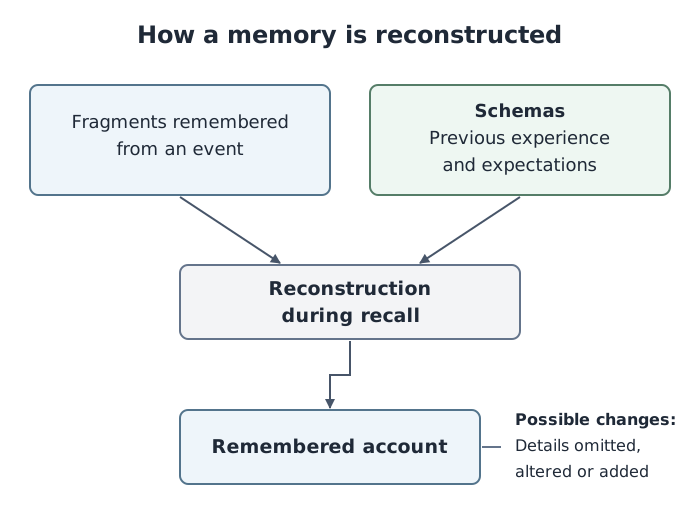
Recall combines remembered fragments with existing knowledge and expectations; the resulting account may contain distortions.
The important relationship is between remembered information and existing knowledge: recall draws on both, rather than simply retrieving an untouched record.
Previous experience helps build our schemas, and schemas influence what we expect. Two people can therefore recall the same event differently because they bring different experiences to it.
For example, someone whose previous parties were large celebrations may expect different things from someone used to small family gatherings. When each recalls a new party, those expectations may influence which details seem important and how gaps are filled.
Schemas are not permanently fixed. New experiences can change them. This means that memory is influenced not only by what happened originally, but also by the knowledge and expectations available when we recall it. Experiences with families, communities and cultures can contribute to these differences.
Confabulation occurs when a person unintentionally fills gaps in memory with inaccurate details that they believe are true. It is different from lying, which involves deliberately giving a false account.
In reconstructive memory theory, fragments from other memories or information from schemas can be used to complete an account. In the party example, remembering balloons that were not there would be confabulation if the person genuinely believed they had seen them. Their account becomes more complete, but less accurate.
A leading question suggests an answer or contains an assumption. Its wording can introduce information after an event, which may influence the person's later reconstruction.
For example, asking ‘What colour was the balloon?’ assumes that a balloon was present. Someone with an incomplete memory might incorporate that suggestion into their account. ‘What decorations do you remember?’ does not make the same assumption.
Loftus and Palmer (1974) demonstrated the influence of question wording. People asked how fast cars were travelling when they ‘smashed’ estimated higher speeds than those asked when the cars ‘contacted’. The stronger verb suggested a more severe collision. This supports the idea that language supplied after an event can influence reports of what happened. However, a changed estimate alone cannot establish whether the memory itself changed or whether the wording influenced the answer given.
A strength of reconstructive memory theory is that it explains why recall can differ between people and why later suggestions can influence remembered accounts. It connects memory with personal experience rather than assuming that everyone records an event identically.
However, schemas are inferred from behaviour rather than directly observed. If an inaccurate memory is explained by a schema, it can be difficult to establish independently exactly what that schema contained. People's different experiences also make it difficult to predict precisely what each person will remember.
There are limitations in the early supporting research too. Bartlett's studies, including War of the Ghosts, lacked fully standardised instructions and controls. Differences in how participants were tested could therefore have affected recall, making it harder to confidently attribute every distortion to reconstruction.
The theory can also be criticised as reductionist if schemas and reconstruction are treated as a complete explanation. This overlooks biological processes involved in storing and retrieving memories. A more holistic explanation would consider how those processes interact with experience, expectations and information supplied by other people.
Nevertheless, the theory already recognises several influences on recall, so it is not simply an explanation based on one isolated cause. A justified conclusion is that reconstruction provides a useful account of memory distortion, but is not a complete explanation of all aspects of memory.
Apply schemas to the situation in the question: identify the person's previous experience or expectation and explain how it could change their recall.
Distinguish confabulation from lying: the person believes the added details are genuine memories.
For evaluation, explain why a limitation matters. For example, ignoring biological processes makes the theory an incomplete explanation of memory.
A leading question can influence an answer, but an altered answer alone does not prove that the underlying memory has changed.
It can see this note and what your specification asks for.
Answers are free with an account.
1 free note left this week
Get more free notesYour answer sets when this note comes back for review, or marks it complete.
Was this note helpful?
Log in to tell us whether it helped, or to report a problem.
Last updated
Reconstructive memory theory
An explanation of memory in which recall involves actively piecing together remembered information, influenced by previous experience, beliefs and expectations.
Schema
A mental framework developed from previous experience that organises knowledge and creates expectations about objects, people or situations.
Expectation
A belief about what is likely to happen or what something is likely to be like, which can influence interpretation and recall.
Confabulation
Unintentionally filling gaps in memory with inaccurate details that the person believes are true.
Memory distortion
A difference between a remembered account and what actually happened, such as an added, altered or omitted detail.
Leading question
A question whose wording suggests a particular answer or introduces an assumption that may influence the response.
Reductionism
Explaining a complex process by focusing on a limited set of factors, potentially overlooking other important influences.
Holism
An approach that considers how several interacting factors contribute to a process or behaviour.
Put your knowledge into practice — try past paper questions for Psychology
Reconstructive memory theory
An explanation of memory in which recall involves actively piecing together remembered information, influenced by previous experience, beliefs and expectations.
Schema
A mental framework developed from previous experience that organises knowledge and creates expectations about objects, people or situations.
Expectation
A belief about what is likely to happen or what something is likely to be like, which can influence interpretation and recall.
Confabulation
Unintentionally filling gaps in memory with inaccurate details that the person believes are true.
Memory distortion
A difference between a remembered account and what actually happened, such as an added, altered or omitted detail.
Leading question
A question whose wording suggests a particular answer or introduces an assumption that may influence the response.
Reductionism
Explaining a complex process by focusing on a limited set of factors, potentially overlooking other important influences.
Holism
An approach that considers how several interacting factors contribute to a process or behaviour.