

Loading…
Loading…
Loading…
OCR GCSE Psychology · J203
OCR J203 · Concepts in Development Check the specification (PDF) (opens in a new tab)
Development means changes in physical abilities, thinking, emotions and social behaviour across a person's life. Physical development includes growth and movement; cognitive development includes changes in memory, language and reasoning. Emotional and social development involves changes in feelings and relationships.
Four broad stages are pre-natal development, childhood, adolescence and adulthood. These stages help us organise the changes, but development is not a series of sudden switches. Changes are gradual, and individuals develop at different rates. Brain development connects these areas: changes in the nervous system help make new abilities possible.
The nervous system receives information, processes it and sends messages that guide responses. Its two main divisions work together.
The central nervous system (CNS) consists of the brain and spinal cord. The brain processes information and coordinates behaviour. The spinal cord carries messages to and from the brain and can also coordinate rapid, automatic responses called reflexes.
The peripheral nervous system (PNS) consists of nerves outside the CNS. Sensory nerves bring information from the body to the CNS, while motor nerves carry messages towards muscles and organs. For example, when someone speaks to you, sensory information reaches your brain. Your brain processes the words and sends messages that allow you to reply.
A neuron is a specialised nerve cell that receives and transmits information. Its cell body contains the nucleus. Branching dendrites receive signals, while the axon carries an electrical impulse away from the cell body towards its endings.
Neurons communicate at junctions called synapses. There is a tiny gap between the sending and receiving cells. When an impulse reaches the sending neuron's ending, chemical messengers called neurotransmitters are released. They cross the gap and bind to matching receptors on the receiving neuron, influencing its activity. Communication therefore involves electrical signals within neurons and chemical signals between them.
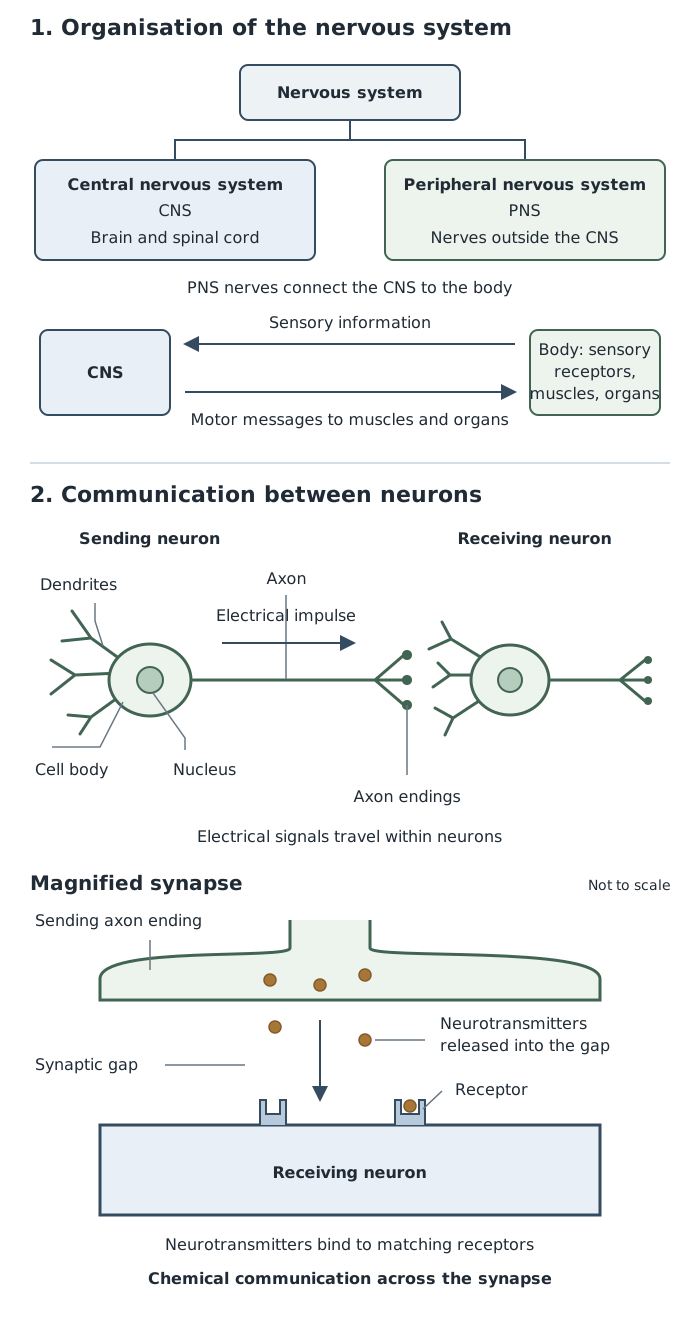
The CNS and PNS work together through networks of neurons. Signals travel electrically within neurons and chemically across synapses.
Brain maturation is not simply an increase in size. It also involves neurons taking their places, forming connections and reorganising those connections. This changes how effectively networks of neurons communicate.
The brain has three main parts: the cerebrum, cerebellum and brainstem. The brainstem connects with the spinal cord and helps control basic life processes such as breathing.
The cerebellum, beneath the back of the cerebrum, controls balance and coordinates movement and muscular activity. For example, walking requires coordinated muscle movements while maintaining balance.
The cerebrum has two hemispheres, connected by a band of nerve fibres called the corpus callosum, which allows information to pass between them. Its outer surface is the cerebral cortex, involved in functions such as thought, language, memory and voluntary movement.
Different cortical areas contribute to different functions. Particularly important for development is the prefrontal cortex, at the front of the frontal lobe. It supports planning, reasoning, decision-making and impulse control. The limbic system, a group of structures beneath the cortex, contributes to emotion and memory. Behaviour depends on communication between these regions, not on one region acting alone.
Pre-natal development takes place before birth. During early pregnancy, the neural tube forms and develops into the brain and spinal cord. New neurons are produced rapidly and move to the locations where they will form different brain regions. Synapses begin to form before birth, allowing neurons to communicate.
The developing brain already supports some responses: during the second trimester, the foetus can respond to sounds. However, birth does not mark the end of brain development.
Both inherited characteristics and the prenatal environment influence development. Alcohol exposure during pregnancy can disrupt brain development and cause lasting learning and memory difficulties, including those associated with foetal alcohol syndrome. This illustrates how an environmental influence can affect a developing biological system.
Childhood includes infancy and the years before adolescence. Physical growth is accompanied by increasing movement skills, language and understanding. A baby who initially relies on automatic responses gradually becomes able to carry out more complex actions.
After birth, neural connections form rapidly. This growth in connections is sometimes called blooming. In some brain areas, young children have more synapses than adults. Having more connections does not automatically mean having a more efficient brain: networks also need refining.
During synaptic pruning, unnecessary or little-used connections are reduced. Pruning occurs through childhood and continues into adolescence in different brain regions. It helps neural networks work more efficiently and supports increasingly complex skills.
This ability to change is part of neuroplasticity. Development and experience can alter the connections within the nervous system, helping explain how biological maturation and learning work together.
Adolescence is the transition between childhood and adulthood. Physical changes occur alongside changes in thinking, emotional responses and social behaviour.
Brain development continues during this stage, including pruning and changes in grey matter. Crucially, brain regions do not mature at the same pace. The limbic system develops earlier than the prefrontal cortex, which supports reasoned decisions and control of impulses.
This difference helps explain why adolescents may experience strong emotional responses or take risks while their ability to regulate those responses is still developing. It is a tendency, not a rule about every teenager: experience and social circumstances also affect behaviour.
Brain maturation continues into early adulthood, including development of the prefrontal cortex into the twenties. This supports improvements in planning, decision-making and impulse control.
The adult brain remains capable of neuroplasticity, so learning and adaptation do not stop when childhood ends. In later adulthood, some brain functions may decline. Neurodegenerative diseases such as Alzheimer's disease and Parkinson's disease can affect memory, thinking or movement, but such diseases should not be treated as an inevitable part of ageing.
Dendrites receive → electrical impulse travels along the axon → neurotransmitters cross the synaptic gap → bind to receptors on the receiving neuron.
Blooming builds connections; pruning reduces unnecessary connections. Plasticity allows continuing adaptation. Development depends on both biological maturation and experience.
Link each developmental stage to a specific change: prenatal neuron formation, childhood synapse formation and pruning, or adolescent differences in the maturation of brain regions.
Distinguish electrical impulses within neurons from chemical communication across synapses.
Explain adolescent behaviour using the interaction between the limbic system and the prefrontal cortex, rather than simply saying that the brain is immature.
Treat developmental ages as approximate: people and brain regions do not all develop at the same rate.
It can see this note and what your specification asks for.
Answers are free with an account.
1 free note left this week
Get more free notesYour answer sets when this note comes back for review, or marks it complete.
Was this note helpful?
Log in to tell us whether it helped, or to report a problem.
Last updated
Development
Changes in physical abilities, thinking, emotions and social behaviour across a person's life.
Pre-natal development
The period of development before birth.
Adolescence
The transition between childhood and adulthood, involving physical, cognitive, emotional and social changes.
Nervous system
The network of cells that receives, processes and transmits information around the body.
Central nervous system
The brain and spinal cord, which process information and coordinate responses.
Peripheral nervous system
The nerves outside the brain and spinal cord that connect the central nervous system to the rest of the body.
Neuron
A specialised nerve cell that receives and transmits information.
Synapse
The junction between neurons, including the small gap across which chemical messages pass.
Neurotransmitter
A chemical messenger that carries a signal across a synapse and binds to receptors on the receiving cell.
Synaptic pruning
The reduction of unnecessary or little-used neural connections during brain development.
Neuroplasticity
The nervous system's ability to change and adapt through development, experience or injury.
Cerebral cortex
The outer surface of the cerebrum, involved in functions including thought, language, memory and movement.
Cerebellum
A part of the brain beneath the back of the cerebrum that controls balance and coordinates movement and muscular activity.
Prefrontal cortex
An area at the front of the frontal lobe involved in planning, reasoning, decision-making and impulse control.
Limbic system
A group of brain structures involved in emotion and memory.
Put your knowledge into practice — try past paper questions for Psychology
Development
Changes in physical abilities, thinking, emotions and social behaviour across a person's life.
Pre-natal development
The period of development before birth.
Adolescence
The transition between childhood and adulthood, involving physical, cognitive, emotional and social changes.
Nervous system
The network of cells that receives, processes and transmits information around the body.
Central nervous system
The brain and spinal cord, which process information and coordinate responses.
Peripheral nervous system
The nerves outside the brain and spinal cord that connect the central nervous system to the rest of the body.
Neuron
A specialised nerve cell that receives and transmits information.
Synapse
The junction between neurons, including the small gap across which chemical messages pass.
Neurotransmitter
A chemical messenger that carries a signal across a synapse and binds to receptors on the receiving cell.
Synaptic pruning
The reduction of unnecessary or little-used neural connections during brain development.
Neuroplasticity
The nervous system's ability to change and adapt through development, experience or injury.
Cerebral cortex
The outer surface of the cerebrum, involved in functions including thought, language, memory and movement.
Cerebellum
A part of the brain beneath the back of the cerebrum that controls balance and coordinates movement and muscular activity.
Prefrontal cortex
An area at the front of the frontal lobe involved in planning, reasoning, decision-making and impulse control.
Limbic system
A group of brain structures involved in emotion and memory.