

Loading…
Loading…
Loading…
OCR GCSE Psychology · J203
OCR J203 · Eysenck's Criminal Personality Theory Check the specification (PDF) (opens in a new tab)
Why might some people be more attracted to risky or antisocial behaviour than others? Hans Eysenck proposed that differences in personality partly reflect differences in the nervous system. These biological differences could influence both the appeal of crime and how readily someone learns to avoid it.
His Criminal Personality Theories (1964 and 1992) and The Biological Basis of Personality (1967) connected personality, inherited biology and learning. Personality traits are relatively enduring characteristics affecting how people think, feel and behave. Eysenck described three dimensions: extraversion, neuroticism and psychoticism. People can score high, low or somewhere between these extremes; they are not three mutually exclusive categories. The Eysenck Personality Questionnaire (EPQ) measures these dimensions.
Eysenck associated high scores on these dimensions with a greater risk of criminal behaviour. This is a claim about likelihood, not a claim that everyone with these traits commits crime.
People high in extraversion tend to be sociable, impulsive, and attracted to risk and sensation. Eysenck explained this through arousal: the level of physiological activation and alertness in the nervous system.
The central nervous system (CNS) consists of the brain and spinal cord. It processes information, supporting cognitions—mental processes such as thinking—and coordinating behaviour. Eysenck proposed that extraverts have relatively low baseline CNS arousal. They therefore seek stimulation from their surroundings. Exciting activities can raise their arousal, and criminal behaviour may offer one source of excitement. However, lawful activities can also provide stimulation.
The reticular activating system (RAS) is a network in the brainstem that helps regulate alertness and arousal. In this explanation, it is less active in extraverts than in introverts. Introverts have higher baseline arousal and are more likely to avoid excessive stimulation. Gray (1970) reported greater RAS activity in introverts, consistent with this distinction.
The cerebral cortex, the outer layer of the cerebrum, is involved in processing information and higher mental functions. Wright and colleagues (2006) found an inverse correlation between extraversion and thickness of the right inferior frontal cortex: greater extraversion was associated with a thinner cortex in this region. This links personality with brain structure, but does not show that thinner cortex causes extraversion.
Dopamine reward systems provide another connection. These are neural pathways involved in the rewarding effects of experiences and in learning to repeat rewarding behaviour. Extraverts may respond more strongly to rewards, making excitement, money or status particularly attractive. The combination of stimulation-seeking and attraction to reward could increase the appeal of some crimes; neither mechanism makes crime inevitable.
People high in neuroticism are emotionally unstable, anxious and easily distressed. They react strongly to unpleasant or threatening experiences. Here, the important difference is not simply a desire for more stimulation, but the intensity and duration of emotional reactions.
The autonomic nervous system (ANS) regulates involuntary bodily functions such as heart rate. The limbic system is a group of brain structures involved in emotion. In Eysenck’s explanation, people high in neuroticism have a highly reactive nervous system: stress quickly activates the ANS and limbic system, and their activity decreases slowly after the stress has gone.
This can produce strong, prolonged anxiety or anger. Such emotional instability may contribute to impulsive or antisocial responses. Eysenck also argued that it interferes with the consistent learning of restraint through socialisation.
High psychoticism involves aggression, egocentrism—being strongly self-centred—and a lack of empathy for others. These characteristics can make antisocial behaviour more likely because the person gives less consideration to its effects on other people. Here, psychoticism is the name of a personality dimension, not a diagnosis of a mental disorder.
Eysenck’s biological explanation of psychoticism was less clearly developed than his explanations of the other traits. In 1992, he suggested that it could involve an overactive dopamine system, with reduced inhibition of dopaminergic neurons and excessive dopamine production.
A neuron is a nerve cell that transmits information. Dopaminergic neurons release dopamine, a chemical messenger called a neurotransmitter. At a synapse, an electrical signal reaching one neuron’s ending causes neurotransmitter to be released into the small gap between neurons. Dopamine crosses this gap and binds to matching receptors on the receiving neuron, affecting its activity. Communication is therefore electrical within the neuron and chemical across this gap.
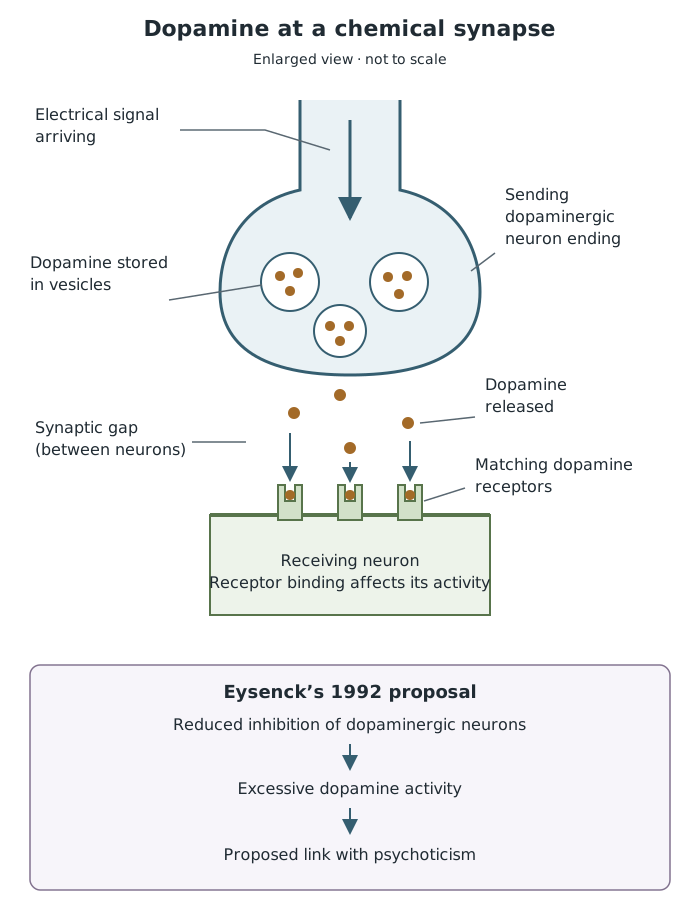
Dopaminergic neurons communicate by releasing dopamine across synaptic gaps. Eysenck proposed that reduced inhibition and excessive dopamine activity were linked to psychoticism.
Inhibition normally restrains neural activity. Eysenck proposed that reduced inhibition allows dopaminergic neurons to become excessively active, increasing dopamine signalling at synapses. He linked this overactivity with psychoticism and its associated antisocial characteristics. Dopamine’s role in reward also helps explain how rewarding consequences can encourage behaviour to be repeated. This remains an explanation to assess, rather than proof that dopamine alone causes aggression or lack of empathy.
Eysenck did not explain crime through biology alone. Socialisation is learning society’s norms, values and acceptable behaviour. He argued that early socialisation teaches children to delay gratification: resisting an immediate reward rather than taking it straight away.
Conditioning is learning through associations. In Eysenck’s account, punishment of antisocial behaviour creates an association between that behaviour and anxiety. Eventually, anticipating the behaviour can bring on anxiety, helping the child avoid it even when nobody is watching.
For example, a child may want to take something belonging to another person. If taking it has become associated with unpleasant consequences, anticipating those consequences can restrain the immediate desire to obtain it.
Eysenck argued that children high in extraversion and neuroticism are harder to condition. Low arousal in extraverts makes punishment less effective, while the instability associated with neuroticism interferes with consistent learning. They may therefore form weaker associations between wrongdoing and negative consequences. Immediate rewards can then outweigh learned restraint, increasing the risk of crime.
This connects nature and nurture: inherited nervous-system characteristics influence how a child responds to social experiences and learning.
A strength is that Eysenck connected measurable personality dimensions with biological mechanisms and learning. Findings such as those concerning RAS activity and cortical thickness are consistent with links between personality and the nervous system. However, evidence about extraversion is not automatically evidence that those biological differences cause crime.
Heaven (1996) examined personality and self-reported delinquency, using self-esteem rather than neuroticism. Associations between these measures cannot establish whether personality causes delinquency. This limits the causal support the study can give Eysenck’s explanation.
The central criticism concerns individual differences. Offenders do not all have the same personality, and people with similar personality scores can behave very differently. A single profile cannot adequately explain the variety of crimes or the different circumstances in which they occur.
The explanation can also be criticised as reductionist because it places considerable weight on a few traits and biological mechanisms. Family experiences, peers and wider social circumstances may also matter. Although Eysenck included conditioning, the emphasis on inherited biology risks underestimating these influences. Its deterministic emphasis also gives less attention to people’s capacity to make choices and change their behaviour.
A justified conclusion is that Eysenck offers an explanation of possible vulnerability to crime, particularly through stimulation-seeking and difficulties in conditioning. Personality and biology may contribute, but they are not sufficient explanations of every offender or every criminal act.
Eysenck’s theories (1964, 1992) and The Biological Basis of Personality (1967): inherited nervous-system differences influence personality and conditioning, affecting the risk of crime. The EPQ measures E, N and P as dimensions.
Link each trait to its biological mechanism and then to possible criminal behaviour; listing traits alone does not explain the theory.
Distinguish low baseline arousal in extraversion from strong, prolonged stress reactions in neuroticism.
Describe Eysenck’s biological explanations as proposals, not proof that a personality trait inevitably causes crime.
A correlation between personality and delinquency, or cortical thickness and extraversion, does not establish cause and effect.
For an evaluation point, explain why the limitation matters: overlooking individual differences makes a single criminal personality profile less able to explain different offenders.
It can see this note and what your specification asks for.
Answers are free with an account.
1 free note left this week
Get more free notesYour answer sets when this note comes back for review, or marks it complete.
Was this note helpful?
Log in to tell us whether it helped, or to report a problem.
Last updated
Personality trait
A relatively enduring characteristic that influences how a person typically thinks, feels and behaves.
Extraversion
A personality dimension involving sociability, impulsiveness and seeking excitement or stimulation.
Neuroticism
A personality dimension involving emotional instability, anxiety and strong reactions to stress.
Psychoticism
Eysenck’s personality dimension involving aggression, egocentrism and lack of empathy.
Central nervous system
The brain and spinal cord, which process information and coordinate cognitions and behaviour.
Arousal
The level of physiological activation and alertness in the nervous system.
Reticular activating system
A network in the brainstem involved in regulating alertness and arousal.
Cerebral cortex
The outer layer of the cerebrum, involved in processing information and higher mental functions.
Autonomic nervous system
The part of the nervous system that regulates involuntary bodily functions, including heart rate and stress responses.
Limbic system
A group of interconnected brain structures involved in emotion and emotional responses.
Synapse
A junction between neurons where signals can pass through the release of neurotransmitters across a small gap.
Dopamine
A chemical messenger involved in reward, motivation and learning, among other functions.
Dopaminergic neuron
A nerve cell that releases dopamine as its neurotransmitter.
Socialisation
The process of learning the norms, values and acceptable behaviour of a society.
Conditioning
Learning through associations, including associations between behaviour and its consequences.
Put your knowledge into practice — try past paper questions for Psychology
Personality trait
A relatively enduring characteristic that influences how a person typically thinks, feels and behaves.
Extraversion
A personality dimension involving sociability, impulsiveness and seeking excitement or stimulation.
Neuroticism
A personality dimension involving emotional instability, anxiety and strong reactions to stress.
Psychoticism
Eysenck’s personality dimension involving aggression, egocentrism and lack of empathy.
Central nervous system
The brain and spinal cord, which process information and coordinate cognitions and behaviour.
Arousal
The level of physiological activation and alertness in the nervous system.
Reticular activating system
A network in the brainstem involved in regulating alertness and arousal.
Cerebral cortex
The outer layer of the cerebrum, involved in processing information and higher mental functions.
Autonomic nervous system
The part of the nervous system that regulates involuntary bodily functions, including heart rate and stress responses.
Limbic system
A group of interconnected brain structures involved in emotion and emotional responses.
Synapse
A junction between neurons where signals can pass through the release of neurotransmitters across a small gap.
Dopamine
A chemical messenger involved in reward, motivation and learning, among other functions.
Dopaminergic neuron
A nerve cell that releases dopamine as its neurotransmitter.
Socialisation
The process of learning the norms, values and acceptable behaviour of a society.
Conditioning
Learning through associations, including associations between behaviour and its consequences.
Electrical signal reaches neuron ending → dopamine released into synaptic gap → binds to matching receptors on receiving neuron → affects its activity.
Antisocial behaviour becomes associated with punishment and anxiety → anticipated anxiety restrains behaviour → delayed gratification.
High E and N make conditioning harder through low arousal and emotional instability. Nature influences responses to nurture.