Loading…


Loading…
Loading…
Loading…
OCR GCSE Computer Science · J277
OCR J277 Check the specification (PDF) (opens in a new tab)
A computer's CPU needs instructions to carry out any task — including starting the computer itself. ROM (read-only memory) is primary storage that holds these essential start-up instructions, also called . It is typically held on a small chip on the motherboard, the main circuit board connecting the computer's components.
ROM is non-volatile, meaning it retains its contents when the power is switched off. This matters because the computer must have its first instructions available immediately when it is switched on again. RAM loses its contents without power, so it cannot keep those instructions ready between uses.
Starting a computer is called booting. ROM contains the BIOS (Basic Input Output System), which is a type of firmware: software stored in hardware to control the device.
The start-up process follows this sequence:
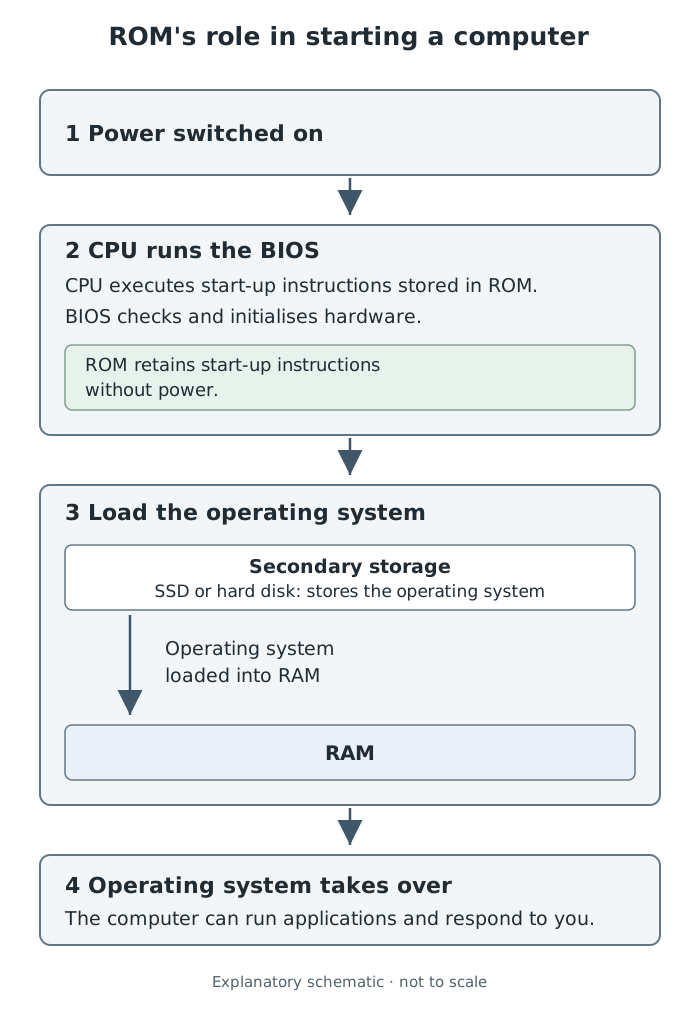
ROM supplies the first instructions; the operating system is loaded from secondary storage into RAM.
ROM therefore provides the starting point for this process; it does not hold the whole operating system. For example, when a laptop has been switched off overnight, its ROM still holds the instructions needed to begin starting it the next morning.
During normal operation, the computer reads instructions from ROM rather than writing everyday working data to it. This keeps the essential start-up instructions available for future use.
Some modern firmware can be updated using a special process called flashing. This is different from the routine reading and writing of data while applications run: ROM's main purpose remains storing the instructions needed to start the computer.
Get unlimited access to all revision notes, key terms, and exam tips.
Power on → execute instructions in ROM → check hardware → load the operating system from secondary storage into RAM → operating system takes over.
Non-volatile: instructions remain when power is off. Read-only during normal operation: essential instructions are not routinely overwritten.
Get unlimited access to all revision notes, key terms, and exam tips.
For a question about ROM's purpose, state that it stores the start-up instructions used to boot the computer. Saying only that it is non-volatile describes a characteristic, not its purpose.
Do not say that ROM stores the whole operating system. The operating system is stored on secondary storage and loaded into RAM during start-up.
ROM
Read-only memory: primary storage that holds instructions needed to start a computer. Its contents are retained without power and are not changed during normal operation.
Non-volatile memory
Memory that retains its contents when the power is switched off.
Booting
The process of starting a computer and loading its operating system.
BIOS
Basic Input Output System: firmware stored in ROM that checks and initialises hardware and begins the process of loading the operating system.
Firmware
Software stored in a device's hardware that provides instructions for controlling the device.
Put your knowledge into practice — try past paper questions for Computer Science
ROM
Read-only memory: primary storage that holds instructions needed to start a computer. Its contents are retained without power and are not changed during normal operation.
Non-volatile memory
Memory that retains its contents when the power is switched off.
Booting
The process of starting a computer and loading its operating system.
BIOS
Basic Input Output System: firmware stored in ROM that checks and initialises hardware and begins the process of loading the operating system.
Firmware
Software stored in a device's hardware that provides instructions for controlling the device.