

Loading…
Loading…
Loading…
OCR GCSE Combined Science B · J260
OCR J260 · Element Properties and Periodicity Check the specification (PDF) (opens in a new tab)
The Periodic Table organises elements so that repeating patterns in their properties become visible. In the modern table, elements are arranged in order of increasing atomic number: the number of protons in an atom’s nucleus. Reading across a period, each successive element has one more proton than the previous one.
A neutral atom has equal numbers of protons and electrons, so its atomic number also tells us how many electrons to arrange in shells. This connects an element’s position to its electron arrangement, and then to its chemical behaviour.
A period is a horizontal row. The period number tells us the number of occupied electron shells. A group is a vertical column. For Groups 1–7, the group number tells us the number of electrons in the outer shell.
For example, sodium has atomic number 11, so a neutral sodium atom has 11 electrons. Its electron arrangement is 2,8,1. Three occupied shells place it in Period 3; one outer electron places it in Group 1. Chlorine has atomic number 17 and arrangement 2,8,7, so it is also in Period 3, but in Group 7.
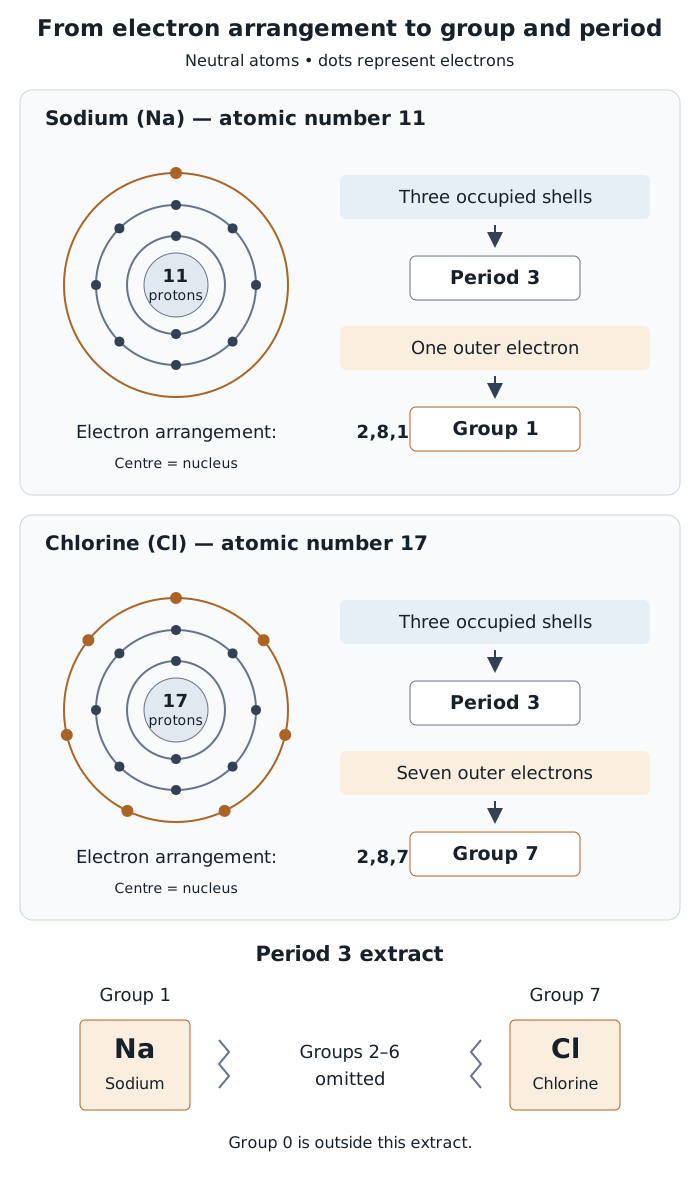
Sodium and chlorine both have three occupied shells, but different numbers of outer electrons place them in different groups.
Group 0 is the exception to the group-number rule: its atoms have a full outer shell, not zero outer electrons. Neon has arrangement 2,8, while helium has just one full shell containing two electrons. These full shells make the noble gases very unreactive.
Chemical reactions involve electrons being lost, gained or shared. Elements in the same main group have the same number of outer-shell electrons, so they tend to react in similar ways and form compounds with similar formula patterns. As electrons begin filling a new shell, outer-electron patterns repeat. This is why chemical properties recur across the table.
Dmitri Mendeleev developed his table before scientists understood atomic number or electron arrangements. He used the evidence available: the elements’ relative atomic masses and the observed properties of the elements and their compounds.
He arranged elements broadly in order of increasing relative atomic mass, placing elements with similar properties beneath one another in groups. For example, patterns in the formulae of compounds helped him recognise elements that belonged together.
However, a strict mass order did not always put similar elements in the same group. Mendeleev gave the chemical patterns priority: he reordered some elements and left gaps where he thought an undiscovered element belonged. The gaps were deliberate predictions, not simply empty spaces. He used neighbouring elements to predict the masses and properties of some missing elements.
When new elements were discovered, some fitted Mendeleev’s gaps and closely matched the properties and masses he had predicted. Successful predictions strengthened the case that his table represented a real pattern in nature.
Later, atomic number provided a better basis for ordering the elements. Ordering by proton number supported the positions of elements that Mendeleev had moved out of strict relative-atomic-mass order.
These two numbers measure different things. Atomic number counts protons, whereas relative atomic mass reflects the masses and proportions of an element’s isotopes. Relative atomic mass therefore does not always increase in exactly the same order as atomic number. Mendeleev’s emphasis on chemical properties had helped him find suitable positions even without knowing the underlying atomic explanation.
Most metals occupy the left-hand side and centre of the Periodic Table. Most non-metals are on the right, although hydrogen is a non-metal on the left.
A physical property can be observed or measured without turning a substance into something different. Metals and non-metals show contrasting typical properties:
| Property | Typical metal | Typical non-metal |
|---|---|---|
| State at room temperature | Solid | May be solid, liquid or gas |
| Appearance when solid | Shiny | Dull |
| Melting and boiling points | High | Lower |
| Density | High | Lower |
| Electrical conductivity | Good | Poor |
| Response to force when solid | Malleable and ductile | Brittle |
Density means mass per unit volume: equal-sized pieces of different substances can have different masses. Malleable materials can be hammered into shape, while ductile materials can be drawn into wires. Copper’s conductivity and ductility make it useful for electrical wiring; aluminium’s malleability allows it to be rolled into foil.
The patterns have exceptions. Mercury is a metal that is liquid at room temperature. Graphite is a non-metal that conducts electricity, and diamond is a non-metal with a very high melting point. Both are forms of carbon, showing that structure matters as well as the identity of the element.
In metals, electrons are free to move through the structure and carry electrical charge. Strong attractions within the metallic structure usually give high melting and boiling points. Many non-metal substances consist of small molecules with weak attractions between molecules, so less energy is needed to melt or boil them. Diamond instead has a giant network of strong bonds, accounting for its exceptionally high melting point.
A chemical property describes how a substance reacts to form new substances. When metals react with non-metals, metal atoms generally lose electrons and form positive ions. Non-metal atoms gain those electrons and form negative ions.
Sodium loses one electron to form , while chlorine gains one to form . Their charges balance in a one-to-one ratio, giving sodium chloride, . Magnesium forms , while oxygen forms , so magnesium oxide also has a one-to-one ratio: . These formula patterns provide evidence about how elements behave chemically.
Non-metals can also react with other non-metals by sharing electrons. Water, , and carbon dioxide, , are examples. Metal oxides are generally basic, whereas non-metal oxides are often acidic.
Reactivity varies within both categories. Sodium is a reactive metal, whereas gold and platinum are very unreactive metals. Non-metals also range from reactive elements to the very unreactive noble gases. How readily atoms lose, gain or share electrons is more useful for explaining reactivity than simply labelling an element a metal or non-metal.
Use atomic number, not relative atomic mass, to work out the number of electrons in a neutral atom.
For Groups 1–7, use outer-shell electrons to identify the group and occupied shells to identify the period. Group 0 has a full outer shell.
Explain both parts of the evidence for Mendeleev: newly discovered elements fitted his gaps and predictions; atomic-number ordering supported the positions of elements he had reordered.
Describe metal and non-metal properties as typical patterns, not universal rules. Use exceptions such as mercury, graphite and diamond where relevant.
Do not assume that all metals are more reactive than all non-metals. Reactivity varies within both categories.
It can see this note and what your specification asks for.
Answers are free with an account.
1 free note left this week
Get more free notesYour answer sets when this note comes back for review, or marks it complete.
Was this note helpful?
Log in to tell us whether it helped, or to report a problem.
Last updated
Atomic number
The number of protons in an atom’s nucleus. In a neutral atom, it also equals the number of electrons.
Relative atomic mass
The weighted mean mass of an element’s atoms compared with one-twelfth of the mass of a carbon-12 atom.
Electron arrangement
The distribution of an atom’s electrons between its shells, for example 2,8,1 for sodium.
Group
A vertical column of the Periodic Table. Elements in the same main group have similar chemical properties because their atoms have similar outer-shell electron arrangements.
Period
A horizontal row of the Periodic Table. Its number gives the number of occupied electron shells in an atom.
Physical property
A characteristic that can be observed or measured without changing a substance into a different substance, such as density or melting point.
Chemical property
A characteristic describing how a substance reacts to form different substances.
Density
Mass per unit volume: how much mass is packed into a given volume.
Malleable
Able to be hammered or pressed into a different shape without breaking.
Ductile
Able to be drawn into a wire.
Ion
An atom or group of atoms with an overall electrical charge because it has gained or lost electrons.
Put your knowledge into practice — try past paper questions for Combined Science B
Atomic number
The number of protons in an atom’s nucleus. In a neutral atom, it also equals the number of electrons.
Relative atomic mass
The weighted mean mass of an element’s atoms compared with one-twelfth of the mass of a carbon-12 atom.
Electron arrangement
The distribution of an atom’s electrons between its shells, for example 2,8,1 for sodium.
Group
A vertical column of the Periodic Table. Elements in the same main group have similar chemical properties because their atoms have similar outer-shell electron arrangements.
Period
A horizontal row of the Periodic Table. Its number gives the number of occupied electron shells in an atom.
Physical property
A characteristic that can be observed or measured without changing a substance into a different substance, such as density or melting point.
Chemical property
A characteristic describing how a substance reacts to form different substances.
Density
Mass per unit volume: how much mass is packed into a given volume.
Malleable
Able to be hammered or pressed into a different shape without breaking.
Ductile
Able to be drawn into a wire.
Ion
An atom or group of atoms with an overall electrical charge because it has gained or lost electrons.