

Loading…
Loading…
Loading…
OCR GCSE Combined Science A · J250
OCR J250 · P4 Waves Check the specification (PDF) (opens in a new tab)
Visible light is an electromagnetic wave: it transfers energy and can interact with materials. A ray box produces a narrow beam that lets you trace the direction in which light travels. A mirror, a transparent glass or Perspex block, white paper, a pencil, a ruler and a protractor provide a simple way to investigate these interactions.
When light meets a material, some may be reflected, returning into the original medium; some may be transmitted, passing through the material; and some may be absorbed, transferring energy to it. These effects can happen together. Transmitted light may also change direction through refraction.
Place a sheet of paper on a flat surface. Draw a straight line for the mirror’s reflecting surface and mark a point on it. At that point, draw a normal: a line at right angles to the mirror. Stand the mirror along the surface line and direct a narrow ray towards the marked point at an angle.
Mark two points along the incoming beam and two along the reflected beam, using the centre of each beam. Remove the apparatus and use a ruler to join the points, extending each ray to the mirror line. Add arrows to show the direction of travel.
Measure the angle of incidence, , between the incoming ray and the normal, and the angle of reflection, , between the reflected ray and the normal. Record both in degrees. Change the incident angle and repeat for several angles, keeping the mirror, beam width and light source the same.
The reflected ray stays on the same side of the mirror as the incoming ray. Your measurements should show the law of reflection, within measurement uncertainty:
A smooth mirror gives a clearly directed reflected beam. A rough surface scatters reflected light in different directions, so you may not see one sharply defined reflected ray.
Place a rectangular glass or Perspex block on fresh paper and draw carefully around it. Aim a narrow beam at one face at an angle. Mark the incoming ray, the entry point, the exit point and two points on the emerging ray.
Remove the block. Join the entry and exit points to trace the ray inside it, and complete the incoming and emerging rays. Draw a normal at each boundary. Measure the incoming angle and the angle of the ray inside the block from the normal at entry. Repeat at different incident angles, replacing the same block exactly within its outline.
Light travelling from air into glass or Perspex slows down. At an oblique angle, it bends towards the normal, so the refracted angle is smaller than the incident angle. On leaving the block for air, it speeds up and bends away from the normal. With a rectangular block surrounded by air, the emerging ray is parallel to the incoming ray but displaced sideways.
If the beam enters along the normal, its speed still changes, but its direction does not. Transmission therefore does not always involve a change of direction.
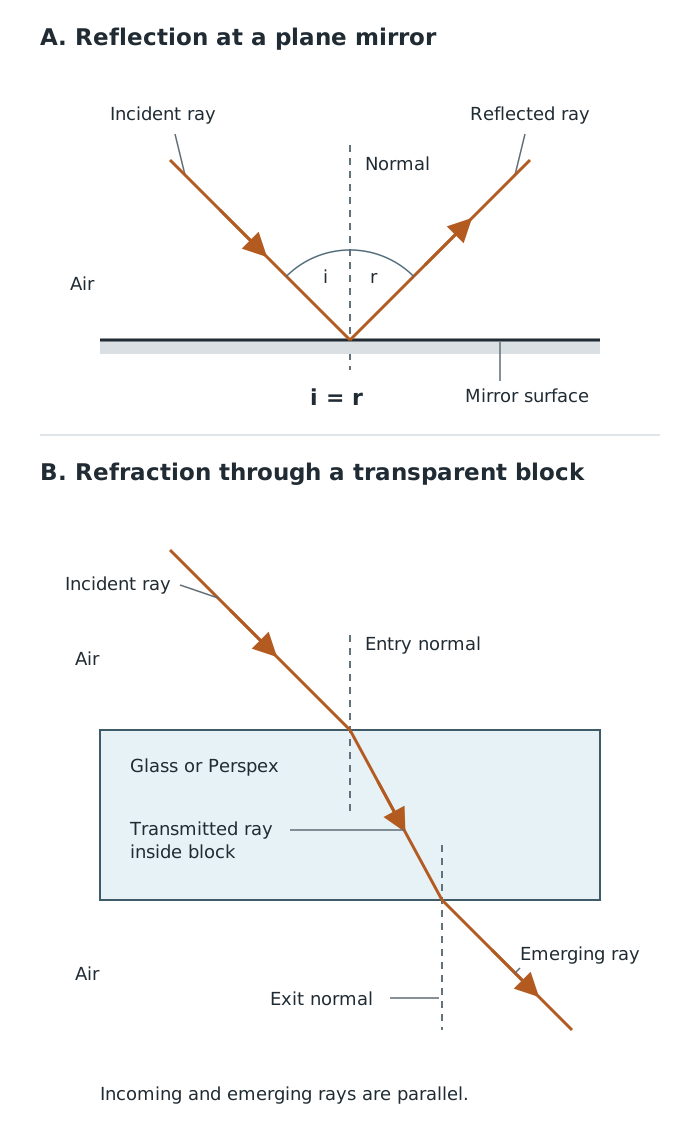
Measure ray angles from the normal. Reflection returns light into air; transmission through the block includes refraction at its boundaries.
A beam emerging from the far side of the transparent block is evidence of transmission. You can place a white screen behind a material to check whether visible light passes through it. Keep the source position, screen position and beam width unchanged when comparing materials.
An opaque material does not transmit visible light through it. Instead, incident light is reflected or absorbed. Absorption transfers energy to the material and can warm it; a measured temperature rise can provide evidence of this energy transfer. Simply failing to see an emerging beam does not distinguish absorption from reflection.
A material need not interact with every electromagnetic wavelength in the same way. Observing that a block transmits visible light does not establish that it transmits every part of the electromagnetic spectrum.
Do not look directly into the ray box beam. Ray boxes can become hot: avoid touching hot parts, switch off between uses and allow the equipment to cool before handling it. Keep liquids away from electrical equipment, and handle mirrors and glass blocks carefully; do not use chipped or broken pieces.
Each ray trace is complete when enough points have been marked to reconstruct its path and the required angles have been recorded. Use a results table with angles in degrees, and describe what actually happened to the beam. Repeating measurements helps you judge whether a small difference is a consistent effect or uncertainty in marking and measuring.
More than one interaction can occur at the same material.
Trace the mirror or block position. Mark points along narrow beams, remove the apparatus, join the points and draw normals. Measure and record angles in degrees. Repeat for different incident angles, keeping the material and light source unchanged.
An emerging beam shows transmission; a reflected beam shows reflection. Temperature rise can indicate absorption. Keep ray boxes away from eyes and liquids, and allow hot equipment to cool.
Measure angles from the normal, not from the surface. A ray perpendicular to the surface has an angle of incidence of 0°.
Distinguish an observation from an explanation: a changed ray direction is observed; a change in wave speed explains refraction.
A weaker transmitted beam does not prove that all the missing energy was absorbed: some may have been reflected.
Mark the centre of a narrow beam with a sharp pencil, and keep the block or mirror aligned with its outline.
It can see this note and what your specification asks for.
Answers are free with an account.
1 free note left this week
Get more free notesYour answer sets when this note comes back for review, or marks it complete.
Was this note helpful?
Log in to tell us whether it helped, or to report a problem.
Last updated
Electromagnetic wave
An electromagnetic wave that transfers energy; visible light is one example.
Reflection
The return of a wave into its original medium after meeting a surface or boundary.
Transmission
The passage of a wave through a material.
Absorption
The transfer of energy from a wave to a material.
Refraction
A change in a wave’s direction as it crosses a boundary at an angle because its speed changes.
Normal
An imaginary line perpendicular to a surface at the point where a ray meets it.
Angle of incidence
The angle between an incoming ray and the normal to the surface.
Put your knowledge into practice — try past paper questions for Combined Science A
Electromagnetic wave
An electromagnetic wave that transfers energy; visible light is one example.
Reflection
The return of a wave into its original medium after meeting a surface or boundary.
Transmission
The passage of a wave through a material.
Absorption
The transfer of energy from a wave to a material.
Refraction
A change in a wave’s direction as it crosses a boundary at an angle because its speed changes.
Normal
An imaginary line perpendicular to a surface at the point where a ray meets it.
Angle of incidence
The angle between an incoming ray and the normal to the surface.