

Loading…
Loading…
Loading…
OCR GCSE Combined Science A · J250
OCR J250 · C1.2b Check the specification (PDF) (opens in a new tab)
Matter is made of atoms. An atom is not a solid ball: it has a small central region called the nucleus, surrounded by electrons.
The nucleus is positively charged, while electrons are negatively charged. These charges belong to different parts of the atom: the positive charge is concentrated at the centre, and the negative electrons occupy the surrounding space.
Inside the nucleus are protons, which have positive charge, and neutrons, which have no electrical charge. The protons therefore account for the nucleus’s positive charge. Electrons are outside the nucleus, not mixed in with its protons and neutrons.
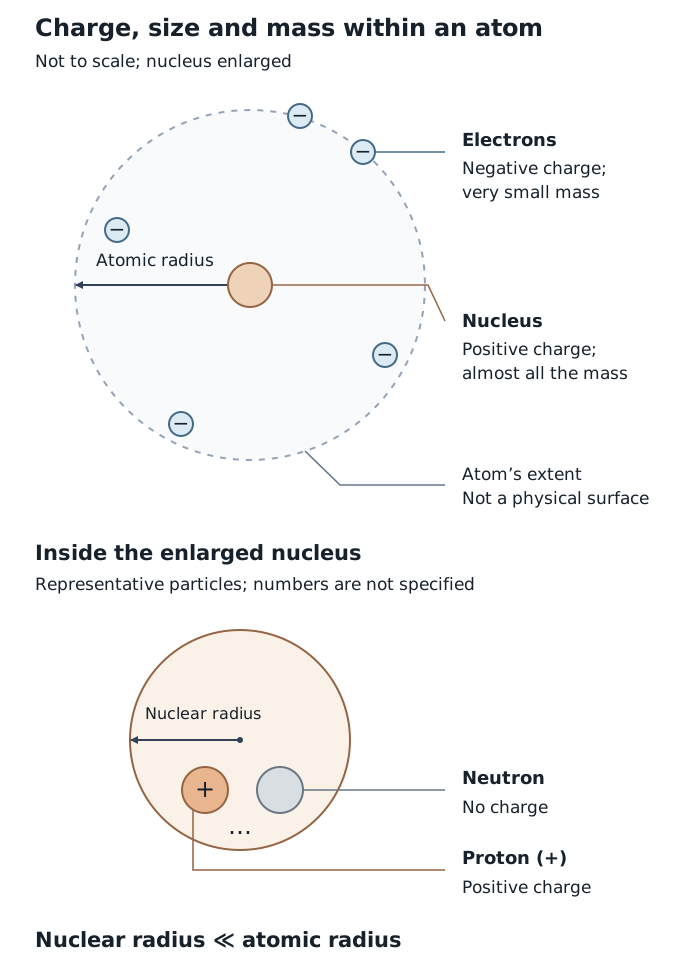
The nucleus contains almost all the mass, while electrons surround it across a much larger region. The nucleus is enlarged here so its structure can be seen.
A radius is a distance measured from the centre to the outside of an object. The nuclear radius measures the size of the nucleus; the atomic radius measures the much larger extent of the whole atom, including its surrounding electrons.
The nuclear radius is roughly 10,000 times smaller than the atomic radius. This means the nucleus occupies only a tiny part of the atom’s overall volume: most of an atom is empty space rather than tightly packed particles.
Diagrams usually enlarge the nucleus so that you can see and label it. They show where the parts are, but do not normally show their sizes to scale.
Protons and neutrons have similar masses. An electron has a much smaller mass—roughly one two-thousandth of the mass of a proton or neutron.
Because the relatively heavy protons and neutrons are packed into the nucleus, almost all of an atom’s mass is concentrated there. The electrons contribute very little to its total mass, even though they occupy the region that determines the atom’s overall size.
Keep these two ideas separate: the atom’s size includes the large region surrounding the nucleus, but its mass is concentrated in the tiny nucleus. This makes the nucleus very dense: it contains a large amount of mass in a very small volume.
Describe both charges and locations: a positively charged nucleus at the centre, with negatively charged electrons surrounding it.
Compare radius with radius: the nuclear radius is much smaller than the atomic radius.
Write ‘almost all of the mass’, not ‘all of the mass’: electrons have a very small mass, but it is not zero.
It can see this note and what your specification asks for.
Answers are free with an account.
1 free note left this week
Get more free notesYour answer sets when this note comes back for review, or marks it complete.
Was this note helpful?
Log in to tell us whether it helped, or to report a problem.
Last updated
Atom
A tiny particle that is the basic building block of an element, consisting of a nucleus surrounded by electrons.
Nucleus
The small, positively charged central region of an atom, containing protons and neutrons and almost all of the atom’s mass.
Electron
A negatively charged particle found outside an atom’s nucleus, with a much smaller mass than a proton or neutron.
Proton
A positively charged particle found in an atom’s nucleus.
Neutron
An electrically neutral particle found in an atom’s nucleus.
Atomic radius
The distance from the centre of an atom to the outer extent of its electrons.
Put your knowledge into practice — try past paper questions for Combined Science A
Atom
A tiny particle that is the basic building block of an element, consisting of a nucleus surrounded by electrons.
Nucleus
The small, positively charged central region of an atom, containing protons and neutrons and almost all of the atom’s mass.
Electron
A negatively charged particle found outside an atom’s nucleus, with a much smaller mass than a proton or neutron.
Proton
A positively charged particle found in an atom’s nucleus.
Neutron
An electrically neutral particle found in an atom’s nucleus.
Atomic radius
The distance from the centre of an atom to the outer extent of its electrons.