

Loading…
Loading…
Loading…
OCR GCSE Combined Science A · J250
OCR J250 · P6.1e Check the specification (PDF) (opens in a new tab)
When a driver notices a hazard, a vehicle does not stop immediately. First, the driver must recognise the danger and respond by applying the brakes. The vehicle continues moving during this reaction time. The distance travelled in this first stage is the thinking distance.
Once the brakes are applied, the vehicle slows down, but it still travels some distance before coming to rest. This second part is the braking distance. The two distances together make the stopping distance:
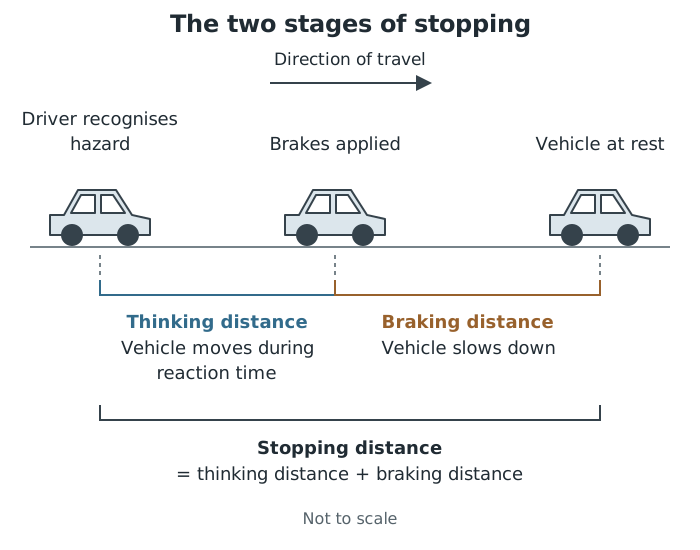
The vehicle travels during the driver's reaction time and then travels further while braking.
A collision may occur if the available clear distance is less than the stopping distance. This is why even an attentive driver with effective brakes needs space to stop safely.
Reaction time is the time between detecting a stimulus and responding. During an emergency stop, this is the interval between recognising the need to brake and applying the brakes. Assuming the vehicle's speed stays constant during this interval:
Speed is measured in metres per second (m/s), reaction time in seconds (s), and thinking distance in metres (m).
For example, suppose a car travels at 20 m/s and its driver's reaction time is 0.7 s. Its thinking distance is m. The car travels those 14 metres before braking even begins. At the same speed, a reaction time of 1.4 s would give a thinking distance of 28 m.
Thinking distance increases when either speed or reaction time increases. A faster vehicle covers more distance during the same reaction time. Tiredness, alcohol, drugs that impair reactions, and distractions, such as using a mobile phone, can delay the driver's response. They therefore increase thinking distance even if the vehicle's speed is unchanged.
Braking requires a force opposing the vehicle's motion. The brakes slow the wheels, while friction between the tyres and the road allows the vehicle to decelerate. Deceleration means a decrease in speed.
Several factors affect braking distance:
A moving vehicle stores kinetic energy:
Here, is mass in kilograms and is speed in m/s. During braking, this energy is transferred mainly to thermal energy in the brakes and surroundings.
For the same vehicle and a constant braking force, braking distance is proportional to speed squared. Doubling the speed gives four times the kinetic energy and therefore four times the braking distance. By contrast, doubling speed only doubles thinking distance if reaction time stays the same. Overall stopping distance therefore does not simply double when speed doubles.
Drivers need to leave enough space to react and brake. Following too closely, or tailgating, removes this safety margin if the vehicle ahead stops suddenly.
The Highway Code advises at least a two-second gap on high-speed roads and in tunnels where visibility is reduced. This gap should be at least doubled on wet roads and up to ten times greater on icy roads. These larger gaps allow for the increased braking distance caused by reduced grip.
A speed limit is a maximum, not a guarantee that the speed is safe. Drivers should slow down for poor road or weather conditions and travel at a speed that allows them to stop well within the distance they can see to be clear. Staying alert and avoiding distractions reduces delays before braking; maintaining tyres and brakes helps the vehicle stop effectively once braking begins.
Increases with speed or reaction time. Tiredness, alcohol, drugs that impair reactions and distractions can increase reaction time.
Increases with:
For unchanged mass and braking force, doubling speed makes braking distance four times greater. Thinking distance only doubles if reaction time is unchanged.
Leave enough space to react and brake. Reduce speed and increase the following gap in poor conditions. Always be able to stop within the distance visible to be clear.
Speed affects both thinking distance and braking distance. Tiredness, alcohol and distractions increase thinking distance by increasing reaction time.
Explain a factor using a causal chain: for example, an icy road gives less tyre–road friction, so the vehicle decelerates less strongly and travels further while braking.
When comparing braking distances, state what stays the same. Doubling speed gives four times the braking distance only if the vehicle mass and braking force remain unchanged.
Use speed in m/s and reaction time in seconds to calculate thinking distance in metres.
It can see this note and what your specification asks for.
Answers are free with an account.
1 free note left this week
Get more free notesYour answer sets when this note comes back for review, or marks it complete.
Was this note helpful?
Log in to tell us whether it helped, or to report a problem.
Last updated
Stopping distance
The total distance a vehicle travels from when the driver recognises the need to stop until the vehicle comes to rest. It is thinking distance plus braking distance.
Thinking distance
The distance a vehicle travels between the driver recognising the need to brake and applying the brakes.
Braking distance
The distance a vehicle travels from when the brakes are applied until it comes to rest.
Reaction time
The time between detecting a stimulus, such as a road hazard, and responding to it.
Friction
A force that opposes relative movement between surfaces in contact. Friction between tyres and the road provides grip during braking.
Put your knowledge into practice — try past paper questions for Combined Science A
Stopping distance
The total distance a vehicle travels from when the driver recognises the need to stop until the vehicle comes to rest. It is thinking distance plus braking distance.
Thinking distance
The distance a vehicle travels between the driver recognising the need to brake and applying the brakes.
Braking distance
The distance a vehicle travels from when the brakes are applied until it comes to rest.
Reaction time
The time between detecting a stimulus, such as a road hazard, and responding to it.
Friction
A force that opposes relative movement between surfaces in contact. Friction between tyres and the road provides grip during braking.