

Loading…
Loading…
Loading…
OCR GCSE Combined Science A · J250
OCR J250 · C6.1a Check the specification (PDF) (opens in a new tab)
Many metals in the Earth’s crust are chemically combined with other elements. Iron, for example, occurs in the ore haematite, which contains iron(III) oxide, . Extracting iron means separating the iron from the oxygen in this compound.
An ore is a rock containing enough of a metal or its compounds to make extraction economically worthwhile. The amount of metal present matters, but so does the cost of obtaining it. Some very unreactive metals, such as gold, can occur as native metals: the uncombined elements. These do not need a chemical reaction to separate them from a compound.
The reactivity series places elements in order of their reactivity. Carbon is included because its position helps us decide whether it can remove oxygen from a metal oxide.
Metals such as zinc, iron and copper are below carbon in the reactivity series. Their oxides can be reduced by heating with carbon. Carbon is more reactive than these metals, so it can combine with the oxygen and leave the metal behind.
Aluminium is above carbon. Carbon cannot extract it from aluminium oxide because aluminium is more reactive than carbon. Such metals require a different method, usually electrolysis. The detailed electrolysis process is separate from extraction using carbon.
Carbon is useful industrially because it is relatively cheap and can also provide heat when it burns. Extraction still requires energy, but using carbon generally costs less than using large amounts of electricity for electrolysis.
In these reactions, reduction means loss of oxygen. Oxidation means gain of oxygen. When carbon removes oxygen from a metal oxide, the oxide is reduced and the carbon is oxidised. Both changes happen together, so the reaction is a redox reaction.
For example, copper(II) oxide reacts with carbon:
The copper oxide loses oxygen and becomes copper. Carbon gains that oxygen and becomes carbon dioxide. Carbon is therefore the reducing agent: it causes the copper oxide to be reduced.
Iron is extracted from haematite in a blast furnace. Iron ore, coke and limestone enter at the top, while hot air is blown in near the bottom. Coke is a form of carbon. Limestone helps remove impurities from the ore as slag.
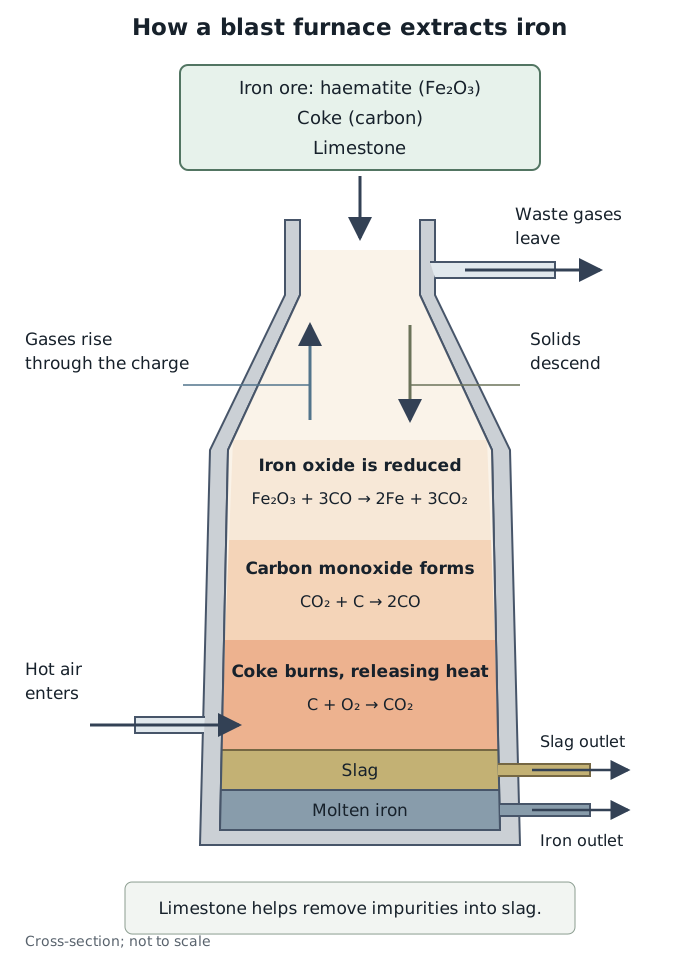
Coke supplies heat and produces carbon monoxide, which removes oxygen from iron oxide. Molten iron and slag are removed separately.
Near the bottom, coke burns in oxygen from the air. This releases heat and produces carbon dioxide:
The carbon dioxide reacts with more hot coke to form carbon monoxide:
As carbon monoxide rises through the furnace, it removes oxygen from the iron oxide:
Here, iron oxide is reduced to iron and carbon monoxide is oxidised to carbon dioxide. Carbon monoxide is the reducing agent in this step, although the overall process depends on the carbon supplied as coke.
The furnace is hot enough for the iron to be molten. It collects at the bottom and is tapped off. Slag forms a separate layer above the iron and is removed through a different outlet.
A non-ferrous metal is a metal other than iron. Copper provides another example of how carbon’s position in the reactivity series is used in extraction.
Copper can be extracted from copper(II) sulfide in two stages. First, heating the sulfide in air converts it into copper(II) oxide and releases sulfur dioxide:
The copper oxide is then heated with carbon and reduced to copper, using the reaction explained above. Converting the sulfide to an oxide allows the oxygen-removal method to be used. This works because copper is less reactive than carbon.
Ore, coke and limestone enter at the top; hot air enters near the bottom.
Molten iron collects at the bottom. Limestone helps remove impurities as slag.
Heat copper(II) sulfide in air to form its oxide, then reduce the oxide with carbon:
The metal oxide loses oxygen; the reducing agent gains oxygen.
Explain the extraction method by comparing the metal’s reactivity with carbon’s, rather than simply naming a method.
In iron extraction, carbon monoxide reduces the iron oxide. Coke provides heat and helps produce the carbon monoxide.
Identify the substance being reduced: the metal oxide loses oxygen, not the metal.
A non-ferrous metal is a metal other than iron; copper is a suitable example.
It can see this note and what your specification asks for.
Answers are free with an account.
1 free note left this week
Get more free notesYour answer sets when this note comes back for review, or marks it complete.
Was this note helpful?
Log in to tell us whether it helped, or to report a problem.
Last updated
Ore
A rock containing enough of a metal or its compounds to make extracting the metal economically worthwhile.
Native metal
A metal found naturally as the uncombined element rather than chemically combined in a compound.
Reactivity series
An ordering of elements by their reactivity, used to predict whether one element can displace another from a compound.
Reduction
Loss of oxygen from a substance, or gain of electrons.
Oxidation
Gain of oxygen by a substance, or loss of electrons.
Reducing agent
A substance that causes another substance to be reduced and is itself oxidised.
Redox reaction
A reaction in which oxidation and reduction occur together.
Non-ferrous metal
A metal other than iron, such as copper or aluminium.
Blast furnace
A large industrial furnace in which iron is extracted from iron ore using carbon monoxide produced from coke.
Put your knowledge into practice — try past paper questions for Combined Science A
Ore
A rock containing enough of a metal or its compounds to make extracting the metal economically worthwhile.
Native metal
A metal found naturally as the uncombined element rather than chemically combined in a compound.
Reactivity series
An ordering of elements by their reactivity, used to predict whether one element can displace another from a compound.
Reduction
Loss of oxygen from a substance, or gain of electrons.
Oxidation
Gain of oxygen by a substance, or loss of electrons.
Reducing agent
A substance that causes another substance to be reduced and is itself oxidised.
Redox reaction
A reaction in which oxidation and reduction occur together.
Non-ferrous metal
A metal other than iron, such as copper or aluminium.
Blast furnace
A large industrial furnace in which iron is extracted from iron ore using carbon monoxide produced from coke.