

Loading…
Loading…
Loading…
OCR GCSE Combined Science A · J250
OCR J250 · B6.3i Check the specification (PDF) (opens in a new tab)
The body’s barriers help prevent pathogens—disease-causing microorganisms—from entering. If pathogens get past these barriers, the works to destroy them and limit the harm they cause. White blood cells are an important part of this defence.
Two groups of white blood cells work together: phagocytes engulf and digest pathogens, while lymphocytes provide a response targeted at particular antigens. This combines a general defence with a specific one.
A phagocyte surrounds a pathogen with its cell membrane and takes it into the cell. Digestive enzymes then break down the pathogen. This process is called phagocytosis.
Phagocytosis is a non-specific response: phagocytes use the same basic engulfing and digesting process against different pathogens. They do not need to produce a different antibody for each type of pathogen.
Pathogens have molecules called antigens on their surfaces. These can be recognised as foreign by the immune system. Different pathogens can carry different antigens.
B-lymphocytes produce antibodies, which are Y-shaped proteins. An antibody has binding sites with a shape complementary to a particular antigen: the shapes fit together. It can therefore attach to that antigen, but not to an antigen with an unsuitable shape. This is why antibody production is a specific immune response.
For example, an antibody that fits an antigen on one pathogen will not necessarily bind to a different pathogen. Protection against one infection therefore does not automatically protect someone against every other infection.
Antibodies can link pathogens together into clumps, a process called agglutination. Clumped pathogens cannot move as easily. Antibody binding also helps mark pathogens for destruction by phagocytes, which engulf and digest them. The specific and non-specific responses therefore cooperate rather than acting as separate defences.
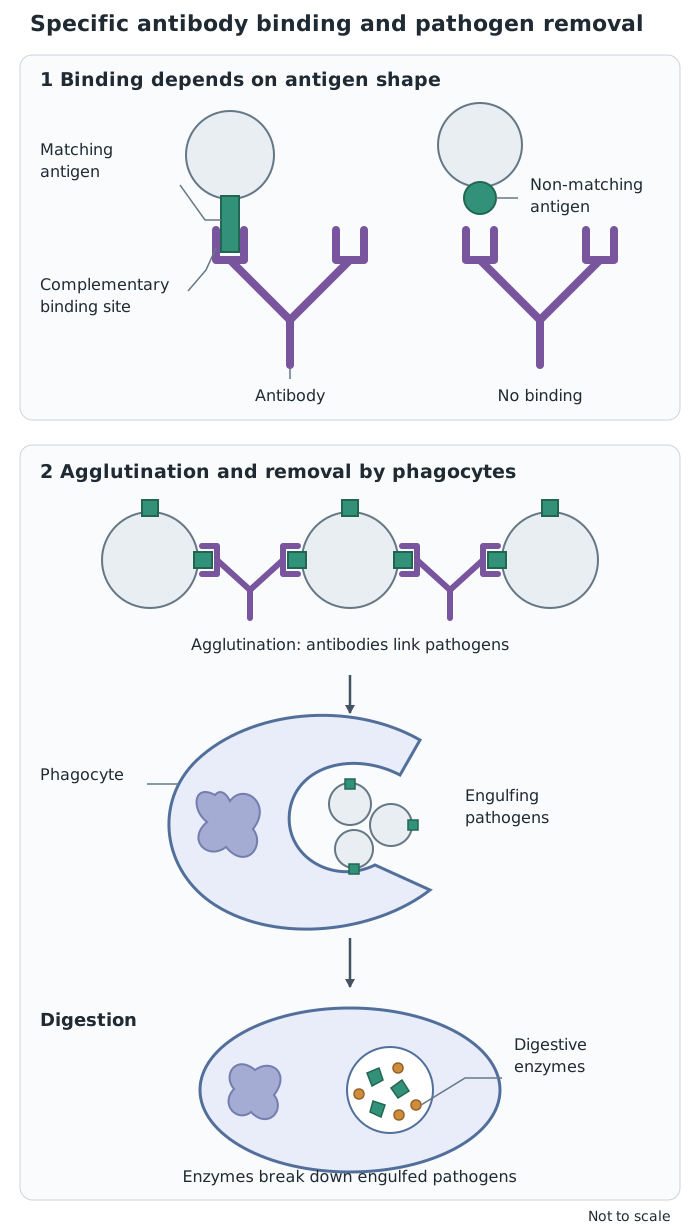
Antibodies bind to matching antigens and can clump pathogens together. Phagocytes then engulf and digest the pathogens.
Some bacteria release toxins, which are poisonous substances that damage the body and contribute to disease symptoms. Lymphocytes also produce antitoxins that neutralise these toxins.
This tackles a different part of the problem: destroying a bacterium removes the pathogen, whereas neutralising its toxin prevents the toxin from causing harm.
When a pathogen first enters the body, it may multiply before the specific response becomes strong enough to control it. Phagocytes can begin engulfing pathogens, but a lymphocyte that recognises the pathogen’s antigen must also be activated.
That lymphocyte multiplies to produce many matching cells, allowing large quantities of the specific antibody to be made. Antibodies bind to the pathogens, and phagocytes help remove them. Because this primary immune response takes time to develop, the person may experience symptoms before recovering.
After an infection, some lymphocytes remain as memory cells. These provide lasting recognition of the particular antigen.
If the same pathogen enters again, memory cells enable the matching antibody to be produced much faster and in larger quantities. This secondary immune response can control the pathogen before it multiplies enough to cause symptoms. This explains how a previous infection can provide immunity to the same pathogen: the protection depends on a faster, specific response, not on an impenetrable barrier.
First infection: antigen recognised → matching lymphocytes multiply → specific antibodies produced → pathogens removed.
After recovery: memory cells remain.
Same pathogen again: faster production of larger quantities of the matching antibody → pathogen may be controlled before symptoms develop.
Keep antigen, antibody and antitoxin distinct: an antigen is recognised, an antibody binds to a complementary antigen, and an antitoxin neutralises a toxin.
When explaining specificity, link the antibody’s shape to the complementary shape of the antigen—not simply to the whole pathogen.
For phagocytosis, state both steps: the phagocyte engulfs the pathogen and digests it using enzymes.
Explain a faster response to reinfection using memory cells and rapid antibody production, not by saying that the body ‘remembers’ without explaining how.
Do not confuse antibodies, which are made by lymphocytes, with antibiotic medicines.
It can see this note and what your specification asks for.
Answers are free with an account.
1 free note left this week
Get more free notesYour answer sets when this note comes back for review, or marks it complete.
Was this note helpful?
Log in to tell us whether it helped, or to report a problem.
Last updated
Pathogen
A microorganism that causes disease.
Phagocyte
A white blood cell that engulfs and digests pathogens.
Phagocytosis
The process in which a cell engulfs a pathogen and digests it using enzymes.
Lymphocyte
A white blood cell involved in specific immunity; B-lymphocytes produce antibodies.
Antigen
A molecule, such as one on a pathogen’s surface, that can be recognised by the immune system and trigger a specific immune response.
Antibody
A protein produced by lymphocytes that binds to a specific antigen because their shapes are complementary.
Agglutination
The clumping together of pathogens when antibodies link them.
Antitoxin
A protein produced by lymphocytes that neutralises a toxin released by a pathogen.
Memory cell
A long-lasting lymphocyte that enables a faster specific immune response when the same antigen is encountered again.
Put your knowledge into practice — try past paper questions for Combined Science A
Pathogen
A microorganism that causes disease.
Phagocyte
A white blood cell that engulfs and digests pathogens.
Phagocytosis
The process in which a cell engulfs a pathogen and digests it using enzymes.
Lymphocyte
A white blood cell involved in specific immunity; B-lymphocytes produce antibodies.
Antigen
A molecule, such as one on a pathogen’s surface, that can be recognised by the immune system and trigger a specific immune response.
Antibody
A protein produced by lymphocytes that binds to a specific antigen because their shapes are complementary.
Agglutination
The clumping together of pathogens when antibodies link them.
Antitoxin
A protein produced by lymphocytes that neutralises a toxin released by a pathogen.
Memory cell
A long-lasting lymphocyte that enables a faster specific immune response when the same antigen is encountered again.