

Loading…
Loading…
Loading…
OCR GCSE Combined Science A · J250
OCR J250 · B6.3c Check the specification (PDF) (opens in a new tab)
Diseases do not always act independently. One disease can change conditions inside the body so that another becomes more likely to develop or more severe. For example, damage to the body's defences can allow another infection to become active. An infection can also disturb the controls on cell division and lead to cancer.
These are different kinds of interaction. HIV and tuberculosis show how one communicable disease can increase the risk from another. HPV and cervical cancer show how a communicable infection can lead to a non-communicable disease.
The immune system protects the body against pathogens — disease-causing microorganisms. White blood cells are important parts of this defence. Some, called lymphocytes, help coordinate the response to infections.
HIV, the human immunodeficiency virus, infects and damages particular lymphocytes. Without treatment, this damage can build up over time, leaving the immune system less able to control other pathogens. Severe damage can lead to AIDS, acquired immune deficiency syndrome, when the person becomes vulnerable to serious infections.
Tuberculosis (TB) is caused by a bacterium, not by HIV. It usually affects the lungs. A person may carry TB bacteria without being ill because their immune system keeps the bacteria under control. This is a dormant, or latent, infection.
If HIV weakens that person's immune system, it may no longer keep the TB bacteria under control. The bacteria can multiply and cause active tuberculosis, with symptoms such as a persistent cough, fever and weight loss. HIV therefore increases the risk that a TB infection will develop into active disease, and TB can become a serious threat to someone with weakened immune defences.
The link is not that HIV creates TB bacteria. The person must also be infected with those bacteria. Instead, HIV changes the body's ability to resist them. Treatment that slows HIV reproduction helps preserve immune function and reduces the risk of active TB.
HPV, human papillomavirus, is a group of viruses passed on through intimate skin-to-skin contact, including during sexual activity. Some types can infect cells in the cervix, the lower part of the uterus that opens into the vagina.
Most HPV infections are controlled or cleared by the immune system and do not cause cancer. However, a persistent infection with a high-risk type of HPV can interfere with the normal controls on cell division in cervical cells.
Abnormal cells may then develop and, over many years, can become cancerous. Cancer involves uncontrolled cell division. The important sequence is therefore: persistent high-risk HPV infection → abnormal changes in cervical cells → possible cervical cancer.
HPV infection is communicable, but cervical cancer is non-communicable. The virus can pass between people; the cancer itself cannot. An infectious cause does not make the resulting cancer something another person can catch.
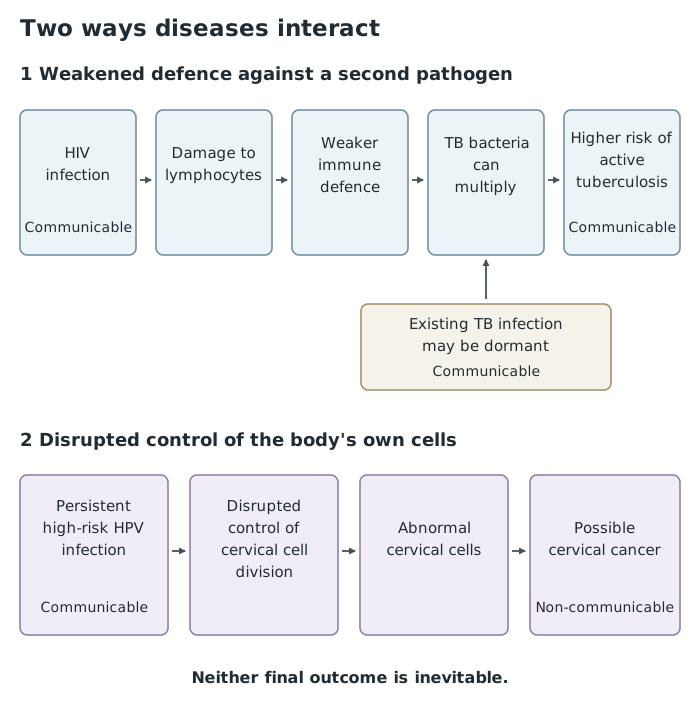
HIV reduces defence against another infection; persistent high-risk HPV can disrupt cell division. Neither sequence means the final disease is inevitable.
In the HIV–TB interaction, the first infection weakens the body's defence against a second pathogen. In the HPV–cancer interaction, a virus changes how the body's own cells behave.
These links also explain why preventing or controlling one disease can reduce another. HPV vaccination helps prevent infection with targeted HPV types and so reduces the risk of cervical cancer. Cervical screening can identify high-risk HPV or abnormal cell changes, allowing follow-up and treatment of precancerous changes before cancer develops.
HIV weakens defence against another pathogen. HPV can disrupt the body's own cells. Controlling or preventing the infection can reduce the risk of the linked disease.
Explain each link in the chain: HIV damages immune cells → weaker immune defence → greater risk of active tuberculosis.
HIV is a virus; tuberculosis is caused by a bacterium. HIV does not turn into tuberculosis.
Distinguish the communicable HPV infection from the non-communicable cervical cancer it can cause.
Use ‘increases the risk’ rather than suggesting that everyone with HIV develops tuberculosis or everyone with HPV develops cancer.
It can see this note and what your specification asks for.
Answers are free with an account.
1 free note left this week
Get more free notesYour answer sets when this note comes back for review, or marks it complete.
Was this note helpful?
Log in to tell us whether it helped, or to report a problem.
Last updated
Communicable disease
A disease that can be transmitted between organisms, caused by a pathogen.
Non-communicable disease
A disease that cannot be transmitted between organisms, even if an infection contributed to its development.
Immune system
The body's defence system against pathogens, involving white blood cells.
HIV
Human immunodeficiency virus: a virus that infects and damages immune cells, weakening the body's defence against other infections.
Tuberculosis
A communicable disease caused by the bacterium Mycobacterium tuberculosis, usually affecting the lungs.
HPV
Human papillomavirus: a group of viruses, some high-risk types of which can cause cervical cancer if infection persists.
Cervical cancer
A non-communicable disease in which abnormal cells in the cervix divide uncontrollably.
Put your knowledge into practice — try past paper questions for Combined Science A
Communicable disease
A disease that can be transmitted between organisms, caused by a pathogen.
Non-communicable disease
A disease that cannot be transmitted between organisms, even if an infection contributed to its development.
Immune system
The body's defence system against pathogens, involving white blood cells.
HIV
Human immunodeficiency virus: a virus that infects and damages immune cells, weakening the body's defence against other infections.
Tuberculosis
A communicable disease caused by the bacterium Mycobacterium tuberculosis, usually affecting the lungs.
HPV
Human papillomavirus: a group of viruses, some high-risk types of which can cause cervical cancer if infection persists.
Cervical cancer
A non-communicable disease in which abnormal cells in the cervix divide uncontrollably.