

Loading…
Loading…
Loading…
OCR GCSE Combined Science A · J250
OCR J250 · B5.1g Check the specification (PDF) (opens in a new tab)
is the passing of genetic information from parents to offspring. are sections of DNA carried on chromosomes. An is an alternative version of a gene: different alleles can produce different forms of a characteristic.
In the simple model used for single gene inheritance, an organism's body cells contain two copies of a gene, one on each chromosome of a pair. One copy was inherited from each parent. The two alleles can therefore be identical or different.
Single gene inheritance, also called monohybrid inheritance, concerns a characteristic controlled by one gene. Pea plant height provides a useful example: the scientist Gregor Mendel investigated inheritance by crossing pea plants with contrasting characteristics, including tall and short plants. Many other characteristics involve several genes, so this simple model does not explain every inherited feature.
An organism's genotype is its combination of alleles for a gene. Its phenotype is its observable characteristic. For the pea height example, the genotype describes the height alleles, whereas the phenotype is tall or short.
The tall allele is dominant, so it produces the tall phenotype even when only one copy is present. The short allele is recessive, so the short phenotype appears only when both alleles are recessive.
We represent the alleles with the same letter: T for the dominant tall allele and t for the recessive short allele.
| Genotype | Description | Phenotype |
|---|---|---|
| TT | Homozygous dominant: two identical dominant alleles | Tall |
| Tt | Heterozygous: two different alleles | Tall |
| tt | Homozygous recessive: two identical recessive alleles | Short |
A heterozygous plant is tall because its T allele is expressed. Its t allele has not disappeared or changed into T: it is still present and can be passed to offspring. This is why a recessive characteristic can appear in offspring even when neither parent shows it.
During meiosis, the two alleles of a gene separate as gametes form. Each gamete receives just one allele of that gene. At fertilisation, two gametes combine, restoring a pair of alleles in the offspring.
A TT parent can pass on only T; a tt parent can pass on only t. A Tt parent produces gametes carrying either T or t, with an equal chance of passing on either allele. Being dominant does not give T a greater chance of being inherited.
A pure-breeding plant is homozygous for the characteristic being considered. When a pure-breeding tall plant, TT, is crossed with a pure-breeding short plant, tt, every offspring receives T from the tall parent and t from the short parent.
All the offspring therefore have genotype Tt and are tall. Their height is not a blend halfway between tall and short: the dominant allele determines their phenotype, while the recessive allele remains in their genotype.
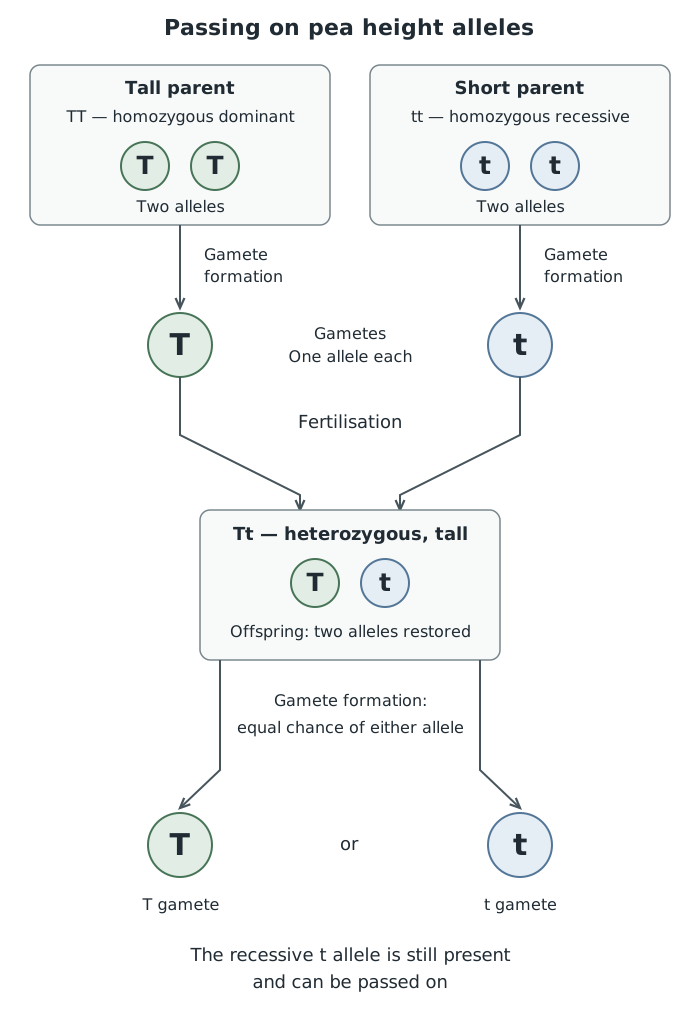
Homozygous parents produce heterozygous tall offspring. The recessive allele remains available to pass to the next generation.
If two of these heterozygous tall plants are crossed, each parent can contribute T or t. The possible allele combinations are TT, Tt, tT and tt. Tt and tT describe the same genotype: one dominant and one recessive allele.
These equally likely combinations give an expected genotype ratio of 1 TT : 2 Tt : 1 tt. Because both TT and Tt are tall, the expected phenotype ratio is 3 tall : 1 short. The short offspring have inherited t from both parents. The recessive allele was carried through the tall generation rather than lost.
A different pattern occurs when a heterozygous tall plant, Tt, is crossed with a short plant, tt. The short parent always contributes t, while the tall parent contributes either T or t. Offspring therefore have an equal chance of being Tt and tall, or tt and short: an expected 1 tall : 1 short ratio.
These patterns follow from the same two rules: each parent contributes one allele, and the offspring's allele combination determines its phenotype under dominant–recessive inheritance.
Each gamete carries one allele of the gene. TT produces T gametes; tt produces t gametes; Tt produces T or t with equal probability. Fertilisation restores the allele pair.
| Parents | Expected offspring genotypes | Expected phenotypes |
|---|---|---|
| TT × tt | All Tt | All tall |
| Tt × Tt | 1 TT : 2 Tt : 1 tt | 3 tall : 1 short |
| Tt × tt | 1 Tt : 1 tt | 1 tall : 1 short |
A recessive allele can be carried and inherited without appearing in the parent's phenotype.
Write about dominant and recessive alleles, rather than dominant and recessive genes: the alleles are different versions of the same gene.
Use the same letter for both alleles, with a capital for the dominant allele and a lower-case letter for the recessive allele.
A dominant phenotype does not identify one definite genotype: a tall pea plant could be TT or Tt.
Expected offspring ratios describe probabilities, not guaranteed numbers in a small group of offspring.
It can see this note and what your specification asks for.
Answers are free with an account.
1 free note left this week
Get more free notesYour answer sets when this note comes back for review, or marks it complete.
Was this note helpful?
Log in to tell us whether it helped, or to report a problem.
Last updated
Inheritance
The passing of genetic information from parents to offspring.
Gene
A section of DNA that contains information contributing to a characteristic.
Allele
An alternative version of a gene.
Single gene inheritance
Inheritance of a characteristic controlled by one gene.
Genotype
The combination of alleles an organism has for a gene, such as TT, Tt or tt.
Phenotype
An observable characteristic of an organism, such as tall or short height in pea plants.
Dominant allele
An allele that is expressed in the phenotype when one or two copies are present.
Recessive allele
An allele expressed in the phenotype only when two copies are present, in a simple dominant–recessive inheritance pattern.
Homozygous
Having two identical alleles of a particular gene.
Heterozygous
Having two different alleles of a particular gene.
Gamete
A reproductive cell that carries one allele of each gene and combines with another gamete at fertilisation.
Put your knowledge into practice — try past paper questions for Combined Science A
Inheritance
The passing of genetic information from parents to offspring.
Gene
A section of DNA that contains information contributing to a characteristic.
Allele
An alternative version of a gene.
Single gene inheritance
Inheritance of a characteristic controlled by one gene.
Genotype
The combination of alleles an organism has for a gene, such as TT, Tt or tt.
Phenotype
An observable characteristic of an organism, such as tall or short height in pea plants.
Dominant allele
An allele that is expressed in the phenotype when one or two copies are present.
Recessive allele
An allele expressed in the phenotype only when two copies are present, in a simple dominant–recessive inheritance pattern.
Homozygous
Having two identical alleles of a particular gene.
Heterozygous
Having two different alleles of a particular gene.
Gamete
A reproductive cell that carries one allele of each gene and combines with another gamete at fertilisation.