

Loading…
Loading…
Loading…
OCR GCSE Combined Science A · J250
OCR J250 · P2.2o Check the specification (PDF) (opens in a new tab)
A force is a push or pull arising from an interaction between objects. Forces are measured in newtons (N). An interaction can involve contact, such as a foot pushing against the ground, or act without contact, such as the gravitational attraction between the Earth and a book.
Newton’s third law states that whenever two objects interact, the forces they exert on each other are equal in magnitude and opposite in direction. These forces are called a third-law pair, sometimes described as an action–reaction pair. They occur together: the word ‘reaction’ does not mean that one force happens later.
Each force acts on a different object. For example, when your foot pushes the ground backwards, the ground pushes your foot forwards with an equally large force. The forward force from the ground helps you move forwards.
To identify a third-law pair, first name the two interacting objects. Then describe the force in each direction: A exerts a force on B, and B exerts a force on A.
The forces must be:
For example, the Earth pulls a book downwards by gravity, and the book pulls the Earth upwards by gravity. Both forces are gravitational. Neither is the contact force exerted by a table.
Force arrows represent direction by the way they point and magnitude by their length. Equal-length arrows pointing in opposite directions can represent a third-law pair, but only if their labels show that they act on different objects.
Consider a book resting on a horizontal table. Two forces act on the book: its weight acts downwards, and the table’s normal contact force acts upwards. They are equal in magnitude, so the resultant force—the overall force on the book—is zero. The book is in equilibrium and remains at rest.
These two forces are not a third-law pair. They both act on the book, and they arise from different interactions: gravity and contact.
The actual third-law pairs are:
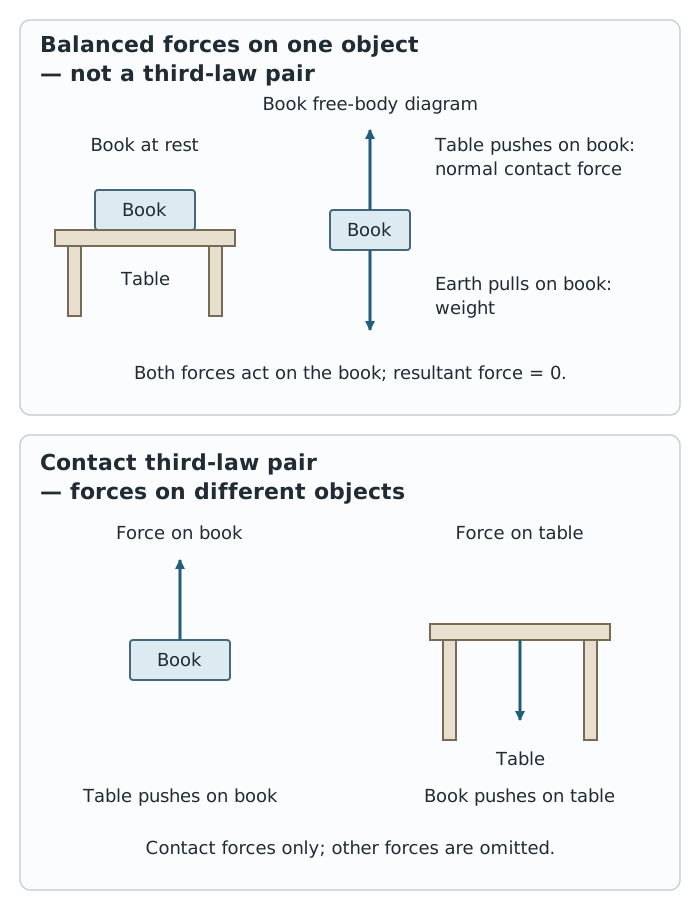
Balanced forces act on one object. A third-law pair acts on two different objects.
A diagram showing only the forces acting on the book is a free-body diagram. It is useful for deciding whether the book’s forces are balanced, but it cannot show both members of a third-law pair: the partner force acts on another object.
Newton’s third law also applies in non-equilibrium situations. Imagine trolley A moving to the right and colliding with stationary trolley B. During contact, A pushes B to the right, while B pushes A to the left with an equally large force.
If these contact forces are not balanced by other horizontal forces, B speeds up to the right and A slows down. The forces do not cancel on either trolley: one acts on A and the other acts on B.
Equal interaction forces do not necessarily produce equal accelerations. For the same resultant force, a smaller mass has a larger acceleration. The trolleys can therefore respond differently even though the forces they exert on each other are equal.
The distinction is the same in both examples: Newton’s third law compares forces on two different objects; equilibrium depends on the resultant force on one object.
Whenever two objects interact, they exert forces on each other that are equal in magnitude and opposite in direction.
Third-law pairs act on different objects and are the same type of force.
For a book resting on a table, weight and normal contact force balance, but are not a third-law pair. The contact pair is table-on-book and book-on-table; the gravitational pair is Earth-on-book and book-on-Earth.
In a trolley collision, A pushes B and B pushes A equally in opposite directions. An unbalanced resultant force changes each trolley’s motion. Equal interaction forces need not produce equal accelerations when the masses differ.
Name both interacting objects: ‘A exerts a force on B; B exerts an equal force in the opposite direction on A.’
Equal and opposite arrows do not automatically show a third-law pair. Check that the forces act on different objects and are the same type.
Forces balance only when their resultant on the same object is zero. Do not cancel forces acting on different objects.
In a collision, neither object exerts a larger force on the other, even if their masses or changes in motion differ.
It can see this note and what your specification asks for.
Answers are free with an account.
1 free note left this week
Get more free notesYour answer sets when this note comes back for review, or marks it complete.
Was this note helpful?
Log in to tell us whether it helped, or to report a problem.
Last updated
Newton’s third law
When two objects interact, each exerts a force on the other that is equal in magnitude and opposite in direction.
Third-law pair
Two forces from the same interaction, acting on different objects, equal in magnitude, opposite in direction and of the same type.
Resultant force
The overall force on an object, found by combining all the forces acting on that object and taking their directions into account.
Equilibrium
A state in which the resultant force on an object is zero, so its velocity does not change.
Normal contact force
The push exerted by a surface on an object, perpendicular to the surface.
Put your knowledge into practice — try past paper questions for Combined Science A
Newton’s third law
When two objects interact, each exerts a force on the other that is equal in magnitude and opposite in direction.
Third-law pair
Two forces from the same interaction, acting on different objects, equal in magnitude, opposite in direction and of the same type.
Resultant force
The overall force on an object, found by combining all the forces acting on that object and taking their directions into account.
Equilibrium
A state in which the resultant force on an object is zero, so its velocity does not change.
Normal contact force
The push exerted by a surface on an object, perpendicular to the surface.