

Loading…
Loading…
Loading…
OCR GCSE Combined Science A · J250
OCR J250 · P2.1f Check the specification (PDF) (opens in a new tab)
This is a Higher Tier topic.
A velocity–time graph shows time on the horizontal axis and velocity on the vertical axis. To find how far an object moves during a , calculate the area enclosed between the graph line and the time axis, within that interval.
Imagine an object moving at a constant velocity of 4 m/s for 3 s. It travels 4 m each second, so it covers . On its velocity–time graph, the line is horizontal at 4 m/s. The area beneath it is a rectangle with a height of 4 m/s and a width of 3 s: the same multiplication gives 12 m.
The area therefore has a physical meaning, not just a geometrical one. Its units are .
Strictly, the signed area gives displacement: the change in position, including direction. When velocity stays positive, the object does not reverse direction, so this area also gives the total distance travelled.
Changing velocity does not prevent us from finding distance using area. A straight sloping line represents a uniform change in velocity, and the region beneath it can be divided into triangles and rectangles.
For a rectangle, use:
For a triangle, use:
The base is a time interval, measured along the horizontal axis. The height is read from the velocity axis. A triangular region occurs when velocity rises uniformly from zero or falls uniformly to zero.
If a sloping section starts and ends above zero velocity, the region beneath it is a trapezium. You can split it into a rectangle beneath the lower velocity and a triangle above that rectangle. The triangle’s height is the difference between the two velocities.
Suppose an object starts from rest, reaches 6 m/s uniformly after 4 s, continues at 6 m/s until 9 s, then slows uniformly to rest at 12 s.
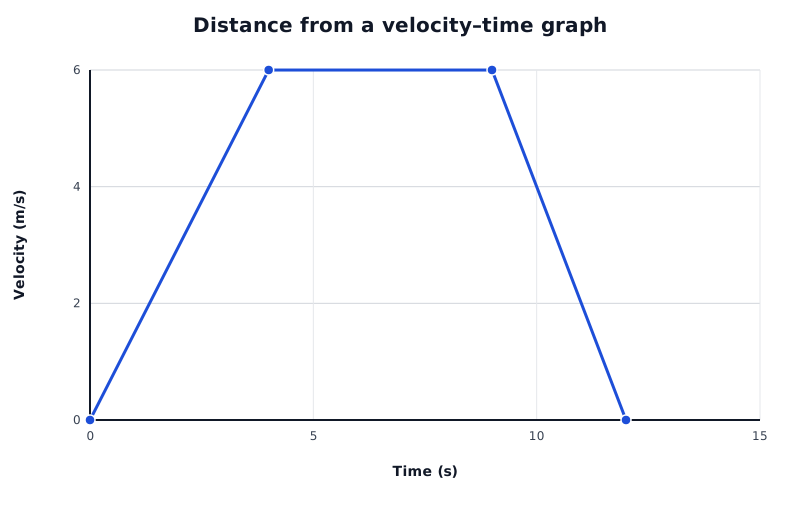
Split the region at 4 s and 9 s into two triangles and a rectangle. Their combined area gives the total distance travelled.
Data for Distance from a velocity–time graph
| Series | Time (s) | Velocity (m/s) |
|---|---|---|
| Object’s velocity | 0 | 0 |
| Object’s velocity | 4 | 6 |
| Object’s velocity | 9 | 6 |
| Object’s velocity | 12 | 0 |
Divide the area at 4 s and 9 s, where the slope changes. This gives a triangle, a rectangle and another triangle.
Adding these areas gives the total distance:
All three regions lie above the time axis, so the object travels 51 m in the positive direction without reversing.
Negative velocity means motion in the opposite direction. A region below the time axis counts as negative displacement, but it still represents distance travelled.
For total distance, split the graph wherever it crosses the time axis and add the sizes of all the areas. For displacement, add the areas with their signs.
For example, suppose the area above the axis represents 8 m forwards and the area below it represents 3 m backwards. The total distance is , but the displacement is forwards. Moving back towards the starting point reduces displacement; it does not undo the distance already travelled.
Higher Tier: the signed area between a velocity–time graph and the time axis gives displacement.
If velocity stays positive, the area also gives total distance travelled.
Split at each crossing of the time axis:
Use the area, not the gradient, to find distance travelled from a velocity–time graph.
Read the axis scales carefully. A shape’s base is the time interval: end time minus start time.
Include the factor of ½ for triangular areas. If splitting a trapezium into a rectangle and a triangle, the triangle’s height is the change in velocity.
Give distance in metres when velocity is in m/s and time is in seconds. For total distance, add the sizes of all areas, including those below the time axis.
It can see this note and what your specification asks for.
Answers are free with an account.
1 free note left this week
Get more free notesYour answer sets when this note comes back for review, or marks it complete.
Was this note helpful?
Log in to tell us whether it helped, or to report a problem.
Last updated
Distance travelled
The total length of the path travelled by an object, regardless of direction, measured in metres.
Displacement
The change in an object’s position from its starting point, including direction, measured in metres.
Velocity
The speed of an object in a specified direction, measured in metres per second.
Time interval
The duration between two times, found by subtracting the start time from the end time.
Put your knowledge into practice — try past paper questions for Combined Science A
Distance travelled
The total length of the path travelled by an object, regardless of direction, measured in metres.
Displacement
The change in an object’s position from its starting point, including direction, measured in metres.
Velocity
The speed of an object in a specified direction, measured in metres per second.
Time interval
The duration between two times, found by subtracting the start time from the end time.