

Loading…
Loading…
Loading…
OCR GCSE Combined Science A · J250
OCR J250 · P2.3g Check the specification (PDF) (opens in a new tab)
A dropped object falls towards Earth even though Earth is not touching it. The force responsible is . Gravity is a non-contact force: objects do not need to touch for it to act between them.
We describe this interaction using a gravitational field — a region of space in which an object with mass experiences a gravitational force. Earth produces a field around it, so an object placed in that field is attracted towards Earth.
Mass is a measure of the amount of matter in an object. Every object with mass has a gravitational field, whether it is a star, a planet, a person or a book. Another mass within that field experiences an attractive force.
The attraction is mutual: Earth attracts a falling object, and the object also attracts Earth. Gravity always pulls masses towards one another; it does not push them apart.
Gravitational field strength describes how much gravitational force acts on each kilogram of mass at a particular position. A stronger field produces a greater force on the same object.
At the same distance from their centres, an object with greater mass produces a stronger gravitational field than an object with less mass. Planets and stars have enormous masses, so their gravitational effects are much more noticeable than those of everyday objects. Two books attract one another gravitationally, but the attraction is too weak to notice in ordinary circumstances.
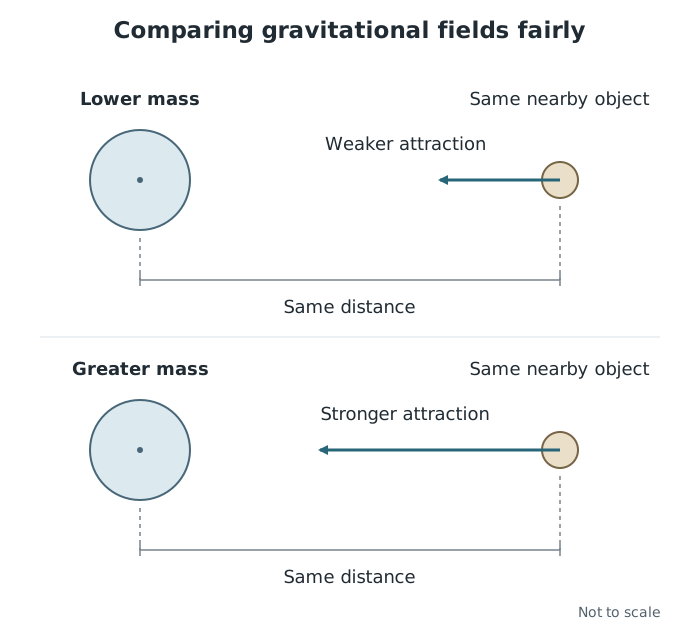
At the same distance, a greater source mass produces a stronger gravitational field and a greater force on the same nearby object.
The comparison keeps the nearby object and its distance the same. This allows the stronger attraction to be linked to the greater mass producing the field, rather than to a change in the object being attracted.
Gravity is not unique to Earth. The Sun produces a gravitational field that attracts Earth and keeps it in orbit around the Sun. Other planets also have gravitational fields, but their field strengths differ. When comparing conditions at their surfaces, both the planet’s mass and its radius matter; greater mass alone is not enough to rank their surface field strengths.
Say that all objects with mass have a gravitational field, not just planets and stars.
Gravitational attraction pulls masses towards one another; it does not repel them.
When comparing fields produced by different masses, compare at the same distance from their centres. Mass alone does not determine the field strength at a planet’s surface: its radius also matters.
It can see this note and what your specification asks for.
Answers are free with an account.
1 free note left this week
Get more free notesYour answer sets when this note comes back for review, or marks it complete.
Was this note helpful?
Log in to tell us whether it helped, or to report a problem.
Last updated
Gravitational field
A region of space in which an object with mass experiences a gravitational force.
Gravitational attraction
The force by which objects with mass pull towards one another.
Gravitational field strength
The gravitational force acting per kilogram of mass at a particular position in a gravitational field.
Mass
A measure of the amount of matter in an object, measured in kilograms (kg).
Put your knowledge into practice — try past paper questions for Combined Science A
Gravitational field
A region of space in which an object with mass experiences a gravitational force.
Gravitational attraction
The force by which objects with mass pull towards one another.
Gravitational field strength
The gravitational force acting per kilogram of mass at a particular position in a gravitational field.
Mass
A measure of the amount of matter in an object, measured in kilograms (kg).