

Loading…
Loading…
Loading…
OCR GCSE Combined Science A · J250
OCR J250 · P5.2g Check the specification (PDF) (opens in a new tab)
When the inside of a building is warmer than the surroundings, energy is transferred from the warmer inside to the cooler outside. If heating does not replace this energy, the building’s temperature falls. The describes how quickly its temperature decreases.
Energy can be transferred through solid walls by thermal conduction. Particles in the hotter part of the wall vibrate and pass energy to neighbouring particles. This transfers energy through the material towards the colder side.
Two important factors affect how quickly energy passes through a wall: its thickness and the thermal conductivity of its material.
Imagine comparing two walls made from the same material, with the same surface area and the same temperatures on their inside and outside faces. The only difference is their thickness.
Through the thicker wall, energy must be transferred across a greater distance. Less energy passes through each second, so the building loses energy more slowly and its rate of cooling is lower.
A thinner wall allows energy to transfer more quickly under the same conditions, so the building cools faster. Thickness is therefore important even when the wall material has not changed.
Thermal conductivity describes how readily a material transfers energy by conduction. It is a property of the material, not a measure of how thick the wall is.
For walls of the same thickness, a material with higher thermal conductivity transfers energy more quickly. More energy leaves the warm building each second, increasing its rate of cooling. Metals have high thermal conductivity and are good thermal conductors.
A material with lower thermal conductivity transfers energy more slowly, reducing the rate of cooling. Air has low thermal conductivity, so trapped air can act as a thermal insulator.
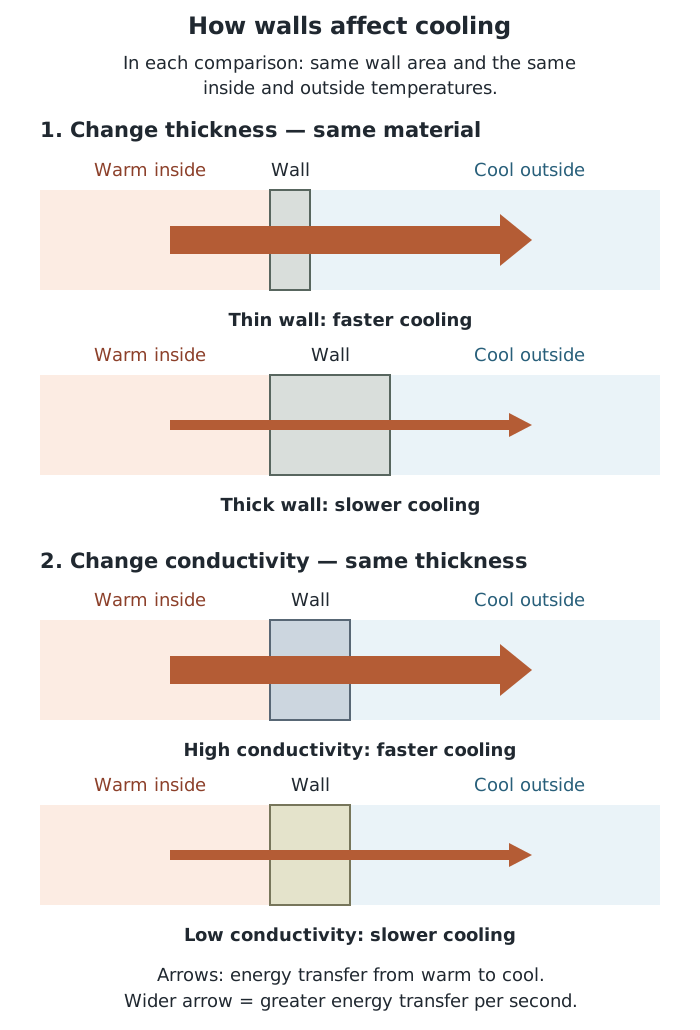
Compare one factor at a time: greater thickness or lower thermal conductivity reduces energy transfer through a wall.
A thick layer of a low-conductivity material is effective at slowing energy transfer. For example, glass-fibre loft insulation traps air between its fibres. The trapped air gives the insulation a low thermal conductivity, while using a thicker layer further reduces energy transfer.
The same two principles apply to walls: increasing thickness slows cooling, and choosing lower-conductivity materials also slows cooling. These comparisons assume other conditions, such as wall area and the temperature difference between inside and outside, stay the same. Insulation keeps a building warm for longer rather than preventing cooling altogether.
A thick layer of low-conductivity material slows cooling effectively.
State what is kept the same when comparing walls: compare thickness using the same material, and compare materials using the same thickness.
Link the change to energy transfer: thicker walls or lower thermal conductivity reduce energy transfer per second, so cooling is slower.
Insulation slows energy transfer; it does not stop it completely or produce energy.
It can see this note and what your specification asks for.
Answers are free with an account.
1 free note left this week
Get more free notesYour answer sets when this note comes back for review, or marks it complete.
Was this note helpful?
Log in to tell us whether it helped, or to report a problem.
Last updated
Rate of cooling
How quickly the temperature of a system decreases.
Thermal conduction
The transfer of energy through a substance from a hotter region to a colder region, as particles pass energy to neighbouring particles.
Thermal conductivity
A property of a material describing how readily it transfers energy by conduction. Higher thermal conductivity means faster energy transfer under the same conditions.
Thermal insulator
A material with low thermal conductivity that reduces the rate of energy transfer by conduction.
Put your knowledge into practice — try past paper questions for Combined Science A
Rate of cooling
How quickly the temperature of a system decreases.
Thermal conduction
The transfer of energy through a substance from a hotter region to a colder region, as particles pass energy to neighbouring particles.
Thermal conductivity
A property of a material describing how readily it transfers energy by conduction. Higher thermal conductivity means faster energy transfer under the same conditions.
Thermal insulator
A material with low thermal conductivity that reduces the rate of energy transfer by conduction.