

Loading…
Loading…
Loading…
OCR GCSE Combined Science A · J250
OCR J250 · C2.1d Check the specification (PDF) (opens in a new tab)
A compound contains different elements chemically combined in a fixed ratio. Its empirical formula shows the simplest whole-number ratio of atoms of those elements. It describes their proportions, rather than the size or arrangement of a molecule.
For example, titanium dioxide has the empirical formula . This means there are two oxygen atoms for every titanium atom. The small 2 is a subscript; the absence of a subscript after Ti means 1. The ratio Ti:O is therefore .
A molecular formula, in contrast, shows the actual numbers of atoms in one molecule. Benzene has the molecular formula : each molecule contains six carbon atoms and six hydrogen atoms. Its empirical formula is because the simplest ratio is .
Start by writing the number of atoms of each element as a ratio, keeping the element labels in the same order. Then divide all the numbers by their highest common factor: the largest whole number that divides exactly into every count. Write the simplified numbers as subscripts after the corresponding symbols, leaving out any 1s.
For example, one glucose molecule contains 6 carbon atoms, 12 hydrogen atoms and 6 oxygen atoms:
Dividing every number by 6 gives , so glucose has the empirical formula . Its molecular formula remains ; simplifying the ratio does not change the molecule itself.
Not every formula can be simplified. In , the ratio has no common factor greater than 1, so the empirical and molecular formulas are the same.
In an atom model, each sphere or circle represents an atom. First use the key or element labels to identify what each represents. Count all the atoms of each element, including atoms drawn on branches of the structure. Lines or sticks represent bonds, not extra atoms.
Ethanoic acid, the acid in vinegar, provides a useful example. Its molecule contains two carbon atoms, four hydrogen atoms and two oxygen atoms.
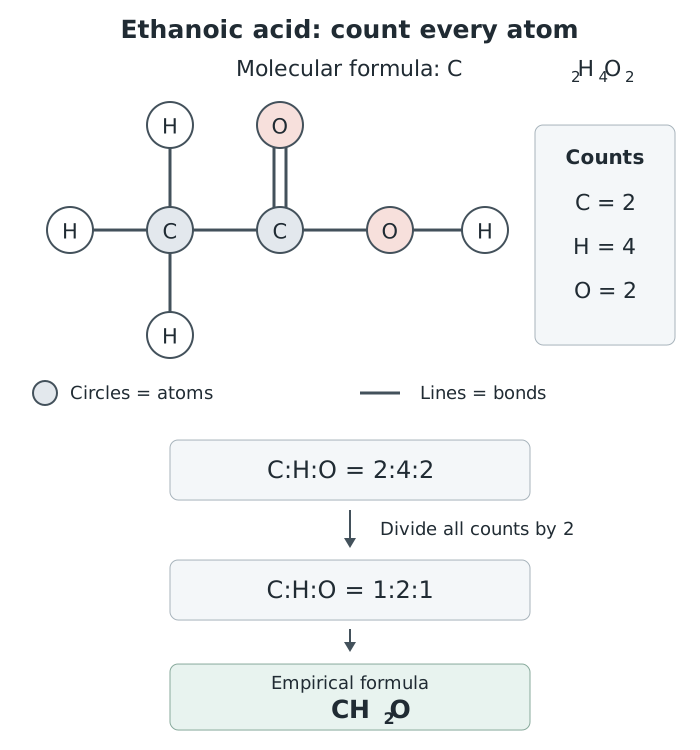
Count the atoms in the whole molecule, then simplify their ratio. Bond lines do not count as atoms.
The counts give C:H:O = . Dividing all three counts by 2 gives , so its empirical formula is . Glucose and ethanoic acid therefore have the same empirical formula even though their molecules contain different numbers of atoms. An empirical formula alone cannot identify a compound uniquely.
To turn an empirical formula into a counting diagram, read its subscripts as a ratio and choose whole-number multiples of that ratio.
For , a diagram showing 3 titanium atoms must show 6 oxygen atoms. You could draw three circles labelled Ti and six labelled O. A diagram with four of each would not represent the correct composition, because its ratio would be , not .
Such a counting diagram represents proportions only. An empirical formula does not tell you how the atoms are connected or how many atoms belong to one molecule. For example, allows counts of , or ; further information is needed to determine the molecular formula.
Empirical formula: simplest atom ratio.
Molecular formula: actual atom counts in one molecule. It is a whole-number multiple of the empirical formula.
Read the subscripts as a ratio. Any whole-number multiple represents the same composition. The empirical formula does not determine the arrangement of atoms or the size of a molecule.
Divide every atom count by the same common factor, and simplify until no common factor greater than 1 remains.
Use the diagram’s key to identify elements: colours are not universal. Count atoms, not bonds.
Do not write a subscript of 1. For example, a ratio of C:H:O = 1:2:1 gives CH₂O.
An empirical formula gives a ratio, not necessarily the actual numbers of atoms in one molecule.
It can see this note and what your specification asks for.
Answers are free with an account.
1 free note left this week
Get more free notesYour answer sets when this note comes back for review, or marks it complete.
Was this note helpful?
Log in to tell us whether it helped, or to report a problem.
Last updated
Empirical formula
A chemical formula showing the simplest whole-number ratio of atoms of each element in a compound.
Molecular formula
A chemical formula showing the actual number of atoms of each element in one molecule.
Subscript
A small number written after and below an element symbol in a chemical formula, indicating the number of atoms of that element. If no subscript is written, the number is 1.
Put your knowledge into practice — try past paper questions for Combined Science A
Empirical formula
A chemical formula showing the simplest whole-number ratio of atoms of each element in a compound.
Molecular formula
A chemical formula showing the actual number of atoms of each element in one molecule.
Subscript
A small number written after and below an element symbol in a chemical formula, indicating the number of atoms of that element. If no subscript is written, the number is 1.