

Loading…
Loading…
Loading…
OCR GCSE Combined Science A · J250
OCR J250 · P3.1c Check the specification (PDF) (opens in a new tab)
An object does not need to be charged to contain electrons. Its atoms contain and . In an object, these opposite charges balance, so the overall charge is zero. Neutral means balanced charge, not an absence of charged particles.
Static electricity occurs when this balance changes. The key is the transfer of electrons between objects.
When certain materials are rubbed together, electrons can transfer from one surface to the other. In this process, electrons move between the objects; protons remain in their atomic nuclei.
The object that gains electrons becomes negatively charged, because it now has more negative charge than positive charge. The object that loses electrons becomes positively charged, because some of its negative charge has been removed, leaving an excess of positive charge.
Becoming positive therefore does not mean gaining protons. It means losing electrons.
For example, rubbing an acetate rod with a cloth can transfer electrons from the rod to the cloth. The rod becomes positively charged and the cloth becomes negatively charged. The direction of electron transfer depends on the materials: electrons do not always move onto the object being rubbed.
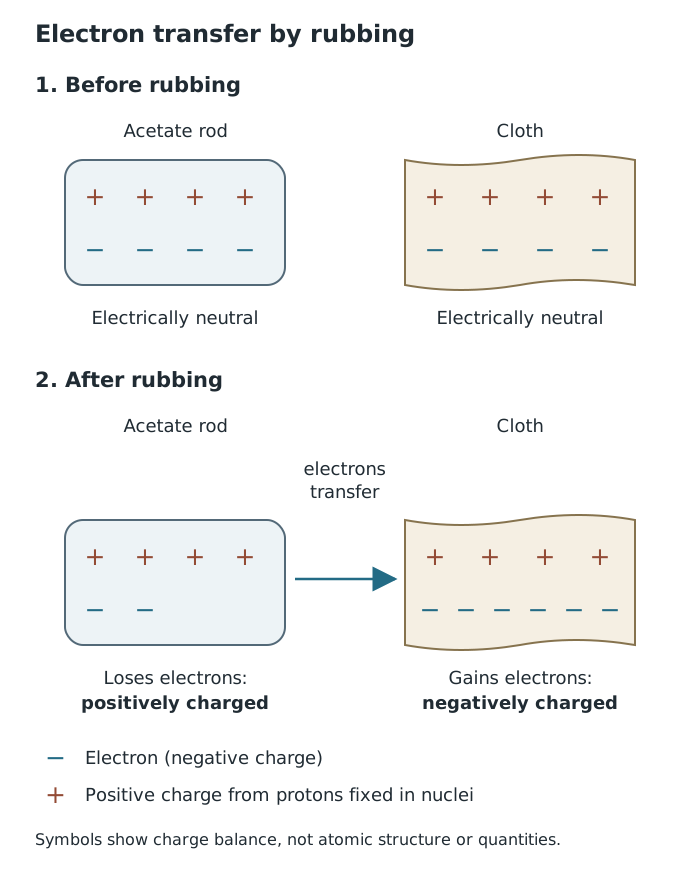
Electrons transfer from the acetate rod to the cloth, leaving equal and opposite charges.
Electrons are transferred rather than created or destroyed. If the rod and cloth start neutral and electrons transfer only between them, their final charges are equal in size and opposite in sign. Every electron lost by the rod is gained by the cloth. On insulating materials, this imbalance can remain because the charge cannot readily flow away.
Electron transfer also explains why rubbing objects can change the forces between them. Opposite charges attract; like charges repel. The positively charged acetate rod and negatively charged cloth therefore attract one another.
A plastic comb rubbed through hair provides another example. Electrons transfer from the hair onto the comb, leaving the comb negative and the hair positive. The hair strands have the same type of charge, so they repel one another and can spread apart.
The charged comb can also attract neutral scraps of paper. Neutral does not mean that the paper contains no charges: its positive and negative charges balance overall. Near the charged comb, these charges become slightly separated, with opposite charge nearer the comb. This produces an attraction even though the paper is still neutral overall.
Walking across a carpet can transfer electrons between materials and leave your body charged. When you approach a metal door handle, charge may move suddenly between you and the handle. This discharge reduces the charge imbalance and can produce a small spark and a brief shock.
Charging builds up an imbalance by transferring electrons; discharging allows charge to move again and reduces that imbalance.
Name the particles that move: electrons. Saying only that ‘charge is transferred’ does not explain the mechanism.
Link gaining electrons to becoming negatively charged, and losing electrons to becoming positively charged.
Do not say that protons move between objects during charging by friction.
Explain both objects: electrons lost by one are gained by the other, giving equal and opposite charges if both were initially neutral.
It can see this note and what your specification asks for.
Answers are free with an account.
1 free note left this week
Get more free notesYour answer sets when this note comes back for review, or marks it complete.
Was this note helpful?
Log in to tell us whether it helped, or to report a problem.
Last updated
Electron
A negatively charged particle found outside the nucleus of an atom.
Electrically neutral
Having zero overall electric charge because positive and negative charges balance.
Static electricity
A build-up of electric charge on an object.
Electron transfer
The movement of electrons from one object to another, changing the overall charge of each object.
Discharge
The movement of charge that reduces a build-up of static charge; it can sometimes produce a spark.
Put your knowledge into practice — try past paper questions for Combined Science A
Electron
A negatively charged particle found outside the nucleus of an atom.
Electrically neutral
Having zero overall electric charge because positive and negative charges balance.
Static electricity
A build-up of electric charge on an object.
Electron transfer
The movement of electrons from one object to another, changing the overall charge of each object.
Discharge
The movement of charge that reduces a build-up of static charge; it can sometimes produce a spark.