

Loading…
Loading…
Loading…
OCR GCSE Combined Science A · J250
OCR J250 · P3.3g Check the specification (PDF) (opens in a new tab)
An electric current produces a magnetic field around a wire. Around a straight wire, the field lines form circles centred on the wire. Winding the wire into a coil changes how the fields from different parts of the wire combine.
A solenoid is a wire wound into a long coil of many turns. When current flows, every turn contributes to the magnetic field. Inside the coil, the fields from neighbouring turns point in the same direction, so they reinforce one another. This concentrates the magnetic effect through the centre of the solenoid, producing a much stronger field than a single turn would produce with the same current.
The overall field resembles the field of a bar magnet: one end behaves as a north pole and the other as a south pole. Outside the solenoid, field lines curve from north to south.
Inside the solenoid, away from its ends, the field is strong and approximately uniform. This means its strength and direction are nearly the same throughout that region. We represent it with straight, parallel, equally spaced field lines. Closely spaced lines represent a stronger field; the lines are a drawing convention, not physical threads.
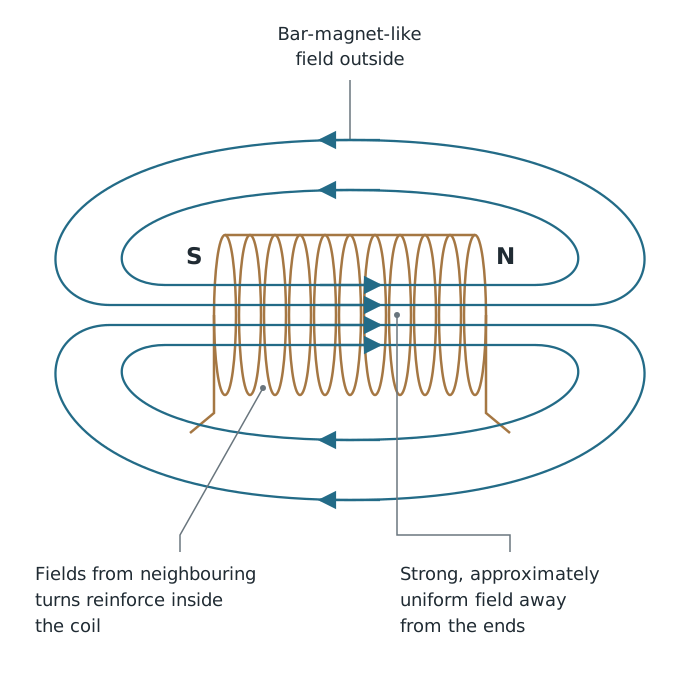
The fields from the turns reinforce inside the solenoid, producing a strong, approximately uniform central field.
The central field runs along the length of the coil, rather than circling around its axis. It is the combined effect of the circular fields around the wire in each turn.
Adding more turns over the same length strengthens the field because more turns contribute reinforcing fields within the coil. Increasing the current also strengthens the field produced by each turn.
A further improvement is to place an iron core through the centre. The coil’s field magnetises the iron, making it an induced magnet. The magnetised core adds to the coil’s field, creating a stronger magnetic effect overall. A current-carrying coil with an iron core is a common arrangement for an electromagnet.
For example, compare two otherwise identical coils carrying the same current, one with an iron core and one without. The coil with the iron core produces the stronger field: the difference comes from the magnetised iron, not from an increase in current.
The magnetic field produced by the coil can be switched on and off by controlling the current. Reversing the current reverses the field direction and swaps the solenoid’s north and south poles.
Reversing the current swaps the poles; switching off the current removes the field produced by the coil.
When asked to explain the enhancement, link the coil arrangement to the fields from neighbouring turns reinforcing one another inside the solenoid.
For a stronger solenoid, state more turns over the same length, a larger current, or an iron core.
Show a uniform field using straight, parallel, equally spaced field lines. Outside the solenoid, arrows run from north to south.
It can see this note and what your specification asks for.
Answers are free with an account.
1 free note left this week
Get more free notesYour answer sets when this note comes back for review, or marks it complete.
Was this note helpful?
Log in to tell us whether it helped, or to report a problem.
Last updated
Solenoid
A wire wound into a long coil of many turns that produces a magnetic field when a current flows through it.
Uniform magnetic field
A magnetic field with the same strength and direction throughout a region.
Electromagnet
A magnet whose magnetic field is produced by an electric current, usually using a coil around an iron core.
Iron core
A piece of iron placed inside a coil that becomes magnetised and strengthens the coil’s magnetic field.
Put your knowledge into practice — try past paper questions for Combined Science A
Solenoid
A wire wound into a long coil of many turns that produces a magnetic field when a current flows through it.
Uniform magnetic field
A magnetic field with the same strength and direction throughout a region.
Electromagnet
A magnet whose magnetic field is produced by an electric current, usually using a coil around an iron core.
Iron core
A piece of iron placed inside a coil that becomes magnetised and strengthens the coil’s magnetic field.