

Loading…
Loading…
Loading…
OCR GCSE Combined Science A · J250
OCR J250 · C3.1j Check the specification (PDF) (opens in a new tab)
When sodium chloride dissolves in water, the sodium chloride is the and the water is the . Together they form a salt . The dissolved salt is still present, even though you can no longer see the salt crystals.
Concentration describes how much dissolved solute there is in a given volume of solution. A concentrated solution contains more solute per unit volume than a dilute solution. This relationship is Higher Tier content.
To find the mass concentration, divide the mass of dissolved solute by the total volume of solution:
Using the symbols for concentration, for solute mass and for solution volume, this is .
When mass is measured in grams and volume in cubic decimetres, concentration is measured in grams per cubic decimetre, written g/dm³. For example, a concentration of 10 g/dm³ means that each 1 dm³ of solution contains 10 g of dissolved solute. It does not mean that the whole solution weighs 10 g.
The volume in the equation is the final volume of the solution, including the dissolved solute, rather than simply the volume of water used.
If the solution volume stays constant, increasing the mass of dissolved solute increases the concentration. More solute is present in the same amount of solution.
Concentration is directly proportional to solute mass at a fixed volume: doubling the dissolved mass doubles the concentration, and halving it halves the concentration. This assumes that the solute dissolves completely; extra solid left undissolved is not part of the dissolved solute mass.
If the solute mass stays constant, increasing the solution volume decreases the concentration. The same mass of solute is now spread through a larger volume.
Adding solvent produces this change, called dilution. The solute is not removed: there is simply less of it in each unit volume. Doubling the total solution volume halves the concentration. Halving the volume, while retaining the same dissolved solute mass, doubles it.
Concentration is therefore inversely proportional to solution volume at a fixed solute mass.
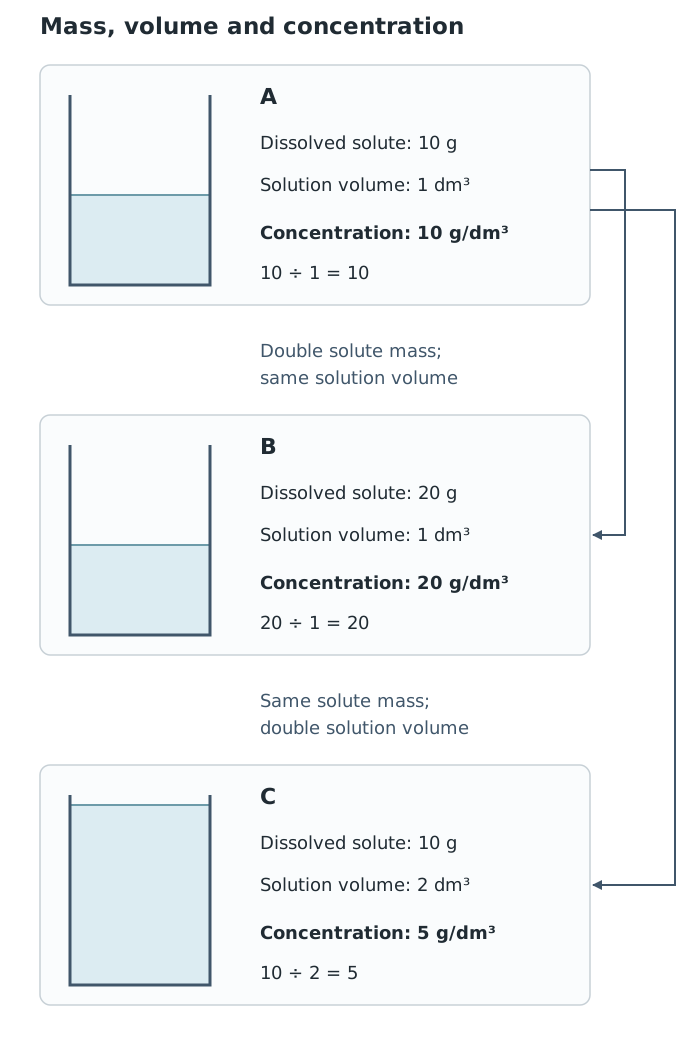
At a fixed volume, doubling the dissolved solute mass doubles concentration. At a fixed solute mass, doubling the solution volume halves concentration.
Mass and volume must be considered together. If both are doubled, their ratio stays the same, so concentration is unchanged. A large container of solution is not necessarily more concentrated than a small one.
A cubic decimetre is the same volume as a litre:
Before using to find concentration in g/dm³, divide a volume in cm³ by 1000. For example, 250 cm³ is 0.250 dm³.
The same relationship can also be rearranged to find the dissolved mass or the solution volume:
Multiplying concentration by volume gives the total mass of solute in that volume. Dividing solute mass by concentration gives the volume containing that mass.
Use in g and the total solution volume in dm³ to obtain in g/dm³.
.
Convert cm³ to dm³ by dividing by 1000.
Use the mass of the dissolved solute, not the mass of the whole solution.
Use the final volume of the solution, not just the volume of solvent added.
For a concentration in g/dm³, use mass in g and volume in dm³. Convert cm³ to dm³ by dividing by 1000.
When explaining a change in concentration, state what stays constant: solute mass or solution volume.
It can see this note and what your specification asks for.
Answers are free with an account.
1 free note left this week
Get more free notesYour answer sets when this note comes back for review, or marks it complete.
Was this note helpful?
Log in to tell us whether it helped, or to report a problem.
Last updated
Solute
The substance that dissolves in a solvent to form a solution.
Solvent
A liquid in which a solute dissolves.
Solution
A mixture formed when a solute dissolves in a solvent.
Concentration
The mass of dissolved solute per unit volume of solution, often measured in g/dm³.
Dilution
Reducing the concentration of a solution by adding solvent, so the same mass of solute is distributed through a larger volume.
Put your knowledge into practice — try past paper questions for Combined Science A
Solute
The substance that dissolves in a solvent to form a solution.
Solvent
A liquid in which a solute dissolves.
Solution
A mixture formed when a solute dissolves in a solvent.
Concentration
The mass of dissolved solute per unit volume of solution, often measured in g/dm³.
Dilution
Reducing the concentration of a solution by adding solvent, so the same mass of solute is distributed through a larger volume.