

Loading…
Loading…
Loading…
OCR GCSE Combined Science A · J250
OCR J250 · C3.4a Check the specification (PDF) (opens in a new tab)
An ionic compound contains positively and negatively charged particles called ions. In a solid ionic compound, these ions are held in fixed positions, so they cannot move through the solid to carry charge. When the compound is molten or dissolved in water, its ions can move freely.
Passing an electric current through this liquid or solution can break down the compound. This process is called electrolysis, and the conducting liquid or solution is the electrolyte. Ions carry charge through the electrolyte; electrons carry charge through the connecting wires.
An electrolysis cell has two conducting electrodes connected to a power supply and placed in the electrolyte. The cathode is negative, and the anode is positive.
Here we are considering inert electrodes, such as graphite or platinum. They conduct electricity and provide surfaces where products form, but do not themselves take part chemically in the reactions. This condition matters: electrodes that react can change what happens during electrolysis.
A cation is a positively charged ion. Opposite charges attract, so cations move towards the negative cathode. For example, a copper ion, , is a cation: the superscript shows its positive charge. A hydrogen ion, , is also a cation.
An anion is a negatively charged ion. Anions move towards the positive anode. For example, a chloride ion, , is an anion because it has a negative charge. A hydroxide ion, , is also an anion, even though it contains more than one atom.
The charge tells you which electrode an ion moves towards. It does not, by itself, tell you which product will form when several types of ion are present.
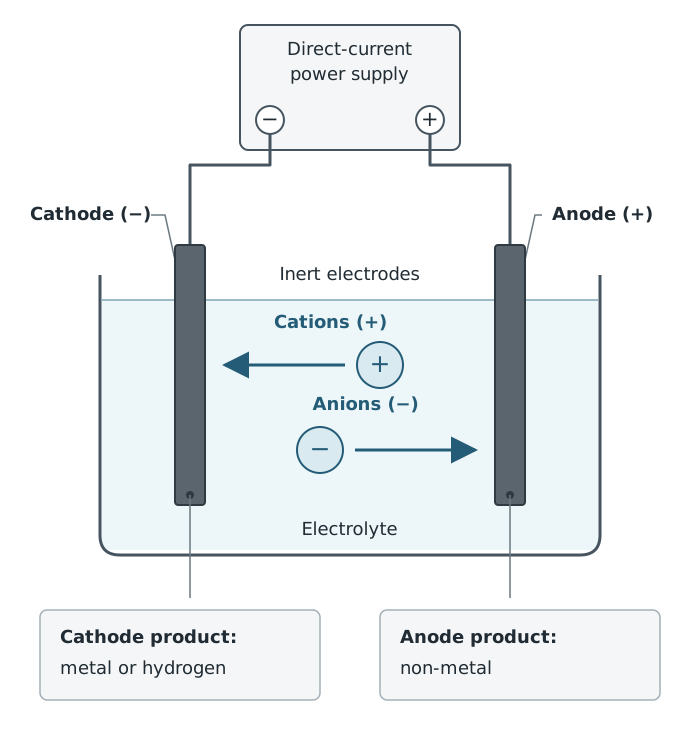
Opposite charges attract: cations move towards the cathode and anions towards the anode. The product rules shown apply to inert electrodes.
With inert electrodes, the central product rule is:
At the cathode, ions that react gain electrons. Metal ions can form metal atoms, producing a deposit of metal on the electrode. Alternatively, hydrogen can form as a gas, giving bubbles at the cathode.
At the anode, ions that react lose electrons. Non-metal products include chlorine and oxygen. These form gases, although the general rule is non-metal, not necessarily gas.
Hydrogen is itself a non-metal, but it forms at the cathode. This is why the cathode rule must include both possibilities: a metal or hydrogen. Keep the direction of ion movement and the type of product connected: positive cations head towards the negative cathode; negative anions head towards the positive anode.
| Electrode | Sign | Ions attracted |
|---|---|---|
| Cathode | Negative | Cations: positive ions |
| Anode | Positive | Anions: negative ions |
The electrolyte needs mobile ions: the ionic compound must be molten or dissolved in water. Its ions cannot move freely in the solid state.
Remember PANIC: Positive Anode, Negative Is Cathode. These signs apply to an electrolysis cell.
Keep an ion's charge separate from the electrode's charge: a positive cation moves towards the negative cathode.
Do not assume every electrode product is a gas: metals can be deposited at the cathode, and non-metals are not all gases.
It can see this note and what your specification asks for.
Answers are free with an account.
1 free note left this week
Get more free notesYour answer sets when this note comes back for review, or marks it complete.
Was this note helpful?
Log in to tell us whether it helped, or to report a problem.
Last updated
Electrolysis
The breakdown of an ionic compound, molten or dissolved in water, by passing an electric current through it.
Electrolyte
A liquid or solution containing mobile ions that carry electric charge.
Electrode
A conductor through which electric current enters or leaves an electrolyte.
Inert electrode
An electrode that conducts electricity and provides a surface for reactions without taking part chemically in those reactions.
Cation
A positively charged ion, attracted towards the negative cathode during electrolysis.
Anion
A negatively charged ion, attracted towards the positive anode during electrolysis.
Cathode
The negative electrode in an electrolysis cell, where a metal or hydrogen forms when inert electrodes are used.
Anode
The positive electrode in an electrolysis cell, where a non-metal forms when inert electrodes are used.
Put your knowledge into practice — try past paper questions for Combined Science A
Electrolysis
The breakdown of an ionic compound, molten or dissolved in water, by passing an electric current through it.
Electrolyte
A liquid or solution containing mobile ions that carry electric charge.
Electrode
A conductor through which electric current enters or leaves an electrolyte.
Inert electrode
An electrode that conducts electricity and provides a surface for reactions without taking part chemically in those reactions.
Cation
A positively charged ion, attracted towards the negative cathode during electrolysis.
Anion
A negatively charged ion, attracted towards the positive anode during electrolysis.
Cathode
The negative electrode in an electrolysis cell, where a metal or hydrogen forms when inert electrodes are used.
Anode
The positive electrode in an electrolysis cell, where a non-metal forms when inert electrodes are used.