

Loading…
Loading…
Loading…
Eduqas GCSE Sociology · C200
Eduqas C200 Check the specification (PDF) (opens in a new tab)
The cycle of deprivation explains how disadvantages associated with poverty can reinforce one another and pass from parents to children. Deprivation means lacking resources or opportunities needed for an adequate life. A cycle exists when the consequences of poverty help create the conditions for poverty to continue in the next generation.
This is not simply a claim that children inherit their parents’ income. It is an explanation of how childhood circumstances can affect health, education and employment, shaping a person's life chances: their opportunities to achieve outcomes such as good health and secure work.
A child growing up in a low-income household may experience material deprivation, such as insufficient nutritious food, inadequate heating or overcrowded housing. Poor nutrition can affect health, while unsuitable housing can make studying difficult. These disadvantages can make it harder to benefit fully from education.
Limited money can also restrict access to books, trips and experiences that support learning. Some explanations describe a lack of these experiences, encouragement or confidence as cultural deprivation. Material and cultural deprivation are different, but they may interact: a family may want to provide learning opportunities yet be unable to afford them. Low income does not itself demonstrate a lack of parental interest or ambition.
If these disadvantages contribute to lower educational achievement and fewer qualifications, the young person may have more limited employment opportunities. Low-paid or insecure work in adulthood can then leave them with too little income to provide their own children with adequate resources. The cycle has returned to childhood poverty, but in a new generation.
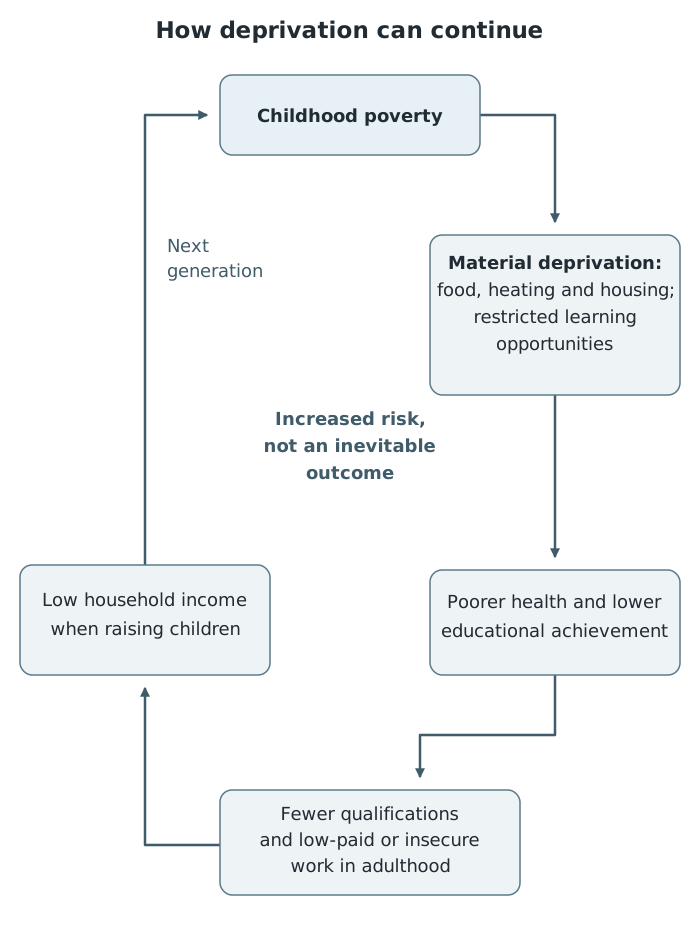
Disadvantages can reinforce one another and carry poverty into the next generation, but the cycle can be interrupted.
For example, a child in an overcrowded home may struggle to find somewhere quiet to study. If this contributes to fewer qualifications, it may restrict access to well-paid work. As an adult, that person may also struggle to afford suitable housing for their children. Each link explains how one disadvantage can contribute to another; none makes the next outcome inevitable.
Some functionalist explanations emphasise socialisation, the process of learning society's norms and values. They argue that some families may not transmit the motivation, aspirations or expectations needed for educational and economic success. On this view, disadvantage can continue through learned attitudes as well as through a lack of money. Family support and early intervention, such as Sure Start, aim to improve children's opportunities and support parenting.
This explanation draws attention to the importance of children's early experiences. However, it risks blaming families and treating the consequences of poverty as its causes. A parent may strongly value education but lack the money, time or suitable housing needed to support it.
Marxists instead emphasise the organisation of capitalism. They argue that concentrated wealth, unequal educational opportunities and dependence on low-paid workers help reproduce poverty. Their explanation focuses on barriers facing working-class families rather than a supposed failure of their values. From this perspective, breaking the cycle requires structural change, not simply changing individual attitudes.
This helps explain why effort and ambition may not be enough to escape poverty. However, a structural explanation should not be treated as a prediction that every disadvantaged child will have the same future: people's experiences and outcomes vary.
Feminists highlight how gender can shape the cycle. For example, single mothers may face a combination of childcare costs, lower pay and reliance on part-time work. These pressures can reduce household income and affect children's opportunities. This points towards changes in employment, childcare and welfare support, rather than assuming that family attitudes alone explain poverty.
The cycle is useful because it connects disadvantages that might otherwise appear separate: poor health, limited qualifications and insecure employment. It also explains why poverty can persist across generations.
However, it is a pattern of increased risk, not an unavoidable destiny. Early support for children can tackle disadvantage before it accumulates, while changes to housing, employment and income can address material barriers. A balanced conclusion is that family experiences matter, but they must be understood alongside the resources and opportunities available to families.
Childhood poverty → material deprivation and restricted opportunities → poorer health or lower educational achievement → fewer qualifications → low-paid or insecure work → poverty affecting the next generation.
Explain the connections, not just the stages. The cycle describes increased risks, not inevitable outcomes.
The cycle connects childhood disadvantage with adult life chances and intergenerational poverty. However, family-centred explanations can blame parents and overlook material barriers. A balanced explanation considers both early experiences and unequal opportunities.
To describe a cycle, explain the links and show how disadvantage can return in the next generation. A list of effects of poverty is not enough.
Use ‘can’ or ‘may’ rather than suggesting that every child in poverty will become a poor adult.
When evaluating, distinguish explanations based on family socialisation from those based on unequal access to resources and opportunities.
It can see this note and what your specification asks for.
Answers are free with an account.
1 free note left this week
Get more free notesYour answer sets when this note comes back for review, or marks it complete.
Was this note helpful?
Log in to tell us whether it helped, or to report a problem.
Last updated
Cycle of deprivation
A process through which disadvantages associated with poverty can reinforce one another and pass from parents to children across generations.
Material deprivation
A lack of material goods and services needed for an adequate standard of living, such as sufficient food, heating and suitable housing.
Cultural deprivation
A lack of experiences, encouragement or other cultural resources thought to support educational success. This is a contested explanation of disadvantage, not a claim that poorer families have no culture.
Life chances
A person's opportunities to obtain valued outcomes, such as good health, educational qualifications and secure employment.
Structural explanation
An explanation that focuses on how the organisation of society, including education, employment and the distribution of wealth, shapes people's circumstances.
Put your knowledge into practice — try past paper questions for Sociology
Cycle of deprivation
A process through which disadvantages associated with poverty can reinforce one another and pass from parents to children across generations.
Material deprivation
A lack of material goods and services needed for an adequate standard of living, such as sufficient food, heating and suitable housing.
Cultural deprivation
A lack of experiences, encouragement or other cultural resources thought to support educational success. This is a contested explanation of disadvantage, not a claim that poorer families have no culture.
Life chances
A person's opportunities to obtain valued outcomes, such as good health, educational qualifications and secure employment.
Structural explanation
An explanation that focuses on how the organisation of society, including education, employment and the distribution of wealth, shapes people's circumstances.