

Loading…
Loading…
Loading…
Eduqas GCSE Sociology · C200
Eduqas C200 Check the specification (PDF) (opens in a new tab)
Social control means the ways society encourages people to follow rules and maintains order. Much everyday control is informal: friends or family may show disapproval when someone breaks an unwritten norm. , in contrast, involves explicit rules and agencies with official authority to enforce them.
The police and courts are agencies of formal social control because their powers come from the state. They are part of the criminal justice system, alongside institutions such as prisons. Their authority extends beyond expressing disapproval: police can arrest suspects, and courts can impose legally enforceable punishments.
The police maintain public order, enforce the law and investigate suspected crimes. They gather evidence and apprehend people suspected of offending. For example, following a reported theft, officers may collect witness accounts and investigate what happened. Arresting a suspect is not the same as proving that person guilty.
Police also control behaviour through deterrence. A visible police presence can discourage offending because people believe they are more likely to be caught. Formal control can therefore influence behaviour before a crime occurs, as well as respond afterwards.
The police are sometimes described as gatekeepers to the criminal justice system. Their decisions about what to investigate and whom to suspect influence which cases enter the system. This makes policing important not only for maintaining order, but also for understanding how the law is applied in practice.
Courts consider criminal cases and determine whether defendants are guilty. A finding of guilt is a conviction; the punishment imposed afterwards is the sentence. Keeping these stages separate matters: an accusation alone does not establish guilt.
In England and Wales, magistrates’ courts deal with less serious criminal offences. The Crown Court deals with serious offences such as murder. In a Crown Court jury trial, the jury decides whether the defendant is guilty, while the judge imposes the sentence if the defendant is convicted.
Courts enforce social control through punishments such as fines and imprisonment. These impose consequences on convicted offenders and can deter others who anticipate similar consequences. Imprisonment also restricts an offender’s ability to commit crimes in the wider community while confined. These are intended effects, not a guarantee that someone will never offend again.
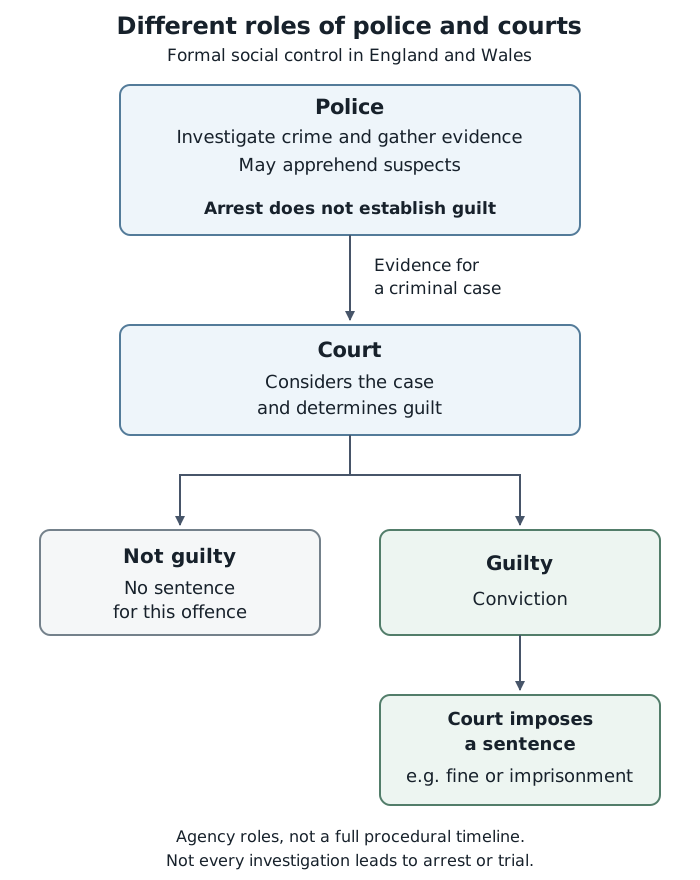
Police investigate suspected offences; courts determine guilt and sentence those convicted.
The police and courts therefore have connected but different roles: investigating an offence supplies evidence for a case, whereas the court’s role is to judge the case and, where appropriate, sentence the offender.
Functionalists see social control as necessary for society to operate. Police enforcement and court decisions help uphold shared rules and protect people from harmful behaviour. From this viewpoint, formal control benefits society by maintaining order.
Marxists question whether that protection is equal. They argue that social control favours the ruling class. For example, they argue that working-class crime is policed more harshly than white-collar and corporate crime. This is differential enforcement of the law: the issue is not simply what the law states, but how strongly it is enforced against different groups.
Feminists argue that social control can favour men in a male-dominated society. They therefore question whether the rules and the institutions enforcing them serve women’s and men’s interests equally.
These perspectives draw attention to different questions. Police and courts can provide protection and discourage crime, but this does not by itself prove that their treatment of everyone is fair. A balanced judgement considers both their capacity to maintain order and whether their powers are exercised equally. Bias and mistrust can weaken the effectiveness of formal control, even where agencies possess strong legal powers.
Distinguish the agencies: the police investigate crime and apprehend suspects; courts determine guilt and sentence those convicted. Arrest does not establish guilt.
Explain how an activity controls behaviour: police patrols can deter crime because people anticipate being caught, rather than simply stating that police patrol.
When evaluating formal social control, distinguish its aim of protecting society from arguments about whether its powers are applied fairly.
It can see this note and what your specification asks for.
Answers are free with an account.
1 free note left this week
Get more free notesYour answer sets when this note comes back for review, or marks it complete.
Was this note helpful?
Log in to tell us whether it helped, or to report a problem.
Last updated
Social control
The ways society encourages conformity to its rules and maintains order.
Formal social control
The enforcement of explicit rules and laws by agencies with official authority, including the police and courts.
Criminal justice system
The institutions involved in enforcing criminal law, deciding criminal cases and dealing with convicted offenders.
Deterrence
Discouraging an offence by making people anticipate being caught or punished.
Conviction
A formal finding that a person is guilty of a criminal offence.
Sentence
The punishment imposed by a court on a person convicted of an offence.
Differential enforcement of the law
Unequal enforcement of the law against different social groups or types of crime.
Put your knowledge into practice — try past paper questions for Sociology
Social control
The ways society encourages conformity to its rules and maintains order.
Formal social control
The enforcement of explicit rules and laws by agencies with official authority, including the police and courts.
Criminal justice system
The institutions involved in enforcing criminal law, deciding criminal cases and dealing with convicted offenders.
Deterrence
Discouraging an offence by making people anticipate being caught or punished.
Conviction
A formal finding that a person is guilty of a criminal offence.
Sentence
The punishment imposed by a court on a person convicted of an offence.
Differential enforcement of the law
Unequal enforcement of the law against different social groups or types of crime.