

Loading…
Loading…
Loading…
Eduqas GCSE Religious Studies (Short Course) · C125
Eduqas C125 · Islam, Non-Religion, and the World Check the specification (PDF) (opens in a new tab)
The origin of the universe concerns how the universe came into existence. For Muslims, this question also concerns who created it and whether its existence has a purpose. Muslims believe that Allah created the universe and everything within it. Creation is understood as intentional, not an accident without meaning.
The Qur’an is a source of authority for these beliefs. Qur’an 36:81 asks whether the One who created the heavens and the earth can also resurrect people, and answers: “Yes ˹He can˺! For He is the Master Creator, All-Knowing.”
The verse connects Allah’s original creation with his power to create again. Its immediate concern is resurrection, but it also teaches that Allah is the Creator of the whole universe. “All-Knowing” presents creation as the work of a being with knowledge, rather than a process beyond his understanding or control. For Muslims, studying the universe can therefore deepen appreciation of Allah’s power and wisdom.
The Big Bang theory explains the universe’s development from an extremely hot, dense early state. As the universe expanded, it cooled, and matter eventually formed structures such as stars and galaxies. Expansion continues today.
Science seeks explanations that can be tested against observations. Evidence supporting the Big Bang includes the movement of distant galaxies away from us and background radiation remaining from the early universe. These support an expanding universe with a hot early history; they do not, by themselves, establish whether God exists.
Atheists do not believe in a god, while Humanists favour reason and evidence rather than religious revelation as a basis for understanding the world. They can accept a scientific account of the universe without attributing its origin to Allah. However, the Big Bang is not exclusively a non-religious belief: a Muslim can accept the same scientific explanation.
In Wonders of the Universe, science presenter Brian Cox explains how tiny differences in the density of the early universe helped produce its later structures. Density describes how much matter is concentrated in a particular amount of space. Slightly denser regions became denser still as matter clumped together.
Over time, these concentrations of matter became massive enough to collapse under their own gravity. Hydrogen fused, releasing enormous amounts of energy: stars began to shine. Cox places the formation of the first stars around 200 million years after the Big Bang. Planets later formed and orbited stars.
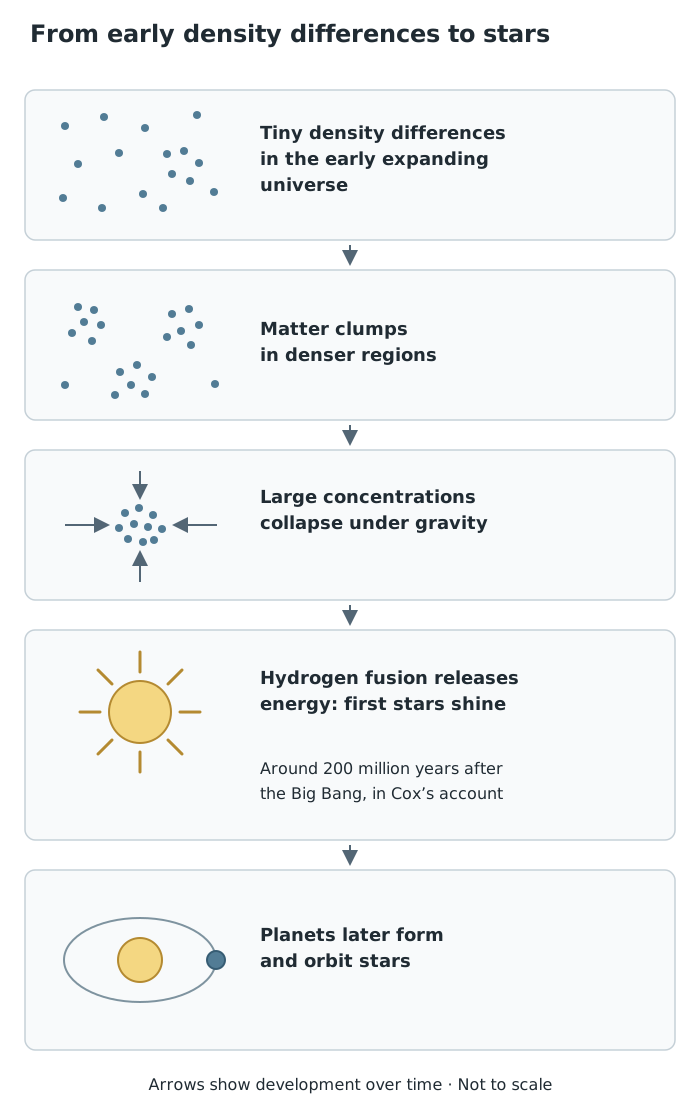
Cox connects the formation of stars and later planetary systems to tiny differences in the density of the early universe.
Cox’s central point is that the structures we see today depended on those tiny early density differences. His account explains their development through physical processes, without invoking a divine intervention. This is not the same as demonstrating that no Creator could have been responsible for those processes.
Many Muslims understand science and religion as addressing different aspects of creation. Science investigates how the universe developed; belief in Allah explains who ultimately created it and gives it purpose. On this view, the Big Bang could be the means through which Allah created the universe.
Muslims who take this approach do not treat the Qur’an as a detailed science textbook. For example, Qur’an 7:54 describes creation in six days. Some interpret these as periods or stages rather than six ordinary twenty-four-hour days. This allows them to accept development over billions of years while retaining belief in Allah as Creator.
Some Muslims also understand the Qur’an’s description of the heavens and earth being joined and then separated in 21:30 as compatible with the Big Bang. This is an interpretation connecting scripture and science, rather than scientific proof of the theory.
Some Muslims interpret the six days of creation literally. A creation account understood as six ordinary days conflicts with the scientific account of development over billions of years. The disagreement here concerns the interpretation of scripture and the timescale of creation.
A different disagreement concerns whether a Creator is needed at all. Some atheists argue that natural processes explain the universe without a designer, and that apparent order does not necessarily prove design. Muslims may respond that explaining a process does not remove the need for an ultimate Creator: Allah could be responsible for the universe and the laws through which it develops.
A justified conclusion must distinguish these disagreements. Islamic belief and the Big Bang need not conflict if Allah is understood as creating through natural processes. Conflict is stronger where someone insists on a literal six-day timescale, or where a non-religious position rejects any divine Creator. The extent of conflict therefore depends on both the interpretation of Islamic teachings and the claims made beyond the scientific explanation.
Use Qur’an 36:81 to support Allah’s power, knowledge and role as Creator; explain the teaching rather than just quoting it.
For Brian Cox’s view, include tiny density differences, gravitational collapse and the formation of stars—not just the words ‘Big Bang’.
Distinguish a scientific explanation from an atheist interpretation of it: accepting the Big Bang does not necessarily mean rejecting Allah.
When evaluating conflict, compare different Muslim interpretations and reach a conclusion about where the disagreement actually lies.
It can see this note and what your specification asks for.
Answers are free with an account.
1 free note left this week
Get more free notesYour answer sets when this note comes back for review, or marks it complete.
Was this note helpful?
Log in to tell us whether it helped, or to report a problem.
Last updated
Allah
The Islamic name for God, believed by Muslims to be the Creator of the universe.
Creation
The belief that the universe and everything within it were brought into existence by God.
Big Bang theory
The scientific explanation that the universe expanded from an extremely hot, dense early state and has continued expanding.
Atheist
A person who does not believe in any god.
Humanist
A person whose non-religious worldview emphasises reason, evidence and human responsibility rather than divine authority.
Literal interpretation
An approach to a text that takes its words in their direct, ordinary sense rather than as symbolism or metaphor.
Put your knowledge into practice — try past paper questions for Religious Studies (Short Course)
Allah
The Islamic name for God, believed by Muslims to be the Creator of the universe.
Creation
The belief that the universe and everything within it were brought into existence by God.
Big Bang theory
The scientific explanation that the universe expanded from an extremely hot, dense early state and has continued expanding.
Atheist
A person who does not believe in any god.
Humanist
A person whose non-religious worldview emphasises reason, evidence and human responsibility rather than divine authority.
Literal interpretation
An approach to a text that takes its words in their direct, ordinary sense rather than as symbolism or metaphor.