

Loading…
Loading…
Loading…
Eduqas GCSE Religious Studies (Short Course) · C125
Eduqas C125 · Buddhism, Non-Religion, and the World Check the specification (PDF) (opens in a new tab)
Buddhism has no creation story explaining how a creator God made the universe. This does not mean that Buddhists have no ideas about the universe. Instead, Buddhist teachings describe a changing world that depends on causes and conditions, rather than a single divine act of creation.
Dependent arising, also called pratitya samutpada, means that things arise because the conditions for them exist. They do not exist independently. Applied to the universe, this encourages an understanding of change through connected causes rather than the actions of a creator God.
Buddhist teaching describes worlds as coming into existence, expanding and developing, then decaying and dying. New worlds arise, so this is a repeating cycle rather than one creation followed by a permanent universe. Buddhism does not identify a single first creation of everything.
This cosmic cycle should be distinguished from samsara, the cycle of birth, life, death and rebirth experienced by living beings. Both express the idea that existence involves continuing change, but the rebirth of a person and the renewal of a world are different processes.
The Big Bang theory is a scientific explanation of the universe’s development from an early hot, dense state through expansion. It describes a natural process, rather than an act performed by a creator God.
In Wonders of the Universe, physicist Brian Cox explains how tiny differences in density helped produce the structures we see today. Density means how much matter is packed into a particular space. As the universe expanded, slightly denser regions became increasingly dense, and atoms clumped together.
These growing structures eventually collapsed under their own gravity. Hydrogen fused, releasing enormous amounts of energy: stars began to shine. Cox places the appearance of the first stars at about 200 million years after the Big Bang. Planets later formed and orbited stars, with solar systems forming parts of galaxies.
The important connection in Cox’s account is that very small early differences had enormous consequences. Without those density differences, matter would not have gathered into the structures needed for stars and planets to form. His explanation uses physical causes, not divine intention.
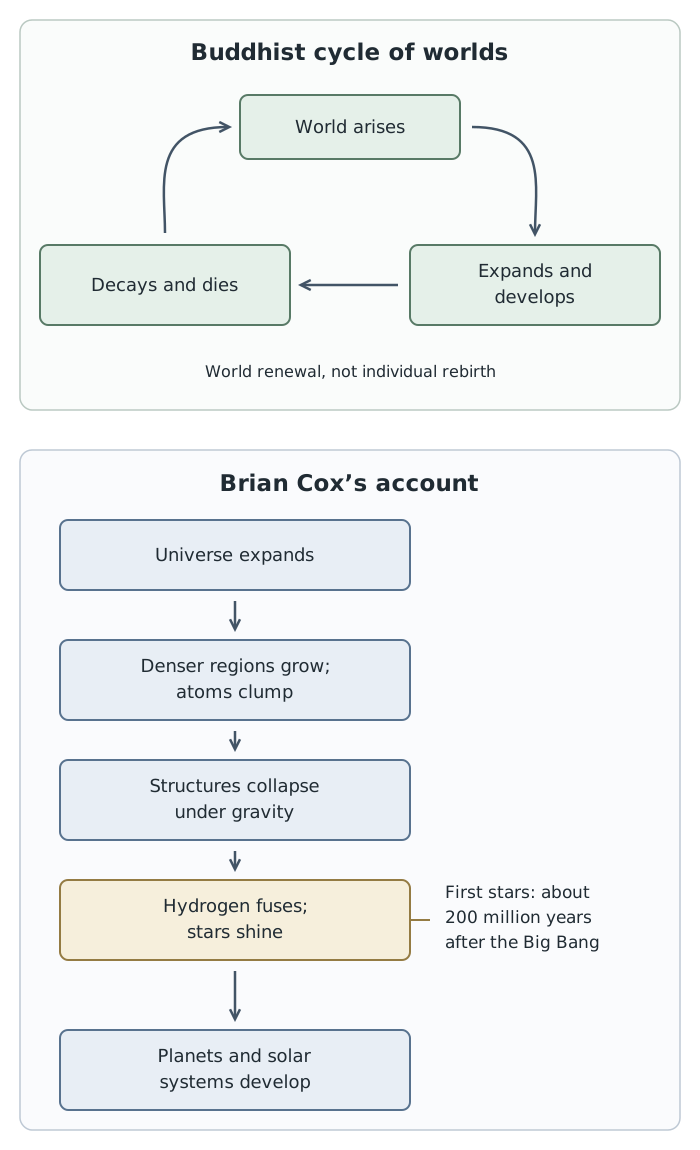
The Buddhist account describes repeating worlds. Cox explains how physical conditions led to stars and planets; this sequence does not itself establish a repeating cosmic cycle.
Buddhist teachings neither explicitly support nor deny the Big Bang theory. Nevertheless, there are reasons why a Buddhist could accept it. Buddhism does not require a creator God, so a natural explanation of the universe need not challenge its beliefs. Cox’s account of structures developing when physical conditions allow also has a broad similarity to dependent arising: events depend on conditions.
Atheists do not believe in God or gods. Humanists generally seek explanations through reason and evidence rather than supernatural claims. They may therefore accept scientific accounts of the universe without adding a divine creator. This overlaps with Buddhism’s absence of a creator God, although Buddhism remains a religion with teachings such as rebirth.
The Big Bang theory explains the development of the universe we observe. It does not, by itself, establish that worlds repeatedly decay, die and arise again. A Buddhist cycle of worlds therefore goes beyond what this scientific account demonstrates.
Similarly, dependent arising is a Buddhist teaching, not a scientific proof of the Big Bang. A non-religious person may accept Cox’s physical explanation while withholding belief in repeated cosmic cycles or rebirth because they do not consider those beliefs established by scientific evidence.
A justified conclusion is that the views can be compatible without being identical. Their strongest agreement is that explaining the universe does not require a creator God. Their important difference concerns the additional Buddhist teaching of repeating cycles: accepting the Big Bang does not automatically mean accepting that teaching.
Expansion → denser regions → atoms clump → gravitational collapse → hydrogen fusion → stars.
Cox describes the first stars appearing about 200 million years after the Big Bang. Planets and solar systems developed later. Tiny early density differences made these structures possible.
Agreement: Buddhism does not require a creator God; atheists and Humanists can also accept natural explanations. Development through physical conditions broadly fits dependent arising.
Difference: the Big Bang theory does not establish repeated cycles of worlds or rebirth.
Judgement: compatible in important respects, but not identical. Buddhist teachings neither explicitly support nor deny the Big Bang.
Distinguish the rebirth of living beings in samsara from the Buddhist belief in cycles of worlds: they are related ideas, but not the same process.
When discussing Brian Cox, explain the chain from density differences to gravity, star formation and planets, rather than just naming the Big Bang.
For an evaluation, explain both agreement and differences. Not requiring a creator God does not make Buddhism and the Big Bang theory identical.
Support your conclusion with the strongest reasons you have discussed, rather than simply stating that you agree.
It can see this note and what your specification asks for.
Answers are free with an account.
1 free note left this week
Get more free notesYour answer sets when this note comes back for review, or marks it complete.
Was this note helpful?
Log in to tell us whether it helped, or to report a problem.
Last updated
Big Bang theory
A scientific explanation of the universe’s development from an early hot, dense state through expansion.
Creator God
A divine being believed to have brought the universe into existence.
Dependent arising
The Buddhist teaching that things arise through causes and conditions rather than existing independently; also called pratitya samutpada.
Samsara
The Buddhist cycle of birth, life, death and rebirth experienced by living beings.
Atheist
A person who does not believe in the existence of God or gods.
Humanist
A person whose non-religious outlook uses reason and evidence to understand the world and emphasises human responsibility for living well.
Put your knowledge into practice — try past paper questions for Religious Studies (Short Course)
Big Bang theory
A scientific explanation of the universe’s development from an early hot, dense state through expansion.
Creator God
A divine being believed to have brought the universe into existence.
Dependent arising
The Buddhist teaching that things arise through causes and conditions rather than existing independently; also called pratitya samutpada.
Samsara
The Buddhist cycle of birth, life, death and rebirth experienced by living beings.
Atheist
A person who does not believe in the existence of God or gods.
Humanist
A person whose non-religious outlook uses reason and evidence to understand the world and emphasises human responsibility for living well.