Loading…


Loading…
Loading…
Loading…
Eduqas GCSE Religious Studies · C120
Eduqas C120 · The World and Its Origins in Hinduism Check the specification (PDF) (opens in a new tab)
An explanation of the universe’s origins might describe how the physical universe developed. It might also ask why anything exists or whether the universe depends on a divine reality. These questions are connected, but they are not identical. This distinction helps explain why Hindu beliefs and scientific explanations can sometimes be seen as compatible and sometimes as conflicting.
Hinduism contains several accounts of creation rather than one account accepted in exactly the same way by every Hindu. A common teaching is that the material universe undergoes repeated creation, preservation and dissolution. The universe changes, but divine reality is not simply destroyed when a material world ends.
The Hymn of Creation in the Rig Veda, 10.129, begins by imagining a condition before familiar features of the world existed: there was no sky, no division between day and night, and neither death nor immortality. Its opening, “THEN was not non-existent nor existent”, challenges the ordinary categories people use to describe things.
The hymn speaks of darkness, formlessness and “That One Thing”, which existed by its own nature. Warmth and desire appear in its exploration of how an ordered world might emerge. These are religious and poetic ideas, not a step-by-step scientific account of particles and galaxies.
Most importantly, the hymn questions how certain anyone can be about creation. It asks, “Who verily knows”, and observes that the gods came later than the world’s production. It ends by suggesting that the one who watches over the world may know its origin, “or perhaps he knows not”.
This makes uncertainty part of the teaching itself. A Hindu could understand the hymn as encouraging humility about the limits of human knowledge, rather than requiring a single detailed explanation of the universe’s physical beginning. It does not simply deny divine reality, but neither does it offer an uncomplicated claim that every detail of creation is known.
Bhagavata Purana 12.4.4 describes the naimittika, or occasional, annihilation. Lord Narayana, a name associated with Vishnu, lies on the serpent Ananta Shesha and “absorbs the entire universe within Himself while Lord Brahma sleeps”. Brahma is the creator deity.
Here, dissolution means the universe being withdrawn into the divine, rather than becoming completely independent of it or ending divine existence. The image of Brahma sleeping connects this withdrawal with a pause in creation. Within a cyclical understanding, creation can occur again.
An everyday comparison is the alternation of waking and sleeping: activity gives way to rest and then resumes. This helps explain the pattern, although the passage concerns the cosmos rather than an ordinary person’s daily routine.
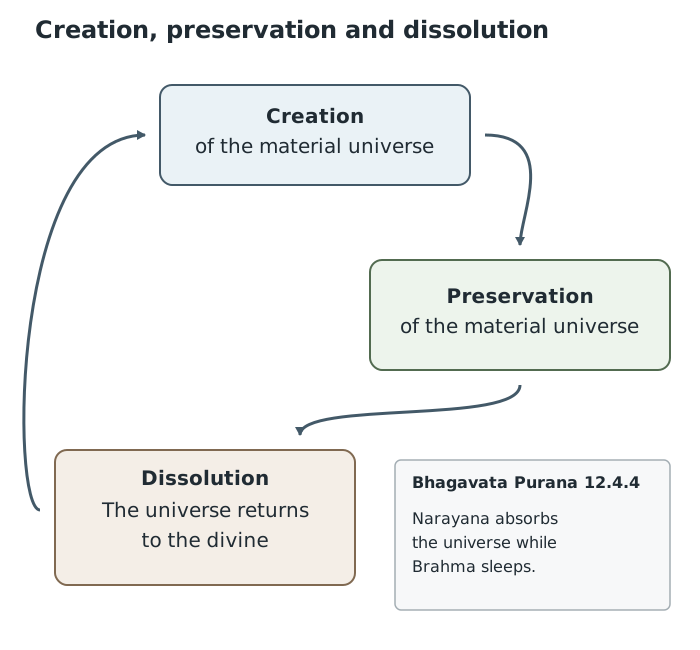
Hindu cyclical cosmology presents material creation and dissolution as recurring, with the universe remaining dependent on divine reality.
The cycle expresses a continuing relationship between the universe and divine reality. It should not be confused with a scientific prediction that the universe must repeatedly expand and contract.
In Bhagavad Gita 11.7, Krishna tells Arjuna to behold “the whole universe of moving and stationary beings” within one part of his body. Krishna is revealing his universal form: the passage presents the whole cosmos as contained within the divine.
“Moving and stationary beings” emphasises the breadth of what is included, not just human life. The universe is vast, yet it occupies only one part of Krishna’s form. This suggests that divine reality exceeds the material universe.
Unlike the Hymn of Creation’s questioning approach, this passage strongly expresses the universe’s dependence on the divine. It is not a timetable of how stars or planets formed. Its central concern is the relationship between the cosmos and Krishna.
The Big Bang theory explains the development of the universe from an extremely hot, dense early state. The universe expanded and cooled; matter formed, and gravity eventually drew matter together into stars and galaxies. It is not an ordinary explosion spreading into already-existing empty space: the explanation concerns the expansion of space itself.
Scientific explanations are assessed through evidence and observation. For example, radiation remaining from the early universe provides evidence about its past. A scientific account does not need to invoke a deity to explain these physical processes.
In Wonders of the Universe, science presenter Brian Cox explains how small differences in density in the early universe made later structures possible. Density describes how much matter is packed into a given space. As the universe expanded, slightly denser regions became increasingly dense, and atoms clumped together to form the first structures.
Cox describes these structures growing so massive that they collapsed under their own gravity. Hydrogen then fused, releasing enormous amounts of energy. He places the appearance of the first stars at 200 million years after the Big Bang. Planets subsequently formed and orbited stars, with solar systems forming part of galaxies.
His central point is that these structures owe their existence to “tiny density fluctuations” present when the observable universe was smaller than a grain of sand. This is an explanation through natural physical processes, rather than divine actions. It explains how a structured universe developed; it does not, by itself, settle whether the universe ultimately depends on a divine reality.
Non-religious thinkers, including Humanists and atheists, can therefore argue that natural explanations are sufficient for understanding the universe’s physical development. However, accepting the Big Bang is not the same as being an atheist: a religious believer can also accept the scientific account.
There are reasons to see compatibility. A Hindu could accept the Big Bang and Cox’s explanation of star formation as accounts of how the present universe developed while understanding scripture as explaining its divine foundation. Bhagavad Gita 11.7 does not specify a competing physical process. The Rig Veda’s questioning also leaves room for investigation and incomplete knowledge. Scientific discovery could therefore deepen understanding of a universe that a Hindu regards as dependent on the divine.
There are also reasons to see conflict. If accounts of divine bodies, cosmic sleep and absorption are treated as literal descriptions of physical events, they make claims that the scientific account does not establish. Repeated cosmic creation is also not demonstrated simply by evidence for the Big Bang. A non-religious critic may argue that adding divine agency is unnecessary when natural processes explain the observations. Conversely, a Hindu may argue that describing those processes does not explain why the universe exists at all.
A justified conclusion should distinguish agreement about physical development from disagreement about ultimate reality. The Big Bang and Hindu belief need not conflict, especially where scripture is interpreted symbolically. They conflict more strongly when either view is presented as excluding the other: a literal religious account may challenge scientific explanations, while an atheist interpretation may reject the divine dependence central to many Hindu accounts.
Get unlimited access to all revision notes, key terms, and exam tips.
Accepting the Big Bang does not automatically mean rejecting God.
Get unlimited access to all revision notes, key terms, and exam tips.
Use each passage for a distinct point: the Rig Veda explores uncertainty, Bhagavata Purana 12.4.4 describes dissolution, and Bhagavad Gita 11.7 connects the universe with the divine.
Distinguish Brahma, the creator deity, from Brahman, ultimate reality.
When evaluating conflict, explain whether you are comparing literal accounts of physical events or religious interpretations of meaning and dependence.
Do not claim that the Big Bang proves either that God exists or that God does not exist.
Explain Brian Cox’s account using tiny density differences, gravitational collapse and the formation of stars; do not treat his explanation of physical processes as proof that he rejects God.
Creation
The bringing into existence of the universe; in Hindu cosmology, material creation can occur repeatedly rather than only once.
Cyclical cosmology
A view of time in which creation, preservation and dissolution recur, rather than history having only one beginning and one final end.
Brahman
The ultimate reality in Hindu belief, from which the universe arises, by which it is sustained and into which it returns.
Big Bang theory
The scientific explanation that the universe expanded from an extremely hot, dense early state and has continued to expand and cool.
Humanism
A non-religious outlook which emphasises human reason, evidence and responsibility rather than divine authority.
Atheism
The absence of belief in God or gods.
Put your knowledge into practice — try past paper questions for Religious Studies
Creation
The bringing into existence of the universe; in Hindu cosmology, material creation can occur repeatedly rather than only once.
Cyclical cosmology
A view of time in which creation, preservation and dissolution recur, rather than history having only one beginning and one final end.
Brahman
The ultimate reality in Hindu belief, from which the universe arises, by which it is sustained and into which it returns.
Big Bang theory
The scientific explanation that the universe expanded from an extremely hot, dense early state and has continued to expand and cool.
Humanism
A non-religious outlook which emphasises human reason, evidence and responsibility rather than divine authority.
Atheism
The absence of belief in God or gods.