Loading…


Loading…
Loading…
Loading…
Eduqas GCSE Religious Studies · C120
Eduqas C120 · The World and Its Origins in Christianity Check the specification (PDF) (opens in a new tab)
Christians believe that the universe exists because God created it. Creation is therefore understood as deliberate and purposeful, not simply an event without a divine intention. The belief in creation ex nihilo, meaning ‘creation out of nothing’, expresses God’s power: God did not need materials that already existed in order to create.
The two creation accounts in Genesis, the first book of the Bible, are central sources of authority for Christian beliefs about origins. They have different emphases. Genesis 1 presents the ordered creation of the whole world, while Genesis 2 focuses more closely on human beings and their relationship with God. Christians differ over how literally these accounts should be read.
Genesis 1 describes God creating through his command. Creation unfolds in an ordered sequence:
On the seventh day, God rests; this completes the creation account at the beginning of Genesis 2.
For Christians, the account teaches more than a sequence of events. God’s ability to bring creation into existence reveals his omnipotence, or unlimited power. Its order suggests intention rather than an accident. Genesis 1:31 describes the completed creation as ‘very good’, showing its goodness and value. Human beings are made in God’s image, giving humanity a special relationship with God.
In Genesis 2, God forms Adam from the dust of the ground and breathes life into him. This presents human life as dependent on God and shows God’s close involvement with humanity. God places Adam in the Garden of Eden and later forms Eve from Adam’s rib as his companion.
The focus is personal: God gives life, provides a place for humans to live and establishes relationships. Eve’s creation also highlights the importance of companionship. Where Genesis 1 gives a broad account of the universe, Genesis 2 concentrates on humanity’s place within creation.
Some literalist Christians regard the creation accounts as factually true descriptions of what happened. They may understand the six days as ordinary days and believe that God directly created the world in the sequence described. Their reason is the authority of the Bible: if it is God’s word and without error, its account should be trusted even when scientific explanations appear to disagree.
Many non-literalist Christians, including many liberal Christians, understand Genesis as communicating religious truths rather than providing a scientific description. They regard the Bible as inspired by God but written by people in a pre-scientific age. On this reading, the six-day structure expresses order and purpose; it need not establish the timescale of creation.
These Christians can accept scientific discoveries while retaining the teachings that God is the Creator, creation is good and human life has value. The disagreement is therefore often about how scripture communicates truth, not simply whether scripture matters.
The Big Bang theory explains the development of the universe from an extremely hot, dense early state. As the universe expanded and cooled, matter could form atoms and later stars and planets. Evidence such as the universe’s expansion and background radiation supports this scientific explanation. Background radiation is understood as radiation remaining from the early universe.
Physicist and science presenter Brian Cox explains how tiny differences in density helped produce the structures we see today. As the universe expanded, slightly denser regions became increasingly dense, and atoms clumped together. These structures grew massive enough to collapse under their own gravity. Hydrogen then fused, releasing enormous amounts of energy and producing shining stars.
In his Wonders of the Universe explanation, Cox places the appearance of the first stars at 200 million years after the Big Bang. He describes planets subsequently forming and orbiting stars, with solar systems within galaxies. His central point is that these structures depended on tiny early density fluctuations, present when the observable universe was smaller than a grain of sand.
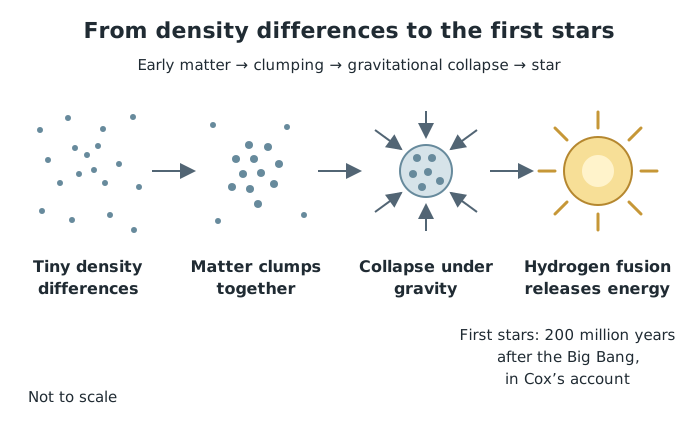
Cox connects tiny early density differences to the formation of stars through clumping, gravity and hydrogen fusion.
This explanation identifies natural processes that link the early universe to later structures. It does not, by itself, settle whether those processes have a divine purpose.
Humanists generally favour scientific investigation and evidence over religious authority as the way to understand the universe’s origins. They regard creation stories as cultural or symbolic accounts rather than factual scientific explanations. Atheists do not believe in God, so an atheist may accept that the universe developed through natural processes without a divine creator.
This is not the same as saying that everything happened without causes: Cox’s explanation includes specific causes, such as gravity and density differences. Nor does accepting the Big Bang automatically make someone an atheist. A Christian scientist can accept the same physical explanation while believing that God is ultimately responsible for the universe.
There is a strong case for conflict with a literal reading. Creation in six ordinary days and the sequence in Genesis differ from a scientific account of development over billions of years. A literalist may prioritise biblical authority; a Humanist may argue that explanations supported by observable evidence are more reliable than a literal creation narrative.
There is also a strong case for compatibility with a non-literal reading. Many Christians argue that science explains how the universe developed, while religion addresses why it exists and what its purpose is. They may believe that the Big Bang was the means through which God created. Explaining a natural mechanism would not then remove God as the ultimate Creator.
However, compatibility is not proof of God. A non-religious person can respond that the scientific account does not require a divine explanation, and that an unanswered question about origins is not evidence that God caused them.
A justified conclusion should distinguish these positions. The Big Bang creates substantial difficulties for a literal six-day account, but it does not necessarily contradict the broader Christian belief that God created the universe. The extent of conflict depends on both the interpretation of Genesis and whether a divine purpose is accepted.
Get unlimited access to all revision notes, key terms, and exam tips.
Get unlimited access to all revision notes, key terms, and exam tips.
Use ‘some Christians’ or ‘many Christians’ when explaining interpretations of Genesis; Christians do not all read it in the same way.
Support explanations with precise references, such as Genesis 1:31, and explain how the teaching supports the belief.
For Brian Cox’s view, explain the role of tiny density fluctuations, gravity and the formation of stars, rather than only defining the Big Bang.
In an evaluation, distinguish conflict with a literal reading of Genesis from conflict with belief in God. Give reasons for your conclusion.
Do not treat scientific explanations as necessarily atheistic, or claim that the Big Bang proves or disproves God.
Creation ex nihilo
The belief that God brought the universe into existence out of nothing, rather than making it from pre-existing material.
Literal interpretation
An interpretation that treats a text as a factual account of events happening as described; in creation debates, this can include six ordinary days of creation.
Non-literal interpretation
An interpretation that understands a text as communicating religious truths through imagery or symbolism, rather than necessarily describing events exactly as they happened.
Big Bang theory
The scientific theory that the universe expanded from an extremely hot, dense early state and has continued to expand.
Omnipotence
Having unlimited power; Christians believe God has the power to create the universe.
Atheist
A person who does not believe in God or gods.
Humanist
A person whose non-religious approach emphasises human reason, evidence and responsibility rather than divine authority.
Put your knowledge into practice — try past paper questions for Religious Studies
Creation ex nihilo
The belief that God brought the universe into existence out of nothing, rather than making it from pre-existing material.
Literal interpretation
An interpretation that treats a text as a factual account of events happening as described; in creation debates, this can include six ordinary days of creation.
Non-literal interpretation
An interpretation that understands a text as communicating religious truths through imagery or symbolism, rather than necessarily describing events exactly as they happened.
Big Bang theory
The scientific theory that the universe expanded from an extremely hot, dense early state and has continued to expand.
Omnipotence
Having unlimited power; Christians believe God has the power to create the universe.
Atheist
A person who does not believe in God or gods.
Humanist
A person whose non-religious approach emphasises human reason, evidence and responsibility rather than divine authority.