Loading…


Loading…
Loading…
Loading…
Eduqas GCSE Mathematics · C300
Eduqas C300 · HG25 Vector Arithmetic and Proofs Check the specification (PDF) (opens in a new tab)
A vector has both magnitude and direction. An arrow represents it: the arrow's length shows its magnitude, and the arrowhead shows its direction. The notation means the movement from A to B. A vector may also be named with a bold letter, such as ; in handwriting, you can underline the letter instead.
A column vector records the horizontal and vertical parts of this movement:
The top entry gives horizontal movement: positive means right and negative means left. The bottom entry gives vertical movement: positive means up and negative means down. For example, means 1 unit right and 2 units up.
A point's coordinates describe a location; a vector describes a movement. If and , subtract the starting coordinates from the finishing coordinates:
Vectors are equal when they have the same magnitude and direction, even if their arrows start in different places. You can therefore slide an arrow to a new starting point without changing the vector, provided you do not rotate it or change its length.
Adding vectors means making one movement followed by another. Draw the first arrow, then place the tail of the second arrow at the head of the first. The resultant vector joins the original starting point directly to the final finishing point.
For three points A, B and C, travelling from A to B and then B to C gives the same overall movement as travelling directly from A to C:
Column notation records the same process by adding corresponding components. Suppose and . The first movement is 5 right and 2 down; the second is 3 left with no vertical movement. Therefore:
The overall movement is 2 right and 2 down. Reversing the order of these two movements reaches the same finishing point, so .
The vector has the same length as but points in the opposite direction. Subtraction means adding this reversed vector:
Using the same vectors, is 3 left, so is 3 right. After making movement , move another 3 right:
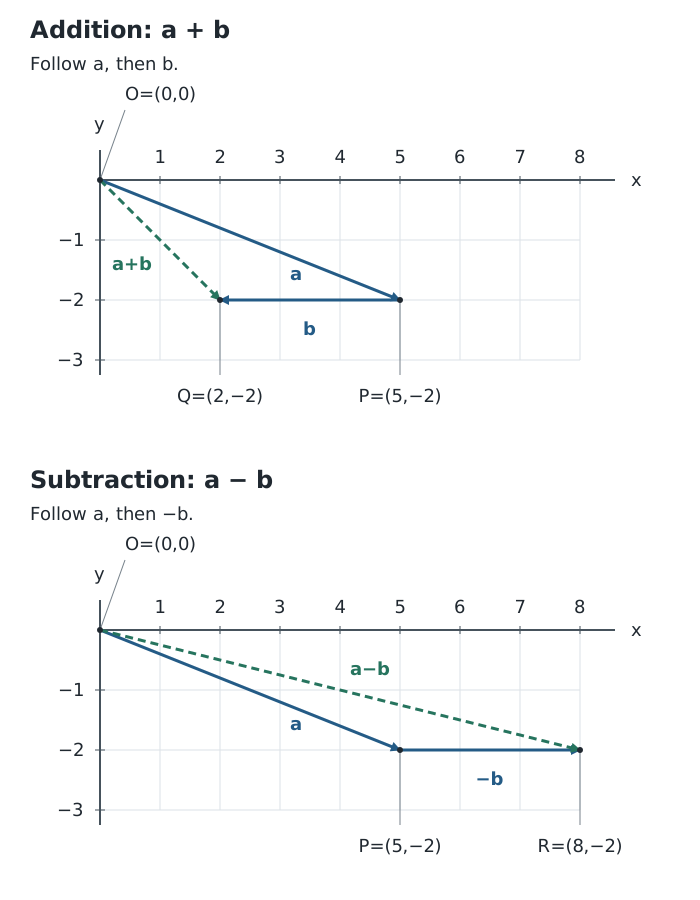
Addition follows the second vector; subtraction follows its reverse. The resultant joins the first starting point to the final finishing point.
Reversing a named arrow follows the same rule: . Unlike addition, subtraction depends on the order: is the reverse of .
A scalar is a number with no direction. To multiply a vector by a scalar, multiply both components by that number. For example, if , then:
Both movements are tripled, so the arrow becomes three times as long while keeping its direction.
For a non-zero vector, multiplying by a positive number greater than 1 stretches the arrow; multiplying by a positive number between 0 and 1 shortens it. For instance, becomes when doubled, or when halved.
A negative multiplier also reverses the direction. Multiplication by doubles the length and reverses the arrow; multiplication by only reverses it. Multiplication by 0 gives , the zero vector: there is no movement and no direction.
Vector arithmetic also works when vectors are given as letters rather than columns. In rectangle ABCD, let and . Opposite sides have equal lengths, and the arrows from A to B and D to C point in the same direction, so .
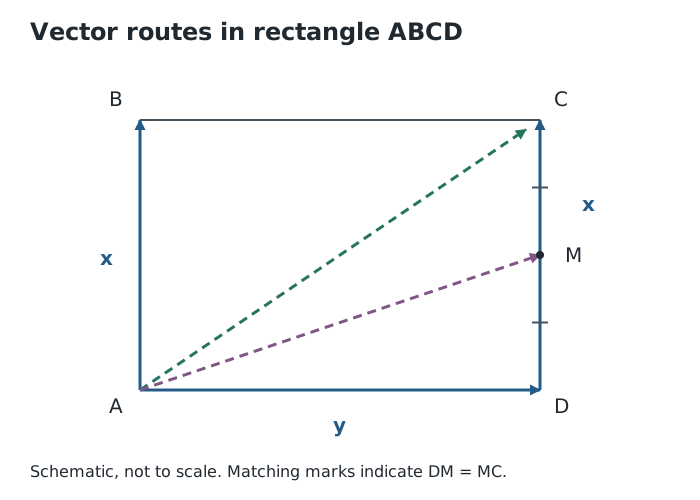
In rectangle ABCD, the upward vectors AB and DC are equal. Since M is the midpoint of CD, DM is half of DC.
To find , take the route A to D to C:
For , take B to A to D. The first part goes against the arrow for :
If M is the midpoint of CD, the movement from D to M is half of the movement from D to C. Hence:
The same route method works with longer expressions. If and , then:
Collect the terms together and the terms together, just as you would collect like terms in algebra.
When two vectors start at the same point O, a route from A to B goes back to O and then out to B. Thus . For example, if and :
Get unlimited access to all revision notes, key terms, and exam tips.
Get unlimited access to all revision notes, key terms, and exam tips.
For a vector between two points, subtract the starting coordinates from the finishing coordinates.
Keep horizontal and vertical components in their own rows. Show the component calculations before simplifying.
When subtracting a vector expression, put it in brackets first: subtracting changes the sign of every term.
Write a route between the required points before substituting vector expressions. Travelling against an arrow gives the negative of that vector.
A midpoint halves the vector along that particular side, not every vector in your route.
Vector
A quantity with both magnitude (size) and direction, represented by a directed arrow or by components.
Magnitude
The size or length of a vector, regardless of its direction.
Component
One part of a vector's movement in a specified direction. In two dimensions, the horizontal and vertical components form the top and bottom entries of a column vector.
Column vector
A representation of a two-dimensional vector as , with horizontal movement above vertical movement.
Scalar
A number with no direction that can multiply a vector, scaling both of its components.
Resultant vector
The single vector representing the overall movement produced by adding vectors.
Put your knowledge into practice — try past paper questions for Mathematics
Vector
A quantity with both magnitude (size) and direction, represented by a directed arrow or by components.
Magnitude
The size or length of a vector, regardless of its direction.
Component
One part of a vector's movement in a specified direction. In two dimensions, the horizontal and vertical components form the top and bottom entries of a column vector.
Column vector
A representation of a two-dimensional vector as , with horizontal movement above vertical movement.
Scalar
A number with no direction that can multiply a vector, scaling both of its components.
Resultant vector
The single vector representing the overall movement produced by adding vectors.
If M is the midpoint of BC, . Choose a connected route, substitute the given vectors and collect like vector terms.