

Loading…
Loading…
Loading…
Eduqas GCSE History · C100
Eduqas C100 Check the specification (PDF) (opens in a new tab)
The First Crusade had established Christian-ruled states in the eastern Mediterranean, but their survival was not secure. They needed troops, supplies and cooperation to defend themselves against neighbouring Muslim rulers. The capture of Edessa by Zangi, ruler of Mosul and Aleppo, on 24 December 1144 was the immediate trigger for the Second Crusade. It showed that the gains of the First Crusade could be lost.
Edessa's fall also caused religious outrage in western Europe. Western Christians in the city were killed or enslaved, and appeals for help made the danger to the other Crusader states seem urgent. When an attempt to recover Edessa failed in 1146, Zangi's successor, Nur ad-Din, punished the city severely. Recovering the original position was becoming increasingly difficult.
Pope Eugenius III formally called for a crusade on 1 December 1145. His appeal emphasised protecting eastern Christians, holy relics and the achievements of the First Crusade. Although Edessa's fall prompted the expedition, the appeal did not establish a precise military target. This distinction matters: defending the Crusader states was a broad purpose, not an agreed plan for where to fight.
Bernard of Clairvaux, an influential abbot, preached in support of the expedition and helped recruit participants. Religious rewards encouraged volunteers: those who joined were promised remission of sins. Protection for their families and property, together with relief from interest on loans, also helped make a long absence possible.
The main armies were led by Louis VII of France and Conrad III of Germany. This was the first crusade personally led by western kings. Their involvement brought prestige and substantial forces, but two kings did not automatically produce a single command or a shared strategy.
Other leaders had different priorities. Manuel I Komnenos, the Byzantine emperor, wanted to protect his empire while the crusaders crossed it. Raymond of Antioch wanted action in northern Syria. Baldwin III of Jerusalem later joined Louis and Conrad in the attack on Damascus. The western kings therefore had to cooperate both with each other and with rulers who understood local conditions but had their own interests.
Muslim opposition was also important. Seljuk forces threatened the armies crossing Asia Minor, while Nur ad-Din's power in northern Syria threatened the Crusader states. Failure resulted partly from these opponents' effective resistance, not only from Christian mistakes.
The armies travelled through Byzantine territory to Constantinople in 1147. Manuel feared that large western forces might threaten his lands rather than simply pass through them. He demanded assurances of allegiance and insisted that supplies should be paid for. Looting by crusaders and clashes with Byzantine troops increased hostility.
Western suspicions deepened when the crusaders discovered that Manuel had made a truce with the Turks. To Manuel, this helped protect his empire; to some crusaders, it appeared to show that he was cooperating with their enemies. These different interpretations made practical cooperation harder.
However, distrust should not be confused with proof of deliberate betrayal. Manuel advised the armies to follow the safer coastal route through Asia Minor. Ignoring local advice contributed to their difficulties. Byzantine policy was shaped by the empire's own security needs, which were not identical to the crusaders' objectives.
Conrad's army advanced into the interior of Asia Minor without adequate preparation for the harsh conditions. Food shortages and an underestimate of travelling time made it vulnerable. On 25 October 1147, Seljuk forces defeated the Germans near Dorylaeum. Mobile archers could harass the slower-moving army, and Conrad was wounded during the fighting. The survivors retreated.
Louis continued eastwards, but his army also suffered. On 7 January 1148, it was badly defeated while crossing the Cadmus Mountains. Its forces had become stretched out and separated, allowing the Seljuks to attack vulnerable sections. Difficult terrain therefore became especially dangerous when combined with poor coordination and effective enemy tactics.
Louis and his mounted troops eventually travelled by sea towards the Holy Land, while infantry left to continue overland suffered further devastating losses. By the time the crusaders reached their destination, the expedition had already lost much of its fighting strength. These were not merely difficulties along the way: they reduced the forces available for the decisive campaign.
Louis reached Antioch in March 1148. Raymond proposed campaigning in northern Syria, but Louis rejected this and travelled south. This disagreement prevented a united strategy between the newly arrived crusaders and Antioch.
At a council at Acre in 1148, the leaders chose to attack Damascus, rather than recover the devastated Edessa. Damascus was a wealthy, prestigious city close to Jerusalem. Capturing it could strengthen Jerusalem's position and provide a major achievement after the losses on the journey. There was also concern that Damascus might become aligned with Nur ad-Din.
Yet the choice was risky. Damascus had previously cooperated with the Kingdom of Jerusalem against other Muslim powers. Attacking it threatened a potentially useful relationship. The decision illustrates a central problem: the leaders wanted a worthwhile victory, but they had not developed a consistent strategy from the beginning.
The crusaders began besieging Damascus on 24 July 1148. They faced determined defenders, difficult defences and fierce fighting. Their weakened forces made little progress, while shortages of water and supplies threatened their ability to remain outside the city.
The prospect of a relief army from Nur ad-Din made time critical. If the crusaders could not capture Damascus quickly, they risked being trapped between its defenders and an approaching Muslim force. Arguments among the crusaders further weakened cooperation. After only four days, the siege was abandoned.
Conrad returned to Europe in September 1148, and Louis followed in 1149. Edessa had not been recovered and Damascus had not been captured. The principal eastern campaign had failed. This does not mean that every campaign associated with the Second Crusade failed: crusaders helped capture Lisbon in 1147. Success elsewhere, however, did not rescue the expedition's main eastern purpose.
The causes worked together rather than separately. Poor planning and logistics weakened the armies on the journey and again at Damascus. Divided leadership prevented a clear strategy. Suspicion damaged cooperation with Byzantium, while effective Muslim attacks and resistance exploited these weaknesses.
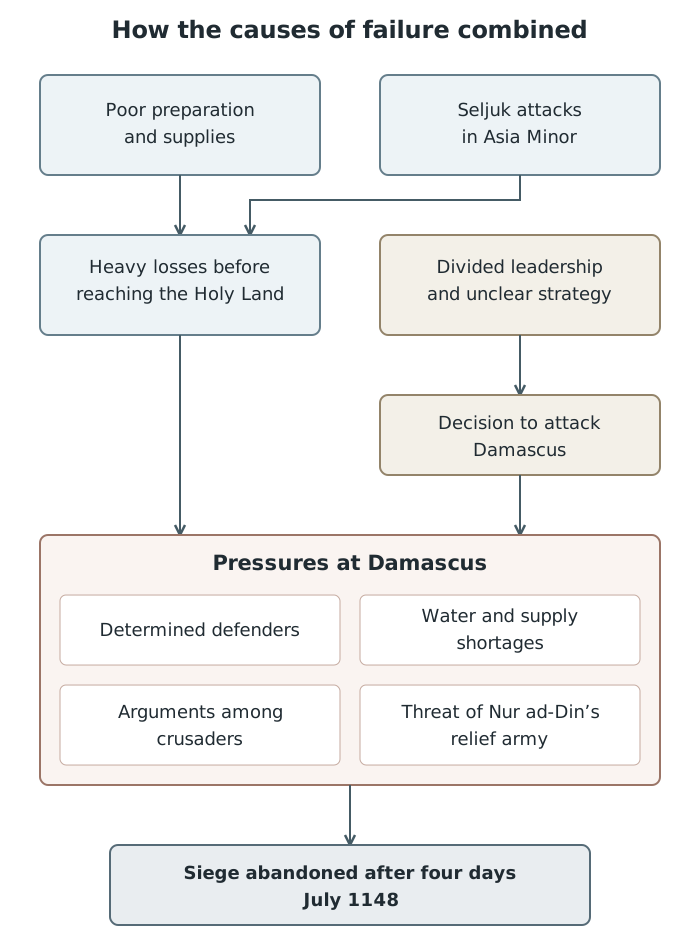
The expedition's earlier weaknesses reduced its ability to overcome the immediate problems at Damascus.
A strong judgement is that poor planning and logistics were the most persistent causes, because they undermined both the journey and the final siege. Nevertheless, leadership disagreements help explain why the already weakened armies attempted such a risky attack, and Muslim resistance explains why those mistakes proved fatal.
Afterwards, some crusaders blamed bribery or Byzantine interference. Such accusations reveal their bitterness, but do not establish that betrayal caused the defeat. An explanation based on identifiable military losses, supply shortages, divided decisions and the threat of relief is more convincing than one resting on unproven accusations.
24 July 1148: siege of Damascus began; abandoned after four days. Conrad left in 1148 and Louis in 1149. Neither Edessa nor Damascus was captured.
Poor planning and logistics were recurring weaknesses; divided leadership and effective Muslim resistance made them decisive. Accusations of betrayal were not proof. Failure in the East should be distinguished from success at Lisbon in 1147.
Explain how each factor caused failure: losses in Asia Minor mattered because they left fewer troops available for the siege of Damascus.
Distinguish the original trigger, the fall of Edessa, from the eventual target, Damascus.
For a judgement about the main cause, compare factors and show how they interacted. Do not simply list problems.
Treat accusations of Byzantine betrayal or bribery as claims, not established explanations.
It can see this note and what your specification asks for.
Answers are free with an account.
1 free note left this week
Get more free notesYour answer sets when this note comes back for review, or marks it complete.
Was this note helpful?
Log in to tell us whether it helped, or to report a problem.
Last updated
Second Crusade
The papally supported military expedition of 1147–1149, launched after the fall of Edessa to defend the Crusader states. Its principal campaign in the eastern Mediterranean failed.
Crusader state
The Christian-ruled territories established in the eastern Mediterranean following the First Crusade, including Edessa, Antioch, Tripoli and Jerusalem.
Edessa
A Crusader city and county whose capture by Zangi in December 1144 prompted calls for the Second Crusade.
Byzantine Empire
The eastern Roman empire, governed from Constantinople, through whose territory the French and German crusading armies travelled.
Asia Minor
The peninsula forming much of modern Turkey, also called Anatolia, where the Second Crusade's armies suffered severe losses.
Logistics
The organisation of supplies, transport and other practical support needed to keep an army operating.
Siege
An attempt to capture a fortified place by surrounding it, cutting off supplies and attacking its defences.
Relief army
A force sent to help a place under attack, potentially forcing the attackers to fight or withdraw.
Put your knowledge into practice — try past paper questions for History
Second Crusade
The papally supported military expedition of 1147–1149, launched after the fall of Edessa to defend the Crusader states. Its principal campaign in the eastern Mediterranean failed.
Crusader state
The Christian-ruled territories established in the eastern Mediterranean following the First Crusade, including Edessa, Antioch, Tripoli and Jerusalem.
Edessa
A Crusader city and county whose capture by Zangi in December 1144 prompted calls for the Second Crusade.
Byzantine Empire
The eastern Roman empire, governed from Constantinople, through whose territory the French and German crusading armies travelled.
Asia Minor
The peninsula forming much of modern Turkey, also called Anatolia, where the Second Crusade's armies suffered severe losses.
Logistics
The organisation of supplies, transport and other practical support needed to keep an army operating.
Siege
An attempt to capture a fortified place by surrounding it, cutting off supplies and attacking its defences.
Relief army
A force sent to help a place under attack, potentially forcing the attackers to fight or withdraw.