

Loading…
Loading…
Loading…
Eduqas GCSE Geography B · C112
Eduqas C112 · 1.2.5 Leisure Use Issues Check the specification (PDF) (opens in a new tab)
Leisure is what people do in their free time for enjoyment, relaxation or recreation. It includes a local resident walking in a park as well as a visitor taking a holiday. Tourism involves travelling to a place for leisure, recreation or learning, so it is connected to leisure but is not the same thing: not every leisure user is a tourist.
Urban and rural areas offer different opportunities. Towns and cities concentrate people, facilities and transport connections. This supports museums, theatres, restaurants, sports venues and other attractions that need many customers. London’s Tate Modern provides cultural leisure, while Hyde Park provides space for walking and outdoor recreation. London’s South Bank combines theatres, restaurants and attractions such as the London Eye, drawing visitors alongside local users.
Rural areas attract people through scenery, open space and opportunities to enjoy the outdoors. Walking, cycling, climbing and sightseeing are important in the Lake District, Eryri/Snowdonia and the Yorkshire Dales. Coastal areas such as Cornwall offer beaches, coastal walks and water sports. Rural leisure is not confined to countryside walks: villages, farm shops, festivals and accommodation also form part of the visitor experience.
Leisure can improve health and wellbeing by providing opportunities for exercise, relaxation and cultural experiences. Residents benefit from having facilities nearby; visitors gain access to attractions and activities they may not have at home. Investment in parks, public spaces and transport can improve a place for both groups.
Visitor spending also supports employment. A visitor paying for accommodation, meals or an activity provides income for those businesses. The benefits can spread further when businesses buy supplies or employ local tradespeople. In rural areas, tourism can diversify the economy, reducing reliance on farming alone. Visitors may help sustain shops and transport services that residents also use.
However, benefits are not shared equally. Tourism jobs are often seasonal and low-paid, so employment may not provide a reliable year-round income. Shops may increasingly sell souvenirs or expensive visitor goods rather than everyday products needed by residents. Demand for holiday homes can push up house prices, making it harder for local people to find affordable housing.
Concentrated leisure use also creates competition for space and services. Residents near nightlife areas may experience noise and litter, while crowds increase demand for roads, parking and public transport. Visitors face queues, congestion and higher costs. In rural areas, narrow roads and limited parking can make these pressures particularly difficult to accommodate.
The balance therefore depends on the type and intensity of use. A popular attraction may help a café owner earn a living while making nearby residents’ journeys slower. Leisure is not simply beneficial or harmful: its effects depend on who gains, who bears the costs and how well pressures are managed.
A honeypot site attracts a particularly large concentration of visitors. The problem is not just the total number of people visiting a region, but their concentration in particular places and times. Busy lakeshores, viewpoints and popular walking routes can experience much greater pressure than less-visited countryside nearby.
Repeated walking tramples vegetation. Once plant cover is damaged, soil is more exposed and can be washed away by rainwater. Paths and lakeshores become eroded, damaging habitats and making routes less attractive. If people avoid a damaged section by walking beside it, they can spread the trampling over a wider area.
More visitors can also mean more litter, disturbance to wildlife and traffic-related air and noise pollution. Cars parked on verges may damage vegetation or obstruct access. Water use, sewage disposal and other services come under additional pressure when visitor numbers rise.
Social effects are closely connected to these environmental pressures. Residents may lose the peace and quiet they value or find their everyday journeys disrupted. Visitors who came for scenery and tranquillity may instead encounter crowds and damaged landscapes. This creates a central challenge: unmanaged leisure use can harm the very qualities that attract people.
Windermere is in the Lake District National Park in north-west England. At 17 km long, it is England’s longest lake. Visitors use the lake and its surroundings for sailing, kayaking, boat trips and lakeside walking. Windermere Lake Cruises carried over 1.3 million users in 2022, showing the popularity of this particular attraction rather than the total number of visitors to the area.
The wider Lake District received 17.45 million tourists in 2025. Their spending supports accommodation, cafés, shops, transport and attractions, but high visitor numbers also create congestion, housing pressure and environmental damage.
At Windermere, walking along the lakeshore damages plants and exposes soil to erosion. As soil is washed away, a stony shore can remain instead of reeds and other water-loving plants. Leisure activities also compete with each other: fast motor boats, jet skis and water skiing can endanger people in smaller, slower craft.
Management therefore needs to protect the landscape and allow different users to enjoy it, without removing the economic benefits of tourism.
A 10 mph speed limit came into force on Windermere in 2005. It was introduced to allow smaller vessels, including sailing boats and kayaks, to use the lake more safely without being endangered by fast-powered activities. The lake has its own rangers and patrol boats during the summer months.
This approach sets a clear rule for a shared space. It favours safer access for slower craft rather than allowing unrestricted high-speed recreation. However, it was controversial: businesses associated with affected activities had to diversify to continue trading. A measure that benefits one group of leisure users can reduce opportunities and income for another.
Some sections of the lakeshore have been cordoned off to allow natural habitats to regrow. Keeping walkers away interrupts the trampling that damages vegetation. This addresses the cause of erosion rather than only dealing with soil after it has been lost.
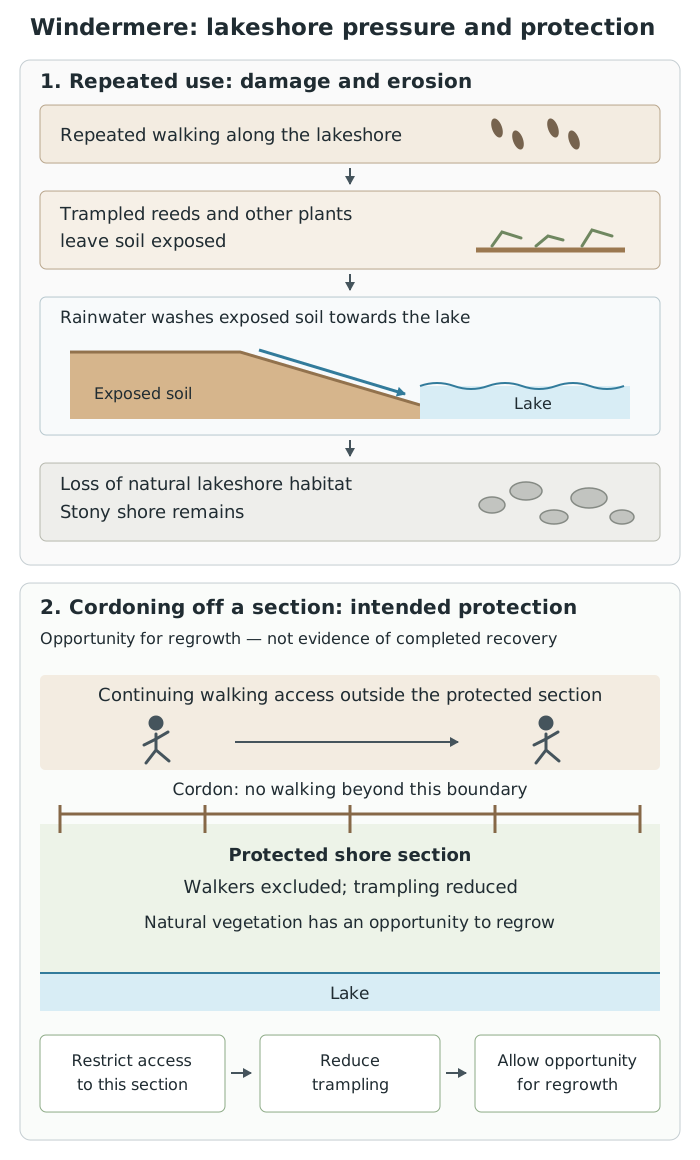
Trampling exposes lakeshore soil to erosion. Restricting access to selected sections gives natural vegetation an opportunity to regrow.
The trade-off is reduced access to those particular sections of shore. Protection depends on people respecting the barriers, and managing one section does not remove visitor pressure elsewhere around the lake. Lakeshore erosion remains a continuing problem, so cordoning off areas should not be treated as a complete solution.
Windermere’s measures are useful because they address specific pressures. The speed limit tackles conflict between fast and slow water-based activities; lakeshore restrictions give damaged vegetation an opportunity to recover. Together, they seek to maintain leisure use while reducing harm, rather than closing the area to visitors.
Their limitations matter. Restricting speed imposes costs on some users and businesses. Restricting access to parts of the shore protects habitats but reduces where people can walk. Neither measure directly solves traffic congestion, housing pressures or all forms of water pollution.
Overall, the strategy is a reasonable compromise between recreation, conservation and local livelihoods, but it is not a complete solution to intensive leisure use. Its effectiveness should be judged through safer shared use, the condition of protected shorelines and the continuing ability of local businesses to operate—not simply by whether rules and barriers have been introduced.
Concentrated visitors → trampling → vegetation loss → exposed soil → erosion.
Other pressures: litter, habitat disturbance, traffic pollution, parking problems, strained services and conflict with residents. Visitor spending can support businesses and conservation.
Distinguish local residents from leisure users: the same development may provide jobs for residents but also create noise, while visitors gain facilities but experience crowding.
Explain impact chains rather than listing effects: trampling removes vegetation, leaving exposed soil that can be washed away.
Use precise case-study details, such as Windermere’s 10 mph speed limit introduced in 2005. Do not confuse figures for Windermere with those for the whole Lake District.
When evaluating management, explain how a measure works, who benefits, its limitations and your overall judgement. An intended benefit is not proof of a measured improvement.
It can see this note and what your specification asks for.
Answers are free with an account.
1 free note left this week
Get more free notesYour answer sets when this note comes back for review, or marks it complete.
Was this note helpful?
Log in to tell us whether it helped, or to report a problem.
Last updated
Leisure
An activity undertaken in free time for enjoyment, relaxation or recreation.
Tourism
Travel to a place for leisure, recreation or learning.
Honeypot site
A place that attracts a particularly large concentration of visitors.
Erosion
The wearing away and removal of soil or rock, for example when rainwater washes exposed soil from a heavily used path.
Seasonal employment
Employment available mainly during particular parts of the year, such as the summer tourist season.
Sustainable tourism
Tourism managed to support the economy and visitor enjoyment while protecting the environment and local communities for the future.
Put your knowledge into practice — try past paper questions for Geography B
Leisure
An activity undertaken in free time for enjoyment, relaxation or recreation.
Tourism
Travel to a place for leisure, recreation or learning.
Honeypot site
A place that attracts a particularly large concentration of visitors.
Erosion
The wearing away and removal of soil or rock, for example when rainwater washes exposed soil from a heavily used path.
Seasonal employment
Employment available mainly during particular parts of the year, such as the summer tourist season.
Sustainable tourism
Tourism managed to support the economy and visitor enjoyment while protecting the environment and local communities for the future.
Judgement: targeted measures help balance recreation and protection, but ongoing erosion and wider tourism pressures mean they are not a complete solution.