

Loading…
Loading…
Loading…
Eduqas GCSE Geography B · C112
Eduqas C112 · 2.2.4 Check the specification (PDF) (opens in a new tab)
River flood management is controversial because protecting one place can change the risks faced elsewhere. A drainage basin is the area drained by a river and its tributaries. Water moves through this connected system, so a decision upstream—closer to the river’s source—can affect communities downstream, towards its mouth.
A stakeholder is anyone with an interest in a decision or affected by its outcome. Residents, farmers, businesses, councils and the Environment Agency may all want less flooding, but disagree about where protection should be provided and how it should be achieved. Limited funding and space mean that not every place can receive the same protection.
A catchment-based approach considers the whole drainage basin rather than treating each flooded location separately. This can improve overall protection, but it raises a difficult question: is it fair for one community to accept flooding so that another is safer?
A stakeholder’s view is their opinion about a proposal. Their values are the things they consider important, such as protecting homes, maintaining farming livelihoods or conserving wildlife. Their attitude is their broader outlook towards management, such as favouring visible engineering works or working with natural river processes.
These differences have practical roots. A farmer whose income depends on productive land may favour drainage and object to using fields for flood storage. A resident whose home has flooded may prioritise rapid action, while a downstream resident may worry that faster drainage will send more water towards their neighbourhood. Business owners have an interest in protecting premises, stock and access routes.
Public bodies have wider responsibilities. The Environment Agency must consider flood risk across connected locations, environmental damage and the effectiveness of spending. Politicians face pressure to respond visibly to people’s immediate losses. People who value river habitats may oppose works that damage aquatic wildlife, even when other stakeholders see those works as essential protection.
These are not simply disagreements between people who understand flooding and people who do not. Stakeholders experience different risks and may place different weight on the same benefits and costs.
In early 2014, widespread flooding affected the Somerset Levels and Moors, particularly the Parrett and Tone catchments. This very flat, low-lying landscape has long depended on drainage. The Environment Agency estimated that 100 million cubic metres of floodwater covered 65 square kilometres, and 172 properties flooded. Residents of Northmoor had to leave their homes, while other communities were cut off.
Many local residents, farmers and politicians argued that reduced dredging had worsened the floods. Dredging removes sediment from river channels, increasing their capacity and helping water pass through them. Supporters wanted floodwater removed more rapidly, protecting homes and restoring productive farmland. For farmers, maintaining drainage was also associated with good farming practice.
The Environment Agency and several flooding specialists challenged the idea that dredging alone would have prevented the disaster. River channels hold relatively little water compared with the amount arriving from the whole catchment during exceptional rainfall. Specialists also argued that Somerset’s very flat landscape limited how quickly water could drain towards the sea. Removing sediment would not remove all these constraints, and sediment could build up again, requiring further work.
There was also disagreement about consequences elsewhere. In January 2014, hydrologist Ola Holmstrom warned that improving the movement of water through Muchelney could increase flood risk in Bridgwater downstream. This was a warning about transferring risk, not a finding that dredging had caused flooding in Bridgwater.
The controversy became intense because flooded households wanted an immediate, tangible response, while specialists emphasised the whole catchment and longer-term consequences. Anger over perceived failures made proposals that took longer to implement appear to some residents like inaction.
If upstream management sends water downstream more quickly, downstream channels may receive more water than they can safely carry. Flood risk can therefore be transferred rather than removed. Whether this happens depends on river conditions and the timing of flows: faster drainage does not automatically cause a downstream flood.
Where extra flooding occurs, economic impacts can include repair costs for homes and business premises, damage to stock and equipment, and lost income while businesses or transport routes are closed. Public money may also be needed for recovery and additional defences.
Social impacts include people leaving their homes, stress, disruption to daily life and communities becoming isolated by flooded roads. Somerset’s 2014 evacuations and cut-off settlements show why flood management decisions matter beyond the river channel itself.
Upstream management can also benefit downstream communities. Allowing suitable land to store floodwater temporarily reduces the amount moving downstream during the flood peak. This can protect homes, businesses and access routes. However, the land used for storage bears a cost: farmers may lose earnings, and rural communities may experience disruption. A benefit downstream can therefore create controversy upstream.
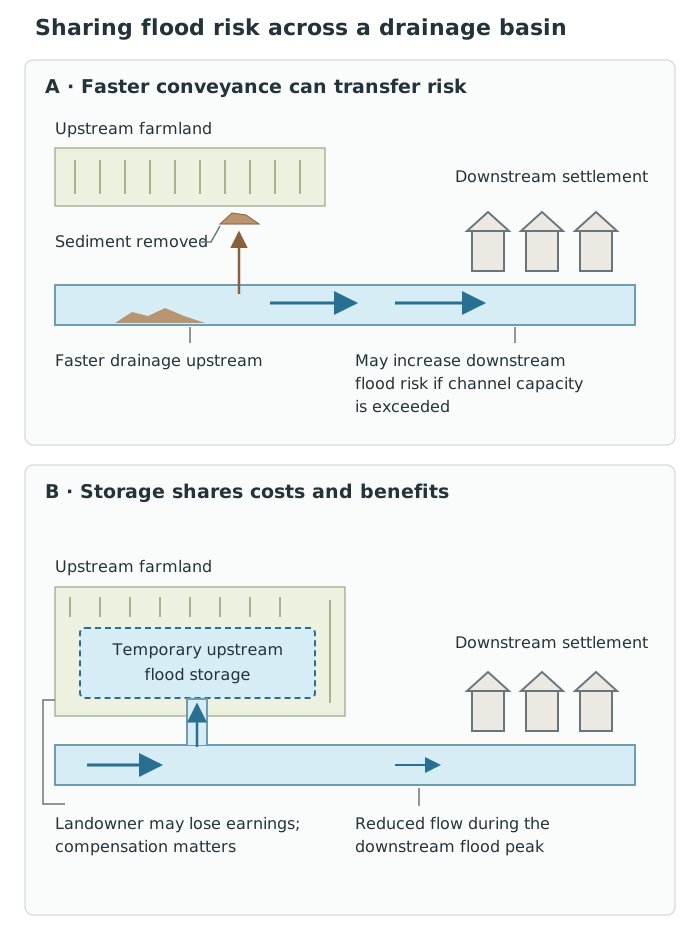
Managing water upstream can transfer risk downstream or reduce it, but the costs and benefits fall on different people.
The important distinction is between reducing risk across the basin and merely moving it from one location to another. Even pumping has this constraint. In Somerset, the Environment Agency cannot pump additional water into a receiving river that is already full, because this could cause overtopping and increase flood risk elsewhere.
A strong evaluation considers effectiveness, fairness and timescale together. Dredging may help water move through particular channels, but it should not be assumed to solve exceptional flooding throughout a catchment. Flood storage may protect downstream communities, but treating rural land as available storage without considering livelihoods would also be unfair.
An experiment near Minehead involved farmers allowing land to flood when river levels rose, reducing water passing downstream. This illustrates both the value of upstream storage and the case for compensating farmers for lost earnings. Consultation and compensation can make a scheme more acceptable, although they do not remove every disagreement.
Somerset’s response after 2014 included dredging and maintenance of the Parrett and Tone, investment in flood storage and pumping, and road raising between Muchelney and Drayton to maintain access during floods. This combination shows why the choice need not be simply engineering versus working with nature.
The most defensible conclusion is that management should be judged across the whole drainage basin, while taking local losses seriously. A scheme is stronger when it provides evidence of benefits upstream and downstream, avoids unnecessary transfer of risk, and recognises the costs borne by the people helping to protect others.
Faster upstream drainage: potentially greater downstream flood risk → repair costs, business losses, evacuation, stress and disrupted access.
Upstream flood storage: potentially less downstream flooding → protected homes and businesses, but losses for landowners providing storage.
Judge effectiveness, costs, fairness and timescale across the whole basin. Consultation, compensation and a combination of measures can reduce conflict; no scheme guarantees protection everywhere.
Explain a stakeholder’s view through their interests, values and experience, rather than simply saying that they support or oppose a scheme.
Link an upstream decision to a downstream consequence: changing water movement → changing flood risk → an economic or social impact.
Distinguish a predicted risk from an observed outcome. The 2014 warning that faster flow from Muchelney could increase flood risk in Bridgwater was not proof that dredging had caused flooding there.
In an evaluation, consider who benefits, who bears the costs and whether the scheme remains fair and effective across the whole drainage basin.
It can see this note and what your specification asks for.
Answers are free with an account.
1 free note left this week
Get more free notesYour answer sets when this note comes back for review, or marks it complete.
Was this note helpful?
Log in to tell us whether it helped, or to report a problem.
Last updated
Drainage basin
The area of land drained by a river and its tributaries.
Stakeholder
A person, group or organisation with an interest in a decision or affected by its outcome.
Controversy
A disagreement that generates public debate because people dispute a decision, its consequences or its fairness.
Dredging
The removal of sediment from a river channel to increase its capacity and help water flow through it.
Catchment-based approach
River management that considers how land use, water movement and decisions throughout a drainage basin affect one another.
Economic impact
A consequence affecting income, employment, business activity or financial costs.
Social impact
A consequence affecting people’s lives, health, wellbeing or access to homes and services.
Sustainability
Management that balances environmental, economic and social needs over the long term, including effects on other communities.
Put your knowledge into practice — try past paper questions for Geography B
Drainage basin
The area of land drained by a river and its tributaries.
Stakeholder
A person, group or organisation with an interest in a decision or affected by its outcome.
Controversy
A disagreement that generates public debate because people dispute a decision, its consequences or its fairness.
Dredging
The removal of sediment from a river channel to increase its capacity and help water flow through it.
Catchment-based approach
River management that considers how land use, water movement and decisions throughout a drainage basin affect one another.
Economic impact
A consequence affecting income, employment, business activity or financial costs.
Social impact
A consequence affecting people’s lives, health, wellbeing or access to homes and services.
Sustainability
Management that balances environmental, economic and social needs over the long term, including effects on other communities.