

Loading…
Loading…
Loading…
Eduqas GCSE Geography A · C111
Eduqas C111 · 7.2.1 Challenges to Social Development Check the specification (PDF) (opens in a new tab)
International migration means moving across a national border to live in another country. Some people choose to move for employment or education; others leave because remaining at home is dangerous. Forced migration occurs when people have little meaningful choice about leaving.
A refugee is outside their country and needs international protection because they cannot safely return, for example because of persecution or conflict. An asylum seeker has applied for protection and is waiting for a decision. These terms describe protection needs and the stage of an application, not simply whether someone has entered a country through an authorised route.
Crossing a border is an important distinction. Someone forced from their home who remains inside their country is an internally displaced person. A family may first move to a safer area within its own country, then cross a border if danger spreads.
War and persecution are major causes of refugee movements. Fighting threatens lives, damages homes and disrupts essential services. It can also destroy employment and food supplies, making it difficult for families to survive even away from the immediate fighting. Persecution means targeting people because of characteristics such as their ethnicity, religion or political beliefs. People may flee because they fear imprisonment, violence or death.
In sub-Saharan Africa, the 1994 genocide in Rwanda, in which Tutsis were targeted, caused people to flee the country. This shows how violence directed at a particular group can turn insecurity into forced international movement.
In Asia, the Syrian civil war has displaced millions of people, both within Syria and across its borders. Conflicts in Afghanistan have also generated refugees and internally displaced people. These examples show why displacement is not a single journey: people may move repeatedly as their circumstances change.
Environmental events can also force people to leave their homes. Floods in Pakistan, for example, have caused displacement. However, being forced to move by a disaster does not automatically give someone legal refugee status. Forced displacement is a wider category than refugee movement.
A push factor is a condition that drives someone away from their place of origin. A pull factor is something that attracts them towards a destination. For someone fleeing persecution, the central push is danger and the central pull is the prospect of safety and protection.
Access to employment, schooling and health care can also influence where a family hopes to rebuild its life. Poverty and unemployment can encourage migration, but they should not be treated as identical to persecution: wanting better-paid work is different from being unable to return home safely.
People cannot always reach their preferred destination. Travel costs, distance, immigration rules and physical danger restrict their choices. Tight border controls can leave people dependent on smugglers and exposed to exploitation or dangerous crossings. The Mediterranean therefore presents two connected challenges: managing movement across borders and protecting people whose lives are at risk.
National governments control entry to their territories and organise responses to people arriving. In the eastern Mediterranean, Greece and Turkey have played important roles because people have crossed from Turkey to the Greek islands to reach the European Union.
One government's decisions affect its neighbours. Preventing movement across one border may leave more people needing accommodation and support elsewhere, or encourage attempts to use another route. International cooperation can coordinate border management, financial support and legal routes to protection rather than leaving individual countries to respond alone.
In March 2016, the EU and Turkey agreed the EU–Turkey Statement. It had three main aims: to reduce irregular migration from Turkey to the EU, improve conditions for refugees in Turkey, and provide safe, legal pathways for Syrian refugees to enter the EU.
The stated arrangements included returning new irregular migrants crossing from Turkey to the Greek islands to Turkey. For every Syrian returned under the arrangement, another Syrian was to be resettled from Turkey to the EU, taking account of vulnerability. Resettlement provided an organised alternative to a dangerous sea crossing. Turkey also agreed to help prevent new irregular sea or land routes to the EU.
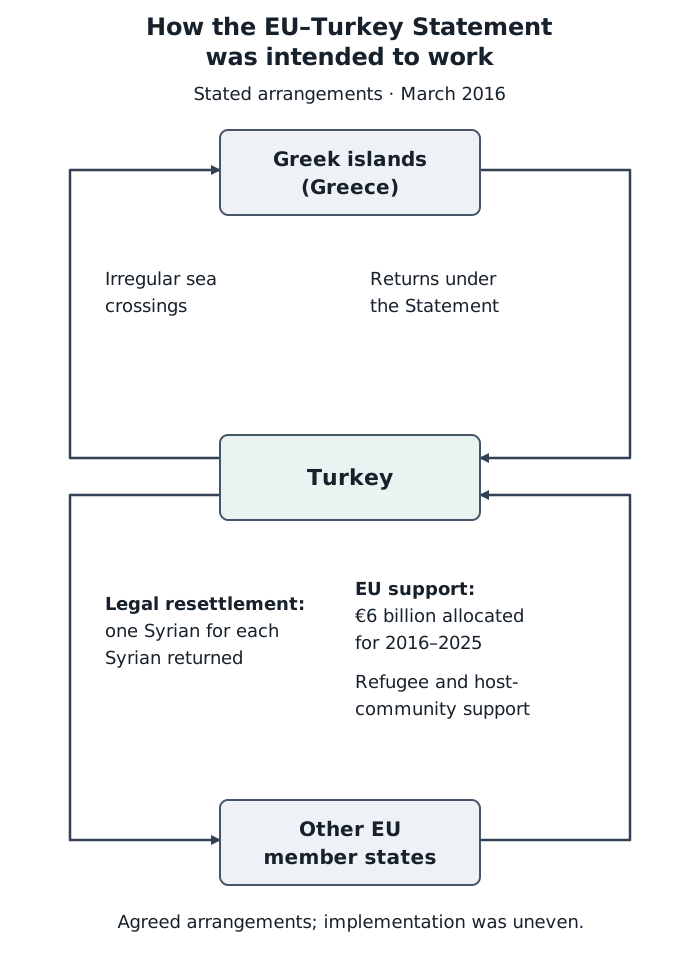
The EU–Turkey response combined returns, legal resettlement and financial support. These were the agreed arrangements; implementation was uneven.
The response combined migration controls with support for refugees and host communities. €6 billion was allocated for 2016–2025 through the Facility for Refugees in Turkey. Its purposes included humanitarian assistance, education, health care, infrastructure and socio-economic support. Measures included building schools, supporting school attendance, providing health consultations and vaccinations, and helping approximately 1.7 million refugees meet basic needs. Supporting services can benefit host communities as well as refugees, reducing pressure on shared facilities.
By March 2020, the European Commission reported that irregular arrivals from Turkey to the EU were 94% lower than before the Statement. About 27,000 Syrian refugees had been resettled from Turkey to EU member states. These results suggest substantial progress towards reducing irregular arrivals and establishing a legal route for some refugees.
However, implementation was uneven. Only 2,735 returns from the Greek islands to Turkey had been completed since the agreement began. Lower arrival numbers also do not automatically mean that those still attempting crossings face less danger. The European Union Agency for Asylum reported that, despite fewer deaths overall, the crossing had become more dangerous in relative terms for those attempting it.
A balanced judgement therefore uses more than border statistics. The arrangement made progress in reducing irregular arrivals and providing resettlement and support, but returns were slow and risks remained. Its success should be judged both by how effectively it managed migration and by whether it improved safety and living conditions for people needing protection.
Distinguish an asylum seeker awaiting a decision from a refugee, and distinguish both from someone displaced within their own country.
Explain a cause through a chain: conflict threatens safety and disrupts homes or livelihoods, so people leave to seek protection.
When assessing a response, separate its aims from its measured outcomes. Fewer arrivals do not by themselves prove that refugees are safer.
Date case-study evidence: the EU–Turkey figures here describe results reported by March 2020, not the present situation.
It can see this note and what your specification asks for.
Answers are free with an account.
1 free note left this week
Get more free notesYour answer sets when this note comes back for review, or marks it complete.
Was this note helpful?
Log in to tell us whether it helped, or to report a problem.
Last updated
International migration
The movement of people from one country to another to live there.
Refugee
A person outside their country who needs international protection because they cannot safely return, for example because of persecution or conflict.
Asylum seeker
A person who has applied for international protection and is waiting for a decision on their claim.
Internally displaced person
A person forced to leave their home who remains within their own country.
Push factor
A condition at the place of origin that encourages or forces someone to leave.
Pull factor
A feature of a destination that attracts someone to move there.
Irregular migration
Movement across a border outside the destination country's normal entry rules. This does not, by itself, determine whether someone needs refugee protection.
Resettlement
The organised transfer of refugees from a country where they have sought protection to another country that agrees to admit them.
Put your knowledge into practice — try past paper questions for Geography A
International migration
The movement of people from one country to another to live there.
Refugee
A person outside their country who needs international protection because they cannot safely return, for example because of persecution or conflict.
Asylum seeker
A person who has applied for international protection and is waiting for a decision on their claim.
Internally displaced person
A person forced to leave their home who remains within their own country.
Push factor
A condition at the place of origin that encourages or forces someone to leave.
Pull factor
A feature of a destination that attracts someone to move there.
Irregular migration
Movement across a border outside the destination country's normal entry rules. This does not, by itself, determine whether someone needs refugee protection.
Resettlement
The organised transfer of refugees from a country where they have sought protection to another country that agrees to admit them.
By March 2020: irregular arrivals reported 94% lower; about 27,000 Syrians resettled; only 2,735 returns completed.
Judgement: progress in controlling arrivals and providing support, but slow returns and continuing crossing risks. Assess protection and living conditions as well as migration numbers.