

Loading…
Loading…
Loading…
Edexcel GCSE Religious Studies B · 1RB0
Edexcel 1RB0 · 4.5 Check the specification (PDF) (opens in a new tab)
For many Buddhists, death does not end the process of existence. Instead, beings undergo rebirth within samsara, the cycle of birth, death and rebirth. Intentional actions, or karma, condition experience in this life and future lives. This is not judgement by a creator god: actions have consequences through cause and effect.
This belief must be understood alongside anicca, impermanence, and anatta, the absence of a permanent self. Bodies, feelings, memories and thoughts change continually. Buddhism therefore does not describe an unchanging soul leaving one body and entering another. What continues is a causally connected process, not a fixed identity.
Think of one candle lighting another. The second flame depends on the first, but it is not an unchanging object transferred between candles. This helps explain continuity without a permanent self. It makes rebirth understandable, but an analogy alone cannot prove that rebirth happens. Equally, impermanence does not by itself prove life after death: it explains the kind of continuation Buddhist rebirth would involve.
A favourable rebirth is not the final goal. Even pleasant lives eventually end. Nirvana is liberation from the greed, hatred and delusion that sustain samsara, rather than an everlasting heaven within it.
The Sahasodgata Avadana, in chapter 21 of the Divyavadana, explains how an image of the Wheel of Life became a teaching aid. In the story, the Buddha’s disciple Mahamaudgalyayana visits different realms and returns to describe their suffering. Animals eat one another, ghosts suffer hunger and thirst, humans experience longing and distress, and even gods suffer when their lives end.
Because the disciple cannot always be available to teach, the Buddha instructs that a five-sectioned wheel should be painted at the monastery entrance. Its realms are hell beings, animals, ghosts, humans and gods. Many Tibetan wheels add a sixth realm, that of the asuras or demigods, but the prescribed story describes five.
At the centre are greed as a pigeon, hatred as a snake and delusion as a pig. These represent forces that keep beings within samsara. The whole wheel is held in the grasp of impermanence. Beings rise and fall like buckets on a waterwheel, showing changing rebirths. The twelve links of dependent arising represent the chain of conditions sustaining the cycle; depicting them forwards and backwards also points towards ending that process. Outside the wheel, the Buddha points towards a shining circle representing nirvana.
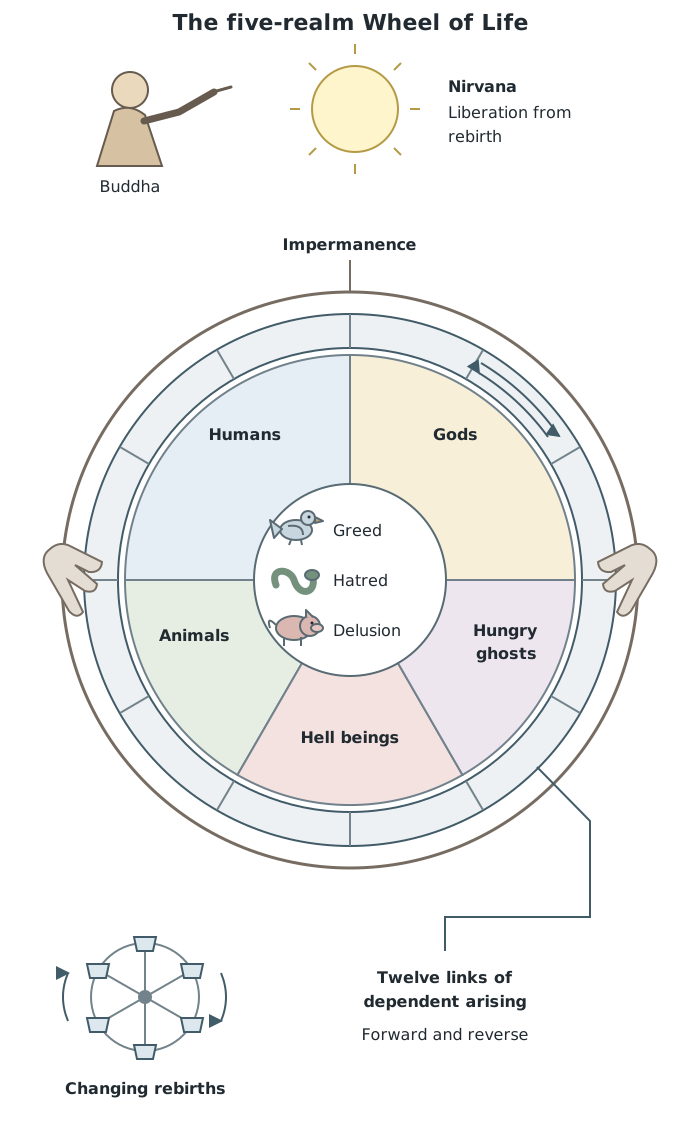
The five-realm wheel connects the causes of rebirth, karmic consequences and impermanence. Nirvana is shown outside the cycle.
The Buddha also requires a competent monk to explain the image. When a young visitor asks about it, the monk connects unskilful actions with painful rebirths and skilful actions with happier ones. Miserliness, for example, is associated with the hungry ghosts’ hunger and thirst. The visitor resolves to practise skilful actions.
The story therefore supports belief in rebirth through religious testimony and shows why that belief matters: understanding future consequences can change behaviour now. It also holds together two messages—seek a better rebirth, but recognise that lasting liberation requires leaving the cycle altogether.
Remembered lives are recollections believed to belong to previous existences. A central Buddhist example is the Buddha’s own recollection of past lives on the night of his awakening. In the Bhaya-bherava Sutta (Majjhima Nikaya 4), he describes reaching deep meditative concentration and directing his mind towards knowledge of his past lives. He recalls details including his names, clans, appearance, food, experiences of pleasure and pain, and deaths. This was the first knowledge he attained, in the first watch of the night.
For Buddhists who trust the Buddha’s awakening and teaching, this gives rebirth the support of his direct experience rather than mere speculation. The account also connects such knowledge with a trained, concentrated mind. Its authority can therefore be especially persuasive to believers, although someone who does not accept that authority may question whether the account establishes rebirth.
A Tibetan Buddhist response appears in the Fourteenth Dalai Lama’s statement on reincarnation of 24 September 2011: ‘For those who remember their past lives, rebirth is a clear experience.’ He argues that people’s recollections, including recognition of places and relatives from earlier lives, should be taken seriously as evidence. He describes Tibetan recognition of tulkus, spiritual masters recognised as rebirths or manifestations of earlier masters, as a method of investigation based on past-life recollection. Recognition procedures can include recounting an earlier life and identifying the predecessor’s possessions or people close to them.
This position understands continuity through a mind-stream, an ongoing sequence of mental experience, rather than a permanent, unchanging soul. The Dalai Lama also explains that most ordinary beings forget previous lives, so their lack of recollection does not, in his view, disprove rebirth.
A contrasting emphasis comes from the Sabbasava Sutta (Majjhima Nikaya 2). The Buddha warns against inappropriate speculation such as ‘What was I in the past?’ when it produces a ‘thicket of views’ rather than freedom from suffering. Instead, he directs attention towards suffering, its cause, its cessation and the way to its cessation. This provides a reason to give less importance to curiosity about past identities and more importance to practice now. It does not deny rebirth or contradict the Buddha’s meditative recollection: it distinguishes liberating knowledge from unhelpful speculation. Some secular Buddhists go further by setting literal rebirth aside and concentrating on this-life practice.
In evaluating remembered-life arguments, distinguish these responses. The Dalai Lama treats recollections as evidence; the Buddha’s recollection carries scriptural authority; the practice-focused response asks whether attention to past lives helps end suffering. Reports still need careful assessment: a claimed memory is not automatically a verified memory, and possible mistakes or ordinarily acquired information affect its evidential strength.
Paranormal experiences offer another possible argument. Mahamaudgalyayana’s journeys through the realms are a religious example of extraordinary perception supporting belief in existence beyond ordinary human life. Buddhists who trust the story’s authority may find this persuasive. Others may withhold judgement about experiences they cannot verify for themselves. Even an unexplained event would need a reasoned connection to rebirth: being unusual does not automatically establish life after death.
The Dalai Lama’s logical argument, representing Tibetan Mahayana reasoning, begins with the premise that awareness must have previous awareness as its substantial cause—the source from which it arises—rather than matter. He therefore argues that awareness at the beginning of this life continues from a previous life, and that death cannot eliminate the subtle mind-stream. He also appeals to familiarity and experience gained in previous lives. This offers a reason to believe in rebirth, not merely a claim that rebirth is possible. However, its central premise is a philosophical claim, not an established scientific fact. Materialists hold that consciousness depends on the brain and ends when it ceases to function; failure to produce a mind in a laboratory does not prove independence from matter. Buddhists also differ over reliance on logic: the Theravada teacher Thanissaro Bhikkhu explains that the Buddha offered no proof to his listeners, but taught rebirth as a safer assumption and as something known directly at awakening. The Kalama Sutta (AN 3.65) warns against accepting teachings through logical conjecture alone, directing people towards qualities known through practice, and praised by the wise, to lead to welfare. Its assurances show that a kind, pure mind benefits a person whether or not there is life after death.
The logical argument’s strength therefore depends on whether its premise about the cause of awareness is accepted; showing that continuity without a permanent self is coherent does not itself prove that it occurs.
The reward argument connects good conduct with beneficial future consequences. Buddhist teachings describe good actions leading towards favourable rebirths and misconduct towards painful ones. This can make moral consequences seem more complete than they appear within a single lifetime, where wrongdoing sometimes brings success.
A traditional Buddhist may find this persuasive because it fits the Buddha’s teachings about karma. A more questioning Buddhist may reply that wanting moral justice does not prove that future lives exist. Karma is also complex: it should not be reduced to the claim that every good person immediately receives a happy rebirth.
The Buddha’s ‘safe-bet’ reasoning, presented in the Apannaka Sutta, offers a practical argument. Acting skilfully brings benefits now and, if rebirth occurs, may bring benefits beyond death. This supports living responsibly under uncertainty; it is not a proof of rebirth. Some secular Buddhists instead emphasise the consequences of actions within this life and set aside belief in future lives.
Belief that death is not the absolute end can offer comfort, especially during bereavement. Some Buddhists may value this reassurance. Others may stress that a comforting belief is not necessarily true, and that Buddhist teaching calls for facing impermanence rather than avoiding it.
The hope of meeting loved ones again can also make life after death attractive. Nevertheless, Buddhist rebirth does not guarantee reunion with particular people or preserve everyone’s identity unchanged. Attachment to a promised reunion may conflict with learning to accept change. Samsara also involves repeated separation and loss, so it is not simply a reassuring continuation of family life.
These arguments can explain why someone wants to believe, but they are weaker as evidence that rebirth exists. A Buddhist can respond compassionately to grief without promising a reunion.
Arguments for rebirth can strengthen confidence in the Buddha’s teaching, encourage careful conduct and connect present choices with a longer moral perspective. The Sahasodgata story illustrates this directly: learning about the realms motivates the visitor to act skilfully. Awareness that all realms remain impermanent can also encourage practice aimed at nirvana rather than merely a pleasant future life.
Buddhists differ over how much weight to give religious testimony, extraordinary experiences and practical reasoning. Traditional believers may regard rebirth as essential to understanding karma and liberation. Some secular Buddhists may consider compassion and ethical practice valuable without accepting literal rebirth.
A justified evaluation should distinguish truth from usefulness. Comfort and moral motivation can make belief significant without proving it. Remembered lives and paranormal claims would be stronger evidence only if credible and carefully examined. Religious testimony may be decisive for a Buddhist who trusts its authority, while the safe-bet argument gives a reason to practise responsibly even when certainty is unavailable.
Belief can strengthen trust in Buddhist teaching, encourage skilful action and motivate liberation. Traditional Buddhists often accept literal rebirth; some secular Buddhists focus on this-life consequences. Thanissaro emphasises rebirth as known at awakening and a safer assumption for practice, not a proof offered to listeners. The safe-bet argument supports responsible practice under uncertainty.
Explain rebirth alongside anatta: Buddhism does not teach that an unchanging soul moves into another body.
Sahasodgata Avadana is the story in chapter 21 of the Divyavadana, not a separate second text. Its wheel has five realms; many Tibetan versions have six.
Use the Buddha’s recollection of past lives in the Bhaya-bherava Sutta (MN 4) as a source of wisdom and authority, explaining how it supports belief in rebirth.
Distinguish evidence that a belief is true from reasons why believing it might be comforting or useful.
When evaluating, explain contrasting Buddhist responses and their reasons, then justify which argument you find strongest.
Describe karmic consequences rather than rewards or punishments handed out by a creator god.
It can see this note and what your specification asks for.
Answers are free with an account.
1 free note left this week
Get more free notesYour answer sets when this note comes back for review, or marks it complete.
Was this note helpful?
Log in to tell us whether it helped, or to report a problem.
Last updated
Anicca
The Buddhist teaching that conditioned things, including bodies, thoughts and feelings, are impermanent and change.
Anatta
The Buddhist teaching that there is no permanent, independent, unchanging self or soul.
Samsara
The cycle of birth, death and rebirth, sustained by ignorance and craving.
Rebirth
The arising of a new existence causally connected to a previous life, without an unchanging soul passing between them.
Karma
Intentional action of body, speech or mind which has consequences for present and future experience; also called kamma.
Nirvana
Liberation from greed, hatred and delusion, ending suffering and the cycle of rebirth; also called nibbana.
Wheel of Life
A Buddhist image representing the realms and causes of repeated birth and death, also called the bhavacakra.
Paranormal experience
A claimed experience or event beyond ordinary explanations, such as communicating with the dead or perceiving other realms of existence.
Tulku
A Tibetan Buddhist spiritual master recognised as a rebirth or manifestation of an earlier master.
Mind-stream
A causally connected sequence of changing moments of awareness, understood in Tibetan Buddhism to continue across lives without being a permanent soul.
Put your knowledge into practice — try past paper questions for Religious Studies B
Anicca
The Buddhist teaching that conditioned things, including bodies, thoughts and feelings, are impermanent and change.
Anatta
The Buddhist teaching that there is no permanent, independent, unchanging self or soul.
Samsara
The cycle of birth, death and rebirth, sustained by ignorance and craving.
Rebirth
The arising of a new existence causally connected to a previous life, without an unchanging soul passing between them.
Karma
Intentional action of body, speech or mind which has consequences for present and future experience; also called kamma.
Nirvana
Liberation from greed, hatred and delusion, ending suffering and the cycle of rebirth; also called nibbana.
Wheel of Life
A Buddhist image representing the realms and causes of repeated birth and death, also called the bhavacakra.
Paranormal experience
A claimed experience or event beyond ordinary explanations, such as communicating with the dead or perceiving other realms of existence.
Tulku
A Tibetan Buddhist spiritual master recognised as a rebirth or manifestation of an earlier master.
Mind-stream
A causally connected sequence of changing moments of awareness, understood in Tibetan Buddhism to continue across lives without being a permanent soul.