

Loading…
Loading…
Loading…
Edexcel GCSE Religious Studies A · 1RA0
Edexcel 1RA0 · 1.2 Check the specification (PDF) (opens in a new tab)
Dhamma is the Buddha’s teaching, which guides Buddhists towards understanding existence and reducing suffering. The word is Pali, a language of early Buddhist scriptures. These teachings were initially passed on orally and later written down in the Pali Canon.
Dhamma has several connected meanings. It can mean the truth about the nature of existence, such as the Three Marks of Existence. It can also mean the path of training through which Buddhists put that understanding into practice, including meditation and the Noble Eightfold Path. Another meaning is universal law or natural order, including kamma: intentional actions have consequences.
These meanings fit together. Understanding how life works should influence how a person lives. In the Dhammapada, chapter 6, the teaching that ‘He who drinks deeply the Dhamma lives happily with a tranquil mind’ connects understanding and practising Dhamma with peace of mind.
Paticca-samuppada, or dependent origination, teaches that things arise because of causes and conditions. They do not exist entirely independently. Conditionality emphasises that when the conditions change or disappear, what depends on them also changes or ceases.
A plant makes this easier to picture. Its growth depends on a seed, water, soil and sunlight. The seed alone is not enough: several conditions must come together. If the water supply stops, the plant’s condition changes. Dependent origination is therefore more than a simple chain in which one event causes another; it includes a network of interconnected conditions.
This matters particularly for understanding suffering. Experiences can give rise to craving, and craving can lead to attachment and dissatisfaction. Suppose someone sees an advertisement for a new phone and begins to feel that they cannot be happy without it. Recognising the conditions behind that craving gives them an opportunity to respond differently, rather than automatically buying the phone.
For Buddhists, suffering is not simply an unavoidable fate. If suffering depends on conditions, changing those conditions can help bring it to an end. This makes dependent origination important both as an explanation of reality and as a basis for spiritual practice.
The Three Marks of Existence, also called the Three Lakshanas, describe central characteristics of ordinary existence. Together, they explain why clinging to things as permanent sources of satisfaction causes difficulties.
Dukkha means suffering or unsatisfactoriness. Life includes physical and mental pain, but dukkha is broader than obvious distress. Pleasant experiences do not provide permanent satisfaction: a favourite possession may disappoint us, and a happy experience eventually ends. This does not mean that Buddhists deny happiness. It means that happiness dependent on changing conditions cannot be held unchanged forever.
Anicca means impermanence. Bodies grow, age and die; buildings deteriorate; thoughts and feelings change. Even things that seem stable depend on conditions that do not remain the same. Understanding anicca helps explain dukkha: expecting a relationship, possession or feeling never to change creates disappointment when it does.
Anatta means no permanent, independent self or soul. Buddhists do not identify an unchanging essence hidden within a person. A person’s body, feelings and mental life all change. Anatta challenges the idea that behind these changes there is an eternal, separate ‘me’ that remains exactly the same.
The Milinda Panha presents conversations between King Milinda and the Buddhist monk Nagasena. Their discussion of a chariot helps explain anatta.
Nagasena asks the king to consider what makes something a chariot. Is a wheel the chariot? Is the axle or frame the chariot? No individual part is the whole chariot. ‘Chariot’ is the name used when these parts are arranged together; there is no separate chariot essence within them.
Nagasena applies this comparison to a person. Body, feelings, perception, mental formations and consciousness are the five changing components known as the Five Khandas, or aggregates. ‘Nagasena’ names the person made up of these components, but none is a permanent Nagasena, and there is no unchanging soul apart from them.
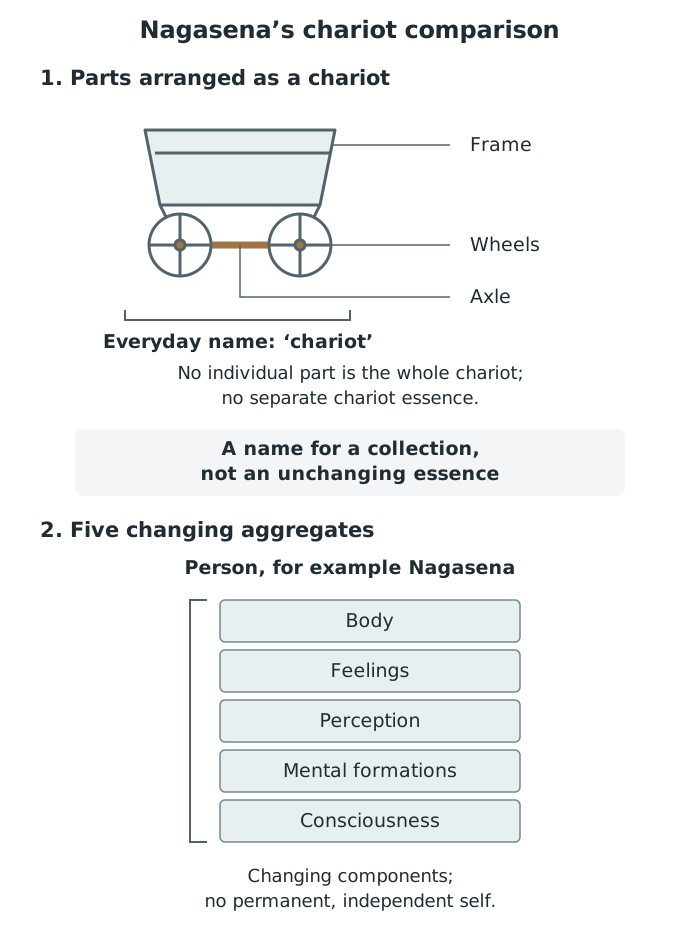
The comparison explains anatta: an everyday name does not imply a permanent essence within the collection of parts.
The point is not that people or chariots cannot be spoken about in everyday life. Rather, their names should not be mistaken for evidence of an independent, permanent essence. The comparison connects anatta with anicca, because a person’s components change, and with dependent origination, because the person depends on those components and their conditions.
These teachings can shape everyday choices for Buddhists in the UK and throughout the world. Understanding dependent origination encourages attention to the consequences of actions: a choice may affect the person making it, their family and other people. Alongside belief in kamma, this supports responsible behaviour rather than the assumption that actions are isolated events.
Understanding dukkha can encourage a Buddhist to question whether another purchase will bring lasting satisfaction. Accepting anicca may help them cope with ageing or loss, because change is part of existence rather than a personal injustice. Belief in anatta can reduce fixation on appearance or a rigid image of who someone must always be.
Studying Dhamma and meditating can help Buddhists recognise changing feelings and cravings without immediately acting on them. This can reduce attachment and encourage kindness and compassion towards others who also experience suffering. Acceptance of change does not mean refusing to help: understanding suffering gives Buddhists a reason to respond compassionately.
A strong argument for its central importance is that dependent origination connects the nature of reality with the causes of suffering and the possibility of liberation. It explains why things change and why changing the conditions behind craving matters. The chariot comparison also helps show that persons are dependent rather than independent, permanent selves.
However, some Buddhists may regard the Four Noble Truths as more important because they directly organise the problem of suffering, its cause, its ending and the path to that ending. Buddhists also differ in their practical emphasis: some prioritise insight and wisdom, while others place greater emphasis on ritual or visualisation. A teaching’s importance can therefore depend partly on how it guides a person’s practice.
A justified judgement might be that dependent origination is foundational for understanding Buddhist beliefs, but it need not be the single most important teaching for every Buddhist. Its value lies partly in how it works with other teachings to support the reduction of suffering.
Paticca-samuppada: things arise dependent on causes and conditions.
Conditionality: change or remove the conditions, and what depends on them changes or ceases. Understanding the conditions behind craving helps Buddhists reduce suffering.
Changing things cannot provide permanent satisfaction; the person who experiences them is also changing.
Milinda Panha: no individual part is the chariot, and no separate chariot essence exists within the parts. Similarly, a person is named through changing components, not an eternal soul. This supports anatta and connects with anicca and dependent origination.
Dhamma can encourage responsible action, reduced craving, acceptance of change, meditation and compassion.
For dependent origination’s central importance: explains reality, suffering’s conditions and how suffering can end.
Against calling it the most important: the Four Noble Truths offer a direct framework for ending suffering; Buddhists differ in their practical priorities.
Judgement: foundational, but its importance works alongside other teachings.
Keep the terms distinct: dukkha means suffering or unsatisfactoriness; anicca means impermanence; anatta means no permanent, independent self or soul.
When using Nagasena and the chariot, explain the comparison: both ‘chariot’ and ‘person’ name collections of parts, not an unchanging essence.
For an explanation of influence, link belief to behaviour and give a reason: accepting anicca may reduce attachment because possessions and experiences cannot last unchanged.
In evaluation answers, develop arguments for and against the statement, weigh their strengths and reach a justified conclusion. Different emphases within Buddhism can support your reasoning.
Use a source of wisdom or authority relevant to your point. Explain how the Milinda Panha supports anatta rather than simply naming the text.
It can see this note and what your specification asks for.
Answers are free with an account.
1 free note left this week
Get more free notesYour answer sets when this note comes back for review, or marks it complete.
Was this note helpful?
Log in to tell us whether it helped, or to report a problem.
Last updated
Dhamma
The Buddha’s teachings; the term can also refer to the truth about existence, the path of training and universal law or natural order.
Dependent origination
The Buddhist teaching that things arise dependent on causes and conditions rather than existing independently. Its Pali name is paticca-samuppada.
Conditionality
The principle that something occurs or exists because the necessary conditions are present; when those conditions change or cease, what depends on them also changes or ceases.
Three Marks of Existence
The three characteristics through which Buddhists understand ordinary existence: dukkha, anicca and anatta.
Dukkha
Suffering or unsatisfactoriness, including the inability of changing experiences to provide lasting satisfaction.
Anicca
Impermanence: the changing nature of things, including bodies, possessions, thoughts and feelings.
Anatta
The Buddhist teaching that there is no permanent, independent self, soul or unchanging essence within a person.
Tanha
Craving: the desire to grasp experiences or possessions as sources of satisfaction, which Buddhists understand as a cause of suffering.
Kamma
Intentional action and its consequences; also called karma.
Put your knowledge into practice — try past paper questions for Religious Studies A
Dhamma
The Buddha’s teachings; the term can also refer to the truth about existence, the path of training and universal law or natural order.
Dependent origination
The Buddhist teaching that things arise dependent on causes and conditions rather than existing independently. Its Pali name is paticca-samuppada.
Conditionality
The principle that something occurs or exists because the necessary conditions are present; when those conditions change or cease, what depends on them also changes or ceases.
Three Marks of Existence
The three characteristics through which Buddhists understand ordinary existence: dukkha, anicca and anatta.
Dukkha
Suffering or unsatisfactoriness, including the inability of changing experiences to provide lasting satisfaction.
Anicca
Impermanence: the changing nature of things, including bodies, possessions, thoughts and feelings.
Anatta
The Buddhist teaching that there is no permanent, independent self, soul or unchanging essence within a person.
Tanha
Craving: the desire to grasp experiences or possessions as sources of satisfaction, which Buddhists understand as a cause of suffering.
Kamma
Intentional action and its consequences; also called karma.