

Loading…
Loading…
Loading…
Edexcel GCSE Design and Technology · 1DT0
Edexcel 1DT0 · 6.4.1 Check the specification (PDF) (opens in a new tab)
Textiles experience forces whenever they are worn, carried, squeezed or cut. A force is a push or pull; it creates stress, or internal loading, within the material. The textile may change shape temporarily, remain distorted or fail if the loading is too great.
The response depends on both the fibres and how they are arranged. Natural and synthetic describe the origin of fibres; woven, knitted and non-woven describe fabric construction. Blended and mixed-fibre textiles combine different fibres, so their behaviour cannot be predicted from just one fibre name.
Compression acts when forces push towards each other. For example, the filling in a cushion is compressed between a person sitting down and the seat underneath. The fibres move closer together and the cushion becomes thinner.
A springy filling can recover when the person stands up. If it does not recover well, the cushion remains flattened. A thin, flexible fabric pushed together along its surface is more likely to wrinkle or fold than to remain straight and support the load like a rigid column.
Tension acts when the ends of a material are pulled away from each other. Imagine a loaded fabric shopping bag: its handles are pulled upwards by the user's hand while the contents pull the bag downwards. The handles must carry this tensile load without breaking or stretching excessively.
Under tension, a textile may first change shape as its yarns or loops straighten. The fibres themselves may also stretch. Knitted fabrics consist of intermeshed loops, which can change shape when pulled. This means knitted fabrics generally stretch more than woven fabrics, whose yarns are interlaced. Extension of the fabric therefore does not necessarily mean that the fibres themselves have stretched by the same amount.
Too much tension can cause permanent stretching, yarn breakage or tearing. The useful response depends on the product: some extension helps clothing accommodate movement, whereas excessive extension in a bag handle would be undesirable.
Shear occurs when parallel forces act in opposite directions, tending to make neighbouring parts of a material slide past each other. Scissor blades apply opposing forces across fabric, producing a cut.
Shear can also distort fabric without immediately cutting it. For example, opposing sideways forces on a woven patch can change the angles between its yarns, making a rectangular patch skew. With greater loading, yarns or connections between fibres may fail.
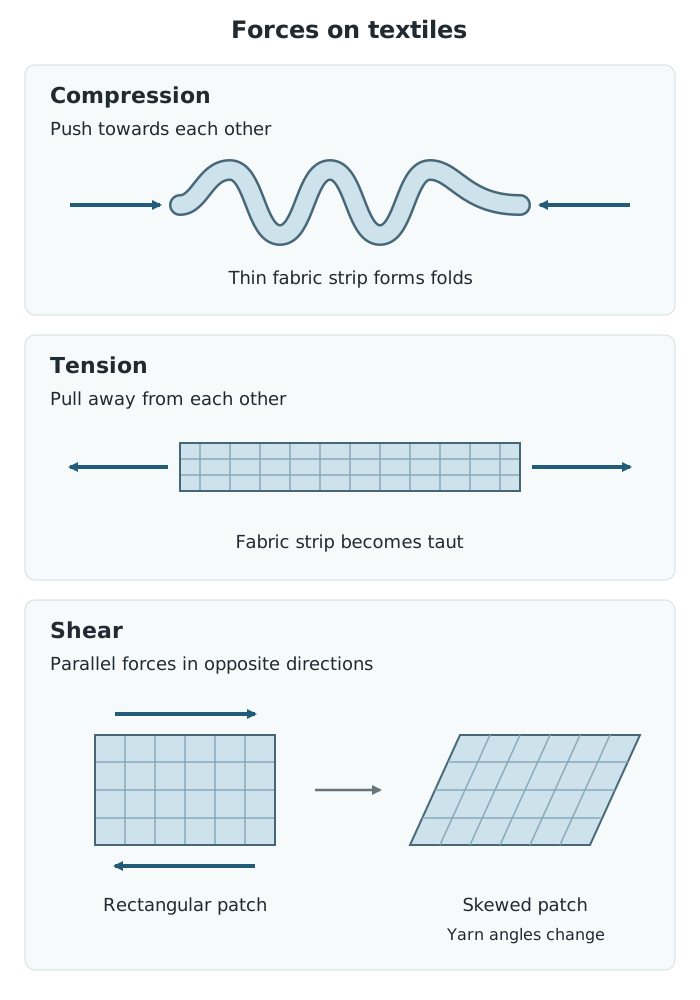
Force direction helps explain whether a textile squashes, becomes taut or distorts by shear.
To identify a force, follow the arrows: compression pushes together, tension pulls apart, and shear acts alongside the material in opposite directions. Look at the resulting change in shape as well as the direction of loading.
A natural fibre is not necessarily a straight strand. The internal structure that forms as it grows influences its shape: forces can arise within the fibre, rather than only from someone pushing or pulling the finished textile. Wool is an important example. Its fibres have a natural waviness called crimp.
The interior of a wool fibre, called the cortex, contains two main types of cell. As finer wool fibres grow, these cell types form in two distinct halves. The two halves expand differently when they absorb moisture. Because they are joined within one fibre, this unequal expansion makes the fibre bend, creating crimp. The structure formed during growth therefore determines how internal forces produce the fibre's curved shape.
In coarser wool fibres, the two cell types form in a more random arrangement, so there is less crimp. Fine wool is consequently generally more crimped and springy than coarse wool.
Crimp makes wool soft and springy and adds bulk. It also holds air between fibres, helping wool provide insulation. Wool's internal spring-like structure contributes to its flexibility, elasticity and recovery from wrinkling. These are related properties, but they are not identical.
Flexibility means bending easily without breaking. A flexible fabric can fold, drape and follow the body's movement. Elasticity means recovering after deformation: a fabric can be flexible without stretching much or returning well after stretching.
Both fibre properties and construction affect the finished textile. Woven fabrics contain interlaced yarns, knitted fabrics contain loops, and non-wovens hold fibres together without weaving or knitting. Their different arrangements influence how forces are transferred and how much movement is possible.
A designer therefore considers the actual task: a garment needs suitable flexibility for comfort and movement, a cushion needs useful recovery after compression, and a carrying strap needs to withstand tension. No single property makes a textile suitable for every product.
Consider fibre properties + fabric construction + direction of force. Natural/synthetic origin alone does not determine behaviour. Knitted loops can change shape under tension, so knitted fabrics generally stretch more than woven fabrics with interlaced yarns.
Link the force to its direction, then explain the effect on the textile in the named product.
Distinguish flexibility from elasticity: bending easily does not necessarily mean stretching and returning to the original length.
For shear, describe forces acting parallel to each other in opposite directions, rather than simply saying that the material is pulled.
Do not assume that all natural or all synthetic textiles behave alike: fibre properties and fabric construction both matter.
It can see this note and what your specification asks for.
Answers are free with an account.
1 free note left this week
Get more free notesYour answer sets when this note comes back for review, or marks it complete.
Was this note helpful?
Log in to tell us whether it helped, or to report a problem.
Last updated
Compression
A pushing force that squeezes a material together.
Tension
A pulling force transmitted through a material as its ends are pulled apart.
Shear
Opposing, parallel forces that tend to make adjacent parts of a material slide past each other.
Stress
The internal loading within a material caused by an applied force.
Flexibility
The ability of a material to bend easily without breaking.
Elasticity
The ability of a material to return to its original shape or length after the force deforming it is removed.
Crimp
The natural waviness or curl of a fibre. In wool, the arrangement of internal cells and their unequal expansion produce this curved shape.
Put your knowledge into practice — try past paper questions for Design and Technology
Compression
A pushing force that squeezes a material together.
Tension
A pulling force transmitted through a material as its ends are pulled apart.
Shear
Opposing, parallel forces that tend to make adjacent parts of a material slide past each other.
Stress
The internal loading within a material caused by an applied force.
Flexibility
The ability of a material to bend easily without breaking.
Elasticity
The ability of a material to return to its original shape or length after the force deforming it is removed.
Crimp
The natural waviness or curl of a fibre. In wool, the arrangement of internal cells and their unequal expansion produce this curved shape.