

Loading…
Loading…
Loading…
Edexcel GCSE Design and Technology · 1DT0
Edexcel 1DT0 · 5.4.1 Check the specification (PDF) (opens in a new tab)
A force is a push or pull. Forces acting on a component can tend to change its shape.
The direction and arrangement of the forces matter. Pulling, squeezing, twisting and sliding actions affect components differently, even when the components are made from the same material. Designers need to recognise these actions to understand how a product will behave in use.
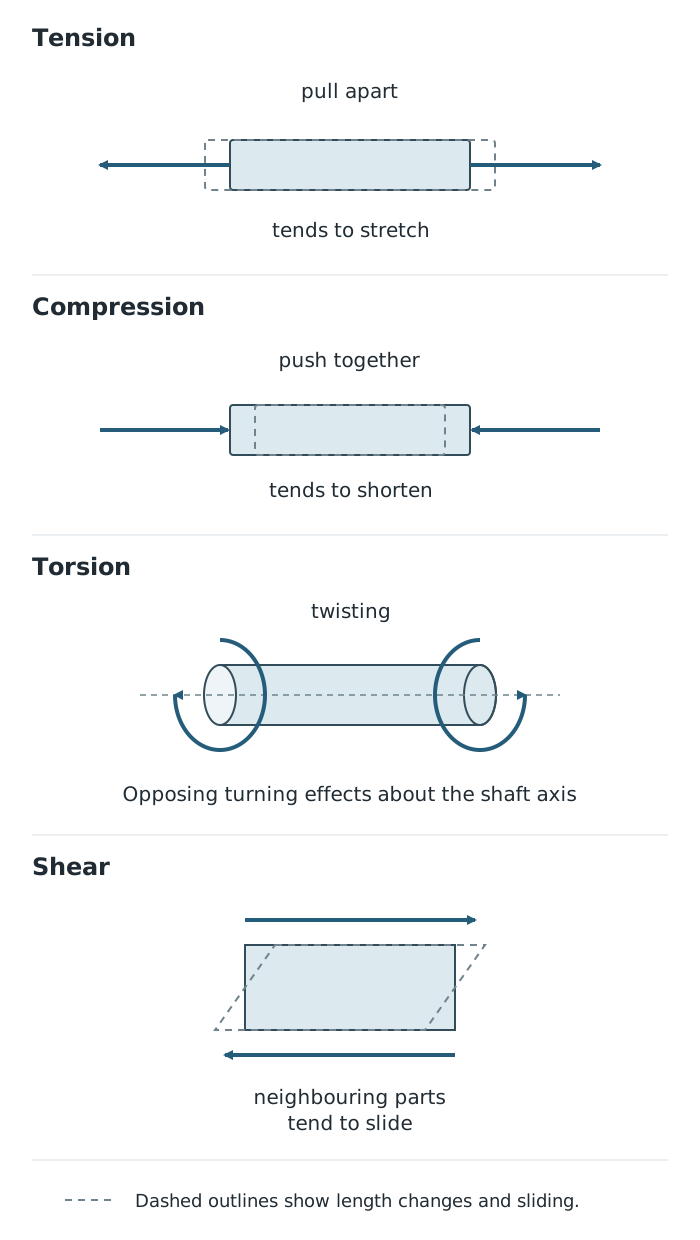
The arrangement of the forces determines whether a component is stretched, compressed, twisted or sheared.
Tension acts when the ends of a material are pulled away from each other. It tends to stretch the material along its length.
A loaded steel chain is in tension: the pull is transmitted through its links. Bridge cables also carry tension as they support a load. Although a cable may show little visible stretching, it is still under tension. If the tensile load becomes too great, the component can break.
To recognise tension, look for a component carrying a pull rather than being pushed or squeezed.
Compression acts when the ends or sides of a material are pushed towards each other. It tends to shorten or squash the material.
Columns and pillars support loads in compression. Chair legs provide another example: the sitter’s weight pushes down through the chair, while the floor pushes upwards against the legs. These opposing forces compress each leg between its ends. The leg must withstand this loading without losing its ability to support the chair.
Tension and compression therefore have opposite effects: tension tends to lengthen a component, while compression tends to shorten it.
Torsion is a twisting action caused by opposing turning effects. One end of a component is turned while the other end resists that turn, so the material tends to twist along its length.
When a screwdriver turns a screw, the handle applies a turning effect and the screw resists the blade. The screwdriver shaft carries torsion between them. A drive shaft also carries torsion as it transmits a turning action through a system. Excessive torsion can twist a component out of shape or cause it to fail.
Torsion is not simply an object rotating freely: the important feature is the twisting load transmitted through the component.
Shear occurs when parallel forces act in opposite directions and tend to make neighbouring parts of a material slide past each other.
Scissors use this action deliberately. Their blades apply opposing forces to nearby parts of the material, causing it to separate along the cut.
In a bolted joint, shear can be unwanted. If the joined parts try to slide in opposite directions, they load the bolt across its shank. If the bolt cannot resist this shear, it can fail and the joint can separate. The same action that makes cutting useful can therefore threaten a connection in a structure.
A component must withstand its loading without unacceptable deformation or failure. Shear is useful when cutting, but can cause a fastener to fail.
Link the force to a specific part of the product and explain how it acts: for example, chair legs are compressed between the sitter’s weight and the floor’s upward reaction.
Distinguish torsion from shear: torsion twists a component; shear tends to make neighbouring parts slide past one another.
When describing arrows on a diagram, explain their directions and the resulting effect on the material, rather than simply naming the force.
It can see this note and what your specification asks for.
Answers are free with an account.
1 free note left this week
Get more free notesYour answer sets when this note comes back for review, or marks it complete.
Was this note helpful?
Log in to tell us whether it helped, or to report a problem.
Last updated
Force
A push or pull acting on an object.
Tension
A pulling action that tends to stretch a material as its ends are pulled away from each other.
Compression
A squeezing action that tends to shorten or squash a material as its ends or sides are pushed together.
Torsion
A twisting action caused by opposing turning effects on a component.
Shear
An action in which opposing, parallel forces tend to make neighbouring parts of a material slide past each other.
Put your knowledge into practice — try past paper questions for Design and Technology
Force
A push or pull acting on an object.
Tension
A pulling action that tends to stretch a material as its ends are pulled away from each other.
Compression
A squeezing action that tends to shorten or squash a material as its ends or sides are pushed together.
Torsion
A twisting action caused by opposing turning effects on a component.
Shear
An action in which opposing, parallel forces tend to make neighbouring parts of a material slide past each other.