

Loading…
Loading…
Loading…
Edexcel GCSE Design and Technology · 1DT0
Edexcel 1DT0 · 3b Check the specification (PDF) (opens in a new tab)
A pure metal contains only one metallic element. An alloy is a mixture of two or more elements, at least one of which is a metal. The added element need not be another metal: steel, for example, contains iron and carbon.
Alloying allows designers to obtain a more useful combination of properties than a pure metal provides. A cutting tool needs to keep a hard edge, a car body needs to be shaped, and kitchen equipment needs to resist corrosion. These jobs do not all call for the same material.
The composition of an alloy means both which elements it contains and their relative amounts. Changing those amounts can change its properties, even when the elements remain the same.
In a simple model of a pure metal, similarly sized atoms form regular layers. These layers can slide over one another when a force is applied, allowing the metal to change shape.
Adding atoms of different sizes disrupts this regular arrangement. The layers cannot slide as easily, so the alloy is often harder than the pure metal. This helps explain why mixing elements can produce a material that better resists indentation and wear.
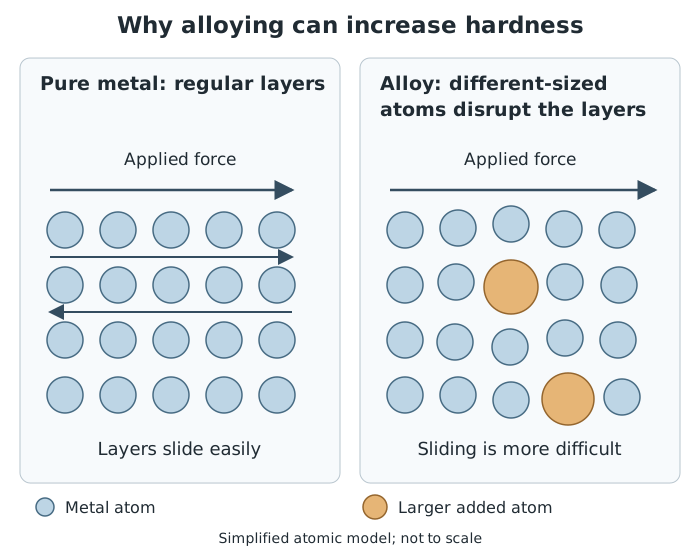
Different-sized atoms disrupt the regular layers, making it more difficult for them to slide past one another.
Hardness is not the same as strength or toughness. Strength concerns resisting forces without failing; toughness concerns resisting impact without breaking. A material can be hard but brittle, so increasing hardness is not automatically an improvement for every product.
Steels are alloys based on iron and carbon. Some also contain other elements to give particular properties.
Low carbon steel, also called mild steel, contains a small amount of carbon. It is relatively soft compared with high carbon steel, but it is strong, tough and easily shaped, cut and welded. This combination makes it useful for car bodies, steel structures, nails and screws. A car body panel must be formed into a shape rather than simply resist scratching.
High carbon steel contains more carbon. It is harder and more wear-resistant, but also more brittle and less easily shaped. It is useful for cutting tools such as saw blades, chisels and knives: hardness helps the cutting edge resist wear. Its brittleness is a limitation where a component must withstand heavy impacts.
Stainless steel contains iron, carbon and chromium; many grades also contain nickel. It combines strength with excellent corrosion resistance and is easy to clean. These properties make it suitable for cutlery, kitchen equipment and medical tools. It is selected not just because it is strong, but because it can remain serviceable in conditions where ordinary steel would corrode.
High-speed steel (HSS) is a steel alloy containing elements such as tungsten, molybdenum and chromium. It remains hard at high temperatures, making it useful for drill bits and lathe cutting tools. Cutting generates heat, so retaining hardness while hot is particularly valuable.
Brass is copper alloyed with zinc. It is corrosion-resistant, durable and easy to machine, with a gold-like appearance. Door handles benefit from its appearance and durability; plumbing fittings benefit from its corrosion resistance and the ease with which accurate parts can be machined.
Bronze is copper alloyed with tin. It is harder than copper and is used for ornaments and medals. Here, alloying provides a harder material while retaining an appearance suitable for decorative objects.
Although both alloys are based on copper, they are not interchangeable names: the added element is different, and so are their combinations of properties.
Aluminium can be alloyed with elements such as copper, manganese and silicon. Suitable aluminium alloys offer greater strength than pure aluminium while retaining low weight. This makes them useful for aircraft structures: the material must carry loads without adding unnecessary mass.
Magnalium is an alloy of aluminium and magnesium. It is another example used in aircraft construction. The important design advantage is a useful combination of strength and low weight, rather than a claim that all aluminium alloys have identical properties.
Begin with the demands on the component, then match them to a material’s properties. Consider both its performance in use and how it will be made.
For a formed car body panel, low carbon steel is appropriate because it is strong but can also be shaped. For a knife blade, high carbon steel offers hardness and wear resistance. For a kitchen utensil exposed to moisture and frequent cleaning, stainless steel offers corrosion resistance and ease of cleaning. For a decorative door handle, brass combines durability, corrosion resistance and an attractive appearance.
A good choice therefore follows a chain: composition gives a combination of properties; those properties suit a particular use. The best alloy is the one that meets the product’s requirements, not necessarily the hardest one.
An alloy contains two or more elements, at least one metallic. Different-sized atoms disrupt regular layers, making sliding more difficult; alloys are often harder than pure metals.
| Alloy | Composition | Key reason for selection | Typical use |
|---|---|---|---|
| Low carbon steel | Iron + a small amount of carbon | Strong, tough, easily shaped and welded | Car bodies, steel structures |
| High carbon steel | Iron + more carbon | Hard and wear-resistant, but brittle | Knives, chisels, saw blades |
| Stainless steel | Iron + carbon + chromium; often nickel | Strong, corrosion-resistant, easy to clean | Cutlery, kitchen equipment |
| High-speed steel | Steel with elements such as tungsten, molybdenum and chromium | Retains hardness at high temperatures | Drill bits, lathe tools |
| Brass | Copper + zinc | Corrosion-resistant, machinable, gold-like appearance | Door handles, plumbing fittings |
| Bronze | Copper + tin | Harder than copper | Medals, ornaments |
| Aluminium alloys | Aluminium with additions such as copper, manganese and silicon | Strength combined with low weight | Aircraft structures |
| Magnalium | Aluminium + magnesium | Useful strength and low weight | Aircraft construction |
Match properties to the component’s demands and its manufacturing process. Hardness, strength and toughness are different; a harder material is not always the better choice.
Justify a material choice by linking a named property to the product’s job: high carbon steel is hard and wear-resistant, so a cutting edge lasts longer.
Distinguish hardness from toughness: a hard material can still be brittle.
Brass contains copper and zinc; bronze contains copper and tin.
Avoid claiming that every alloy is stronger, lighter or more corrosion-resistant than its base metal. The improvement depends on its composition.
It can see this note and what your specification asks for.
Answers are free with an account.
1 free note left this week
Get more free notesYour answer sets when this note comes back for review, or marks it complete.
Was this note helpful?
Log in to tell us whether it helped, or to report a problem.
Last updated
Alloy
A mixture of two or more elements, at least one of which is a metal.
Composition
The elements present in a material and their relative amounts.
Strength
A material’s ability to withstand a force without failing.
Hardness
A material’s resistance to scratching, indentation and wear.
Toughness
A material’s ability to absorb energy or withstand impact without breaking.
Brittleness
The tendency of a material to break with little bending or stretching first.
Corrosion resistance
A material’s ability to resist chemical attack by its surroundings.
Put your knowledge into practice — try past paper questions for Design and Technology
Alloy
A mixture of two or more elements, at least one of which is a metal.
Composition
The elements present in a material and their relative amounts.
Strength
A material’s ability to withstand a force without failing.
Hardness
A material’s resistance to scratching, indentation and wear.
Toughness
A material’s ability to absorb energy or withstand impact without breaking.
Brittleness
The tendency of a material to break with little bending or stretching first.
Corrosion resistance
A material’s ability to resist chemical attack by its surroundings.