

Loading…
Loading…
Loading…
Edexcel GCSE Computer Science · 1CP2
Edexcel 1CP2 · 5.1.1 Check the specification (PDF) (opens in a new tab)
A digital device affects the environment throughout its lifecycle: obtaining raw materials, manufacturing and transporting it, using it, and eventually disposing of it. Looking only at the electricity a phone or computer uses misses much of its environmental impact.
These stages are connected. Replacing a working device does not just create waste: it also creates demand for another device to be manufactured and transported.
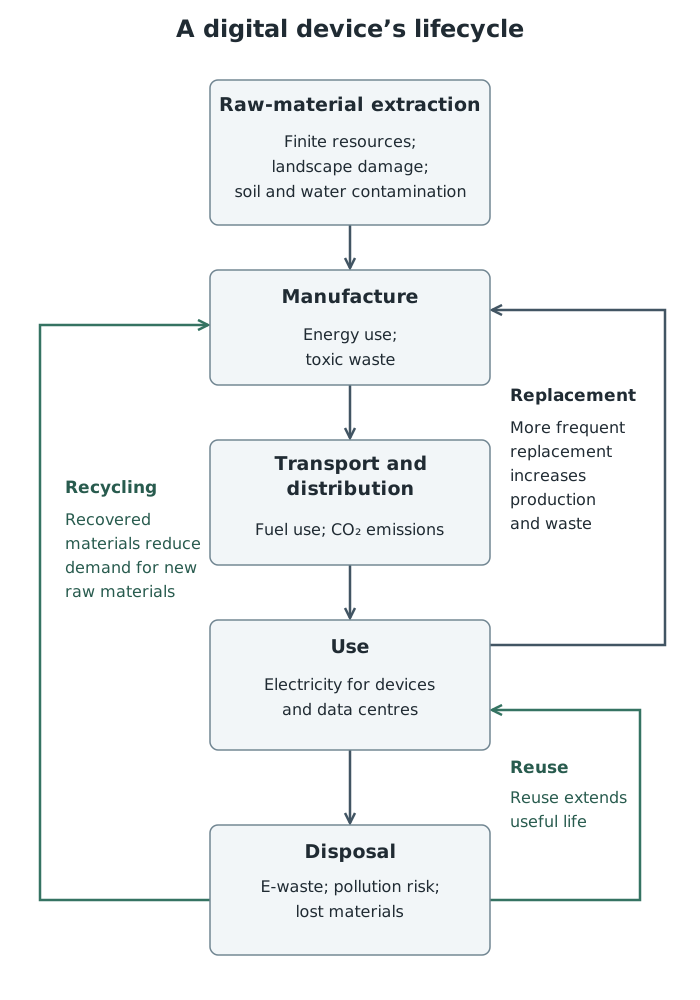
Environmental impacts occur throughout a device’s life. Reuse and recycling address different parts of that lifecycle.
Digital devices require raw materials including sand, oil and metals, such as copper, gold and silver. Extracting these materials uses energy and can scar the landscape, destroy habitats, and contaminate soil and local water supplies. Using finite, non-renewable resources also leaves less available for the future.
Manufacturing turns these materials into components and finished devices. Factory processes consume energy and can produce toxic waste. Components may contain hazardous substances, including lead, mercury and cadmium, which require careful handling.
Transport adds another impact. Raw materials travel to factories, and finished devices travel to suppliers and consumers. When factories and transport burn fossil fuels, they release carbon dioxide, a greenhouse gas that contributes to global warming. Manufacturing therefore has both local effects, such as water contamination, and wider effects through greenhouse gas emissions.
Computers, phones and servers need electricity to operate. The environmental consequence depends partly on how that electricity is generated: electricity produced by burning fossil fuels is associated with carbon dioxide emissions.
The device in front of a user is only part of the system. Internet services and cloud storage also rely on data centres, which house servers that process and store data. These servers consume electricity, so storing something online does not remove its energy cost; some of that cost occurs elsewhere.
Energy-efficient hardware reduces the energy required to perform a task. Reducing energy demand can reduce the emissions associated with electricity generation. However, an efficient device still has manufacturing and disposal impacts, so efficiency during use is not the whole picture.
The replacement cycle is the time between acquiring a device and replacing it. It can vary between devices and between users. A business may replace equipment according to its needs and costs, while an individual may replace a phone to obtain newer features.
A short replacement cycle means more devices are bought and discarded over the same period. This increases demand for raw materials, factory production and transport, as well as the amount of e-waste needing disposal.
For example, replacing a working laptop simply to obtain newer features creates demand for another laptop even though the original can still perform useful tasks. Keeping suitable equipment in use for longer, or passing it to another user, can reduce the need for new production and delay waste.
E-waste is discarded electrical or electronic equipment. If a device is sent to landfill, valuable materials are lost rather than recovered. Many components do not biodegrade, and hazardous substances can leak into soil and water when waste is handled or disposed of improperly.
Sending e-waste elsewhere does not automatically solve the problem. Poorly controlled disposal or material recovery can expose people to harmful substances and cause environmental contamination in the receiving country.
The main alternatives are reuse and recycling. Reuse keeps a device or component working, extending its useful life. Recycling processes unwanted equipment to recover materials for new products. Manufacturer take-back programmes and appropriate electrical-waste collection facilities help direct devices towards controlled treatment rather than ordinary landfill.
Different measures address different problems:
Two relevant measures are the Restriction of Hazardous Substances (RoHS) rules, which restrict hazardous materials in electrical and electronic equipment, and the Waste Electrical and Electronic Equipment (WEEE) Regulations 2013, which set collection, recycling and recovery targets.
No single measure removes every impact. Recycling helps recover materials, but does not undo the energy already used to manufacture and transport a device. Likewise, replacing equipment with a more efficient model creates new manufacturing and disposal impacts. A sensible environmental judgement considers the whole lifecycle, not just one stage.
Shorter cycle → more new devices → more extraction, manufacture, transport and e-waste.
Keeping suitable equipment in use for longer reduces replacement demand and delays disposal.
Judge improvements across the whole lifecycle: lower operating energy does not eliminate manufacturing or disposal impacts.
Link an activity to its environmental consequence: mining can contaminate water; burning fossil fuels releases carbon dioxide, contributing to global warming.
For replacement-cycle questions, cover both increased production of new devices and increased disposal of old ones.
Keep reuse and recycling distinct: reuse keeps equipment in service; recycling recovers materials from it.
If asked to discuss an environmental impact, explain how a proposed solution reduces harm rather than simply naming it.
It can see this note and what your specification asks for.
Answers are free with an account.
1 free note left this week
Get more free notesYour answer sets when this note comes back for review, or marks it complete.
Was this note helpful?
Log in to tell us whether it helped, or to report a problem.
Last updated
Device lifecycle
The stages a digital device passes through, from extracting its raw materials and manufacturing it to use and eventual disposal.
Energy consumption
The amount of energy used by an activity or system, such as manufacturing a computer or running a server.
Raw material
A natural material used to manufacture a product, such as a metal, oil or sand.
Replacement cycle
The time between acquiring a digital device and replacing it with another.
E-waste
Discarded electrical or electronic equipment, such as unwanted computers, phones and monitors.
Recycling
Processing waste to recover materials that can be used to make new products.
Landfill
A site where waste is deposited on or buried in the ground.
Put your knowledge into practice — try past paper questions for Computer Science
Device lifecycle
The stages a digital device passes through, from extracting its raw materials and manufacturing it to use and eventual disposal.
Energy consumption
The amount of energy used by an activity or system, such as manufacturing a computer or running a server.
Raw material
A natural material used to manufacture a product, such as a metal, oil or sand.
Replacement cycle
The time between acquiring a digital device and replacing it with another.
E-waste
Discarded electrical or electronic equipment, such as unwanted computers, phones and monitors.
Recycling
Processing waste to recover materials that can be used to make new products.
Landfill
A site where waste is deposited on or buried in the ground.