Loading…


Loading…
Loading…
Loading…
Edexcel GCSE Combined Science · 1SC0
Edexcel 1SC0 · Fuels Fuels Check the specification (PDF) (opens in a new tab)
Recall that hydrocarbons are organic compounds consisting exclusively of carbon and hydrogen atoms.
Describe crude oil as a complex, finite mixture of hydrocarbons, consisting of carbon atoms arranged in chains or rings, serving as an important source of useful substances.
Describe and explain the industrial process of fractional distillation used to separate crude oil into simpler, more useful hydrocarbon fractions.
Recall the specific names and primary uses of key crude oil fractions, including gases, petrol, kerosene, diesel oil, fuel oil, and bitumen.
Explain how different hydrocarbon fractions vary in their carbon and hydrogen atom counts, boiling points, ease of ignition, and viscosity, noting they primarily belong to the alkane homologous series.
Explain the concept of a homologous series as a family of compounds sharing a general formula, differing by CH2 units, and exhibiting gradual variations in physical properties while maintaining similar chemical properties.
Describe the complete combustion of hydrocarbon fuels as an energy-releasing reaction that produces carbon dioxide and water.
Explain the conditions under which incomplete combustion occurs and how it produces carbon particulates and toxic carbon monoxide.
Explain the biological mechanism by which carbon monoxide acts as a toxic gas.
Describe the environmental and health problems associated with the production of carbon monoxide and soot from incomplete combustion.
Explain how sulfur impurities in certain hydrocarbon fuels lead to the production of sulfur dioxide upon combustion.
Explain the environmental problems associated with acid rain, which is formed when atmospheric sulfur dioxide dissolves in rainwater.
Explain how high engine temperatures facilitate the reaction between oxygen and nitrogen, producing polluting oxides of nitrogen.
Evaluate the environmental and practical advantages and disadvantages of using hydrogen fuel compared to traditional petrol in automotive vehicles.
Recall that petrol, kerosene, and diesel oil are non-renewable fossil fuels derived from crude oil, while methane is a non-renewable fossil fuel obtained from natural gas.
Explain the chemical process of cracking, which breaks down large, saturated alkanes into smaller, more useful molecules, including unsaturated alkenes.
Explain the economic and industrial necessity of cracking large hydrocarbon molecules.
A hydrocarbon is a compound containing carbon and hydrogen only. Crude oil is not one hydrocarbon: it is a complex mixture of many different hydrocarbons. Their molecules vary in size, and their carbon atoms can be arranged in chains or rings.
Crude oil is an important source of fuels and of feedstock: raw materials used by the petrochemical industry to make other useful substances. Separating this complex mixture produces simpler mixtures that are easier to use and process.
Crude oil is also a finite resource: there is a limited supply. Petrol, kerosene and diesel oil obtained from it are non-renewable fossil fuels. They are used much faster than they can be replaced. Methane is another non-renewable fossil fuel, but it is found in natural gas rather than obtained as one of these crude oil fractions.
Most hydrocarbons in crude oil fractions belong to the alkane homologous series. Alkanes are saturated hydrocarbons: they contain only single bonds between carbon atoms. An unsaturated hydrocarbon, by contrast, contains a carbon–carbon double bond.
A homologous series is a family of compounds with four connected features:
For chain alkanes, the general formula is , where is the number of carbon atoms. For example, methane is , ethane is and propane is . Each successive member adds . Longer alkane molecules therefore contain more carbon and hydrogen atoms.
Their chemical behaviour remains similar, but their physical properties do not stay identical. For example, boiling points increase gradually as the molecules become larger.
A crude oil fraction is a mixture of hydrocarbons with similar boiling points and broadly similar molecular sizes. Different fractions have different properties because they contain different-sized molecules.
| Property | Shorter-chain hydrocarbons | Longer-chain hydrocarbons |
|---|---|---|
| Number of carbon and hydrogen atoms per molecule | Fewer | More |
| Boiling point | Lower | Higher |
| Ease of ignition | Easier to ignite | Harder to ignite |
| Viscosity | Lower: flow more easily | Higher: flow less easily |
Viscosity means resistance to flow. A runny liquid has low viscosity; a thick liquid that flows slowly has high viscosity.
Larger hydrocarbon molecules experience stronger intermolecular attractions. More energy is needed to separate the molecules, so they have higher boiling points. These stronger attractions also make it more difficult for molecules to move past one another, increasing viscosity. Boiling overcomes attractions between molecules; it does not break the covalent bonds within them.
Shorter-chain hydrocarbons ignite more easily, making them particularly useful as fuels. These differences in properties help explain why crude oil is separated rather than simply used as one mixture.
Fractional distillation separates hydrocarbons using their different boiling points. It is a physical separation: the molecules are collected in different groups, not changed into new substances.
Crude oil is heated so that much of it vaporises, and the heated mixture enters near the bottom of a fractionating column. The column is hot at the bottom and becomes progressively cooler towards the top.
The vapours rise and cool. A hydrocarbon condenses when it reaches a region cool enough for it to become liquid:
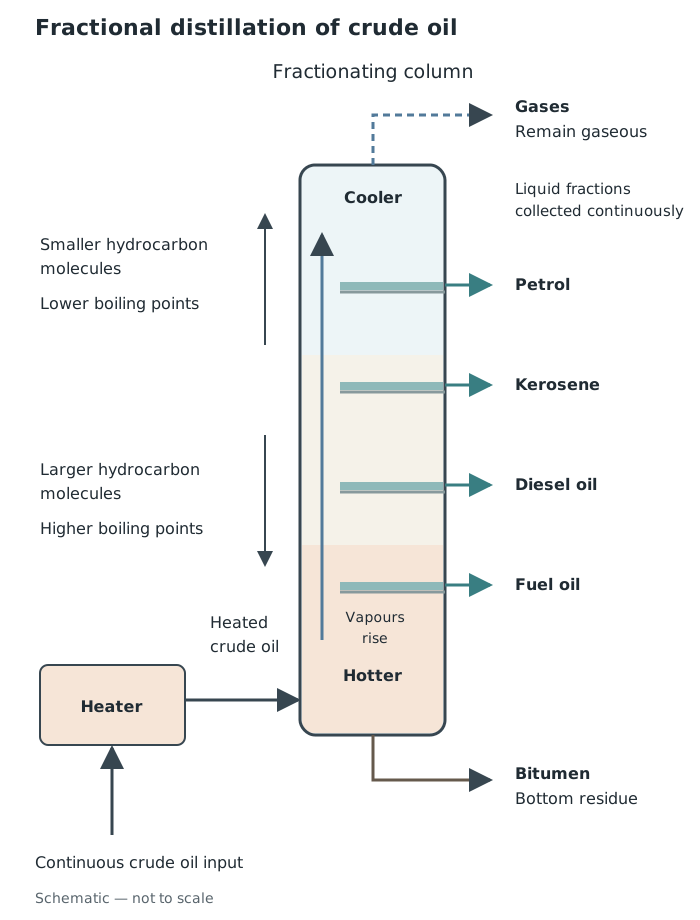
Higher-boiling hydrocarbons condense lower down; lower-boiling hydrocarbons rise into cooler regions before condensing. The smallest leave as gases.
Fractions are drawn off at different heights. Each contains several hydrocarbons with similar boiling points, so fractional distillation produces simpler mixtures, not pure individual hydrocarbons.
Industrial fractional distillation runs continuously: heated crude oil enters while the separated fractions are collected. The fractions can then be used or processed further to provide fuels and petrochemical feedstock.
The following fractions are listed from the top towards the bottom of the column. Moving down this list, molecules generally become larger, boiling points and viscosity increase, and ignition becomes more difficult.
| Fraction | Main uses |
|---|---|
| Gases | Domestic heating and cooking |
| Petrol | Fuel for cars |
| Kerosene | Fuel for aircraft |
| Diesel oil | Fuel for some cars and trains |
| Fuel oil | Fuel for large ships and in some power stations |
| Bitumen | Surfacing roads and covering roofs |
Not every useful fraction is a fuel. Bitumen, for example, is useful as a road-surfacing and roofing material rather than as an easily ignited fuel.
Fractional distillation only separates the molecules already present in crude oil. Cracking goes further: it breaks larger, saturated alkane molecules into smaller, more useful molecules. Some products are smaller alkanes; others are unsaturated hydrocarbons called alkenes, which contain a carbon–carbon double bond.
The large hydrocarbons are heated to vaporise them. Their vapours are then either passed over a hot catalyst or mixed with steam and heated to a very high temperature. Covalent bonds within the large molecules break, and smaller molecules form. This is a chemical change, unlike fractional distillation.
One possible example is the cracking of decane into octane and ethene:
The atoms are conserved: both sides contain ten carbon atoms and twenty-two hydrogen atoms. Octane is a smaller alkane that can be used in petrol; ethene is an alkene. Actual cracking produces mixtures of products rather than always following this one equation.
Fractional distillation does not necessarily supply the fractions in the quantities people want. Demand for shorter-chain hydrocarbons is greater than demand for longer-chain hydrocarbons, because shorter chains ignite more easily and are useful as fuels.
Cracking converts less-wanted larger molecules into smaller, higher-demand products. It therefore helps refineries make better use of crude oil: separation groups the existing molecules, while cracking changes their sizes to produce more useful substances.
Get unlimited access to all revision notes, key terms, and exam tips.
A fraction is a mixture of hydrocarbons with similar boiling points, not a single pure compound.
When explaining fractional distillation, connect different boiling points to the temperature gradient and different condensation heights.
Boiling separates molecules from one another; cracking breaks covalent bonds within molecules.
For property comparisons, state the direction of the change: longer chains have higher boiling points, greater viscosity and are harder to ignite.
Explain the need for cracking using demand: short-chain hydrocarbons are wanted in greater quantities than fractional distillation supplies.
Check that a cracking equation contains the same number of carbon and hydrogen atoms on both sides.
Hydrocarbon
A compound containing carbon and hydrogen atoms only.
Crude oil
A complex, finite mixture of hydrocarbons whose carbon atoms are arranged in chains or rings.
Non-renewable resource
A resource that cannot be replaced as quickly as it is used.
Feedstock
A raw material used to make other substances in industrial chemical processes.
Fraction
A mixture of hydrocarbons with similar boiling points, collected during fractional distillation.
Fractional distillation
The separation of a mixture into fractions using differences in boiling point, through vaporisation and condensation.
Viscosity
A measure of a fluid’s resistance to flow. A highly viscous liquid flows less easily.
Homologous series
A family of compounds with the same general formula and similar chemical properties. Neighbouring members differ by and physical properties change gradually through the series.
Alkane
A saturated hydrocarbon containing only single bonds between carbon atoms.
Alkene
An unsaturated hydrocarbon containing a carbon–carbon double bond.
Cracking
The breakdown of larger alkane molecules into smaller, more useful molecules, including alkanes and alkenes.
Put your knowledge into practice — try past paper questions for Combined Science
Hydrocarbon
A compound containing carbon and hydrogen atoms only.
Crude oil
A complex, finite mixture of hydrocarbons whose carbon atoms are arranged in chains or rings.
Non-renewable resource
A resource that cannot be replaced as quickly as it is used.
Feedstock
A raw material used to make other substances in industrial chemical processes.
Fraction
A mixture of hydrocarbons with similar boiling points, collected during fractional distillation.
Fractional distillation
The separation of a mixture into fractions using differences in boiling point, through vaporisation and condensation.
Viscosity
A measure of a fluid’s resistance to flow. A highly viscous liquid flows less easily.
Homologous series
A family of compounds with the same general formula and similar chemical properties. Neighbouring members differ by and physical properties change gradually through the series.
Alkane
A saturated hydrocarbon containing only single bonds between carbon atoms.
Alkene
An unsaturated hydrocarbon containing a carbon–carbon double bond.
Cracking
The breakdown of larger alkane molecules into smaller, more useful molecules, including alkanes and alkenes.
Heat crude oil → vapours enter the column → rise and cool → condense at different heights → fractions are collected continuously.
Large saturated alkanes → smaller alkanes and unsaturated alkenes.
Vaporise the hydrocarbons, then use a hot catalyst or steam at very high temperature. Cracking breaks covalent bonds: it is a chemical change, not a separation.
Why needed? Demand for shorter-chain fuels exceeds their supply from distillation. Cracking converts less-wanted larger molecules into smaller, more useful products.
Get unlimited access to all revision notes, key terms, and exam tips.