

Loading…
Loading…
Loading…
Edexcel GCSE Citizenship Studies · 1CS0
Edexcel 1CS0 · The British Constitution Check the specification (PDF) (opens in a new tab)
The government develops policies and carries them out. Parliament makes laws and examines what the government is doing. Although ministers work within Parliament, government and Parliament are not the same institution. Holding government to account means requiring ministers to explain and justify their decisions, rather than allowing them to exercise power without challenge.
Parliamentary sovereignty means that Parliament is the highest legal authority in the UK. It can make, change or repeal any law. Courts must follow Acts of Parliament and cannot overturn them.
No Parliament can bind a future Parliament. For example, Parliament may pass a law today, but a later Parliament can amend or repeal it. This allows laws to change as elected representatives respond to different needs and priorities.
Having the authority to govern does not remove the need for scrutiny. Government decisions affect people’s rights, public services and the use of public money. Checks and balances help prevent abuse of power by making decisions open to examination and challenge.
Two different forms of checking are important here. Parliamentary scrutiny asks ministers to explain their decisions and allows MPs and peers to challenge whether policies are effective, fair or affordable. Judicial review allows courts to examine whether a public body has acted lawfully.
These checks serve different purposes. A policy might be lawful but still attract strong political criticism. Equally, a public body’s decision might be challenged in court because it was made unlawfully, regardless of whether ministers consider it desirable.
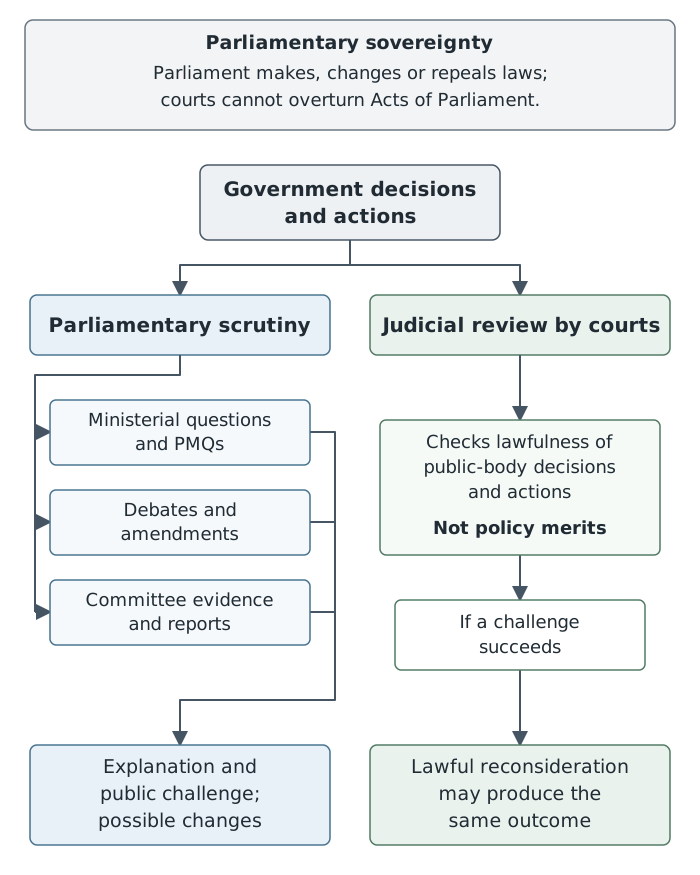
Parliament examines and challenges government policy; judicial review checks whether public bodies act lawfully.
Ministers regularly answer MPs’ questions about the work of their departments. Questions can draw attention to failures, test explanations and bring information into public discussion. Accountability therefore involves more than announcing a decision: ministers must defend what they have done.
Prime Minister’s Questions (PMQs) takes place on Wednesdays when the House of Commons is sitting. The Leader of the Opposition can ask six questions, while other MPs also question the Prime Minister. Its public nature and media coverage help citizens hear challenges to the government and judge its answers.
Questioning and debates also take place in the House of Lords, although it has no equivalent of PMQs. Public questioning can expose weaknesses, but its effectiveness depends partly on how fully ministers answer. An opportunity to ask a question does not guarantee a complete explanation.
MPs and peers debate proposed laws and important national issues. They can challenge a proposal’s purpose, costs or likely effects, and suggest amendments to its wording. Amendments can then be voted on.
Debate provides an opportunity to identify problems before a proposal becomes law. It also makes disagreements visible: citizens can see why representatives support or oppose a measure. However, criticism alone does not ensure that the government’s proposal will be changed. The outcome also depends on parliamentary decisions and votes.
Committee work allows more sustained examination than a short exchange of questions in the chamber.
Bill committees examine proposed laws line by line. Looking closely at the wording can reveal unclear provisions or unintended consequences, giving Parliament an opportunity to consider amendments.
Select committees investigate government work. For example, the Health and Social Care Committee scrutinises the NHS and the work of the relevant government department. Committees can call ministers, civil servants and experts to give evidence, then question them about decisions and performance. Some committees are joint committees containing members from both the Commons and the Lords.
Committees publish reports, and the government is expected to respond. Detailed evidence can make criticism better informed and identify practical improvements. Committee work is often less dominated by party-political exchanges than chamber debates. Nevertheless, publishing a report and obtaining a response do not automatically mean that every recommendation will be adopted.
Judicial review is a court proceeding in which a judge examines the lawfulness of a public body’s decision or action. Public bodies include government departments and local authorities.
The central question is not simply, ‘Was this a good decision?’ It is whether the decision was made lawfully, including whether the proper procedures were followed. Courts do not substitute their preferred policy just because they would have reached a different conclusion.
For example, a local authority’s decision about special education provision for a child can fall within judicial review. The court examines the lawfulness of the authority’s decision-making, rather than simply choosing the educational arrangement it prefers.
Following a successful challenge, a public body may need to reconsider its decision lawfully. It may still reach the same outcome if it follows a lawful process. Judicial review therefore checks the exercise of public power without giving judges Parliament’s authority to make or repeal Acts.
Parliamentary sovereignty gives elected law-making institutions the final legal authority and allows future Parliaments to change existing laws. But sovereignty alone does not ensure that government decisions are well explained, fair or lawful. Scrutiny and legal checks remain necessary.
Parliament can examine policy choices, expose failures and seek changes. Courts provide a different safeguard by checking lawfulness. Neither guarantees that everyone will agree with the eventual decision. A justified conclusion is that these mechanisms are complementary: Parliament examines the merits of government action, while judicial review helps ensure that public bodies exercise their powers lawfully.
Distinguish Parliament from government: parliamentary sovereignty does not mean ministers have unlimited power.
For judicial review, explain that courts check lawfulness, not simply whether a policy is popular or a good idea. Do not claim that judges can overturn Acts of Parliament.
When assessing scrutiny, connect each method to its effect and a limitation: questions demand explanations, committees investigate in detail, but criticism does not automatically produce a policy change.
It can see this note and what your specification asks for.
Answers are free with an account.
1 free note left this week
Get more free notesYour answer sets when this note comes back for review, or marks it complete.
Was this note helpful?
Log in to tell us whether it helped, or to report a problem.
Last updated
Parliamentary sovereignty
The principle that Parliament is the highest legal authority in the UK: it can make, change or repeal any law, and cannot bind a future Parliament.
Executive
The branch of the state that develops and carries out policy, led in the UK by the Prime Minister and government ministers.
Checks and balances
Arrangements through which institutions examine and limit the exercise of power, helping to prevent its abuse.
Scrutiny
Careful examination of government decisions, actions and proposals.
Accountability
The responsibility to explain and justify decisions and actions to those entitled to question them.
Judicial review
A court proceeding in which a judge reviews the lawfulness of a public body's decision or action, rather than simply deciding whether its outcome was desirable.
Select committee
A parliamentary committee that investigates an area of government work, gathers evidence and publishes findings and recommendations.
Bill committee
A parliamentary committee that examines a proposed law in detail, including consideration of its wording and possible amendments.
Put your knowledge into practice — try past paper questions for Citizenship Studies
Parliamentary sovereignty
The principle that Parliament is the highest legal authority in the UK: it can make, change or repeal any law, and cannot bind a future Parliament.
Executive
The branch of the state that develops and carries out policy, led in the UK by the Prime Minister and government ministers.
Checks and balances
Arrangements through which institutions examine and limit the exercise of power, helping to prevent its abuse.
Scrutiny
Careful examination of government decisions, actions and proposals.
Accountability
The responsibility to explain and justify decisions and actions to those entitled to question them.
Judicial review
A court proceeding in which a judge reviews the lawfulness of a public body's decision or action, rather than simply deciding whether its outcome was desirable.
Select committee
A parliamentary committee that investigates an area of government work, gathers evidence and publishes findings and recommendations.
Bill committee
A parliamentary committee that examines a proposed law in detail, including consideration of its wording and possible amendments.
Parliamentary scrutiny examines policy and demands explanations; judicial review checks legality. Public criticism and committee recommendations do not automatically change policy. The checks work together rather than doing the same job.