Loading…


Loading…
Loading…
Loading…
Edexcel GCSE Business · 1BS0
Edexcel 1BS0 · 2.3.2 Supplier Management Check the specification (PDF) (opens in a new tab)
Stock is what a business holds ready for production or sale. It includes raw materials, work in progress (partly completed products) and finished goods. A bakery might hold flour, dough being prepared and bread ready to sell.
Stock control balances two needs: having enough stock to keep production running and meet customer demand, while avoiding the cost of holding too much. Large stocks need storage space, insurance and security. Goods may deteriorate or become outdated, and money spent buying them cannot be used elsewhere until they are sold.
Too little stock creates the opposite problem. A stock-out can stop production or prevent a sale. Workers may still need paying while production is halted, and disappointed customers may buy from a competitor. Sales forecasts help businesses judge how much stock they will need and when.
A bar gate stock graph shows stock levels over time. Time runs along the horizontal axis; the quantity of stock held is measured on the vertical axis.
The line slopes down as materials are used or goods are sold. A steeper downward slope means faster stock usage. When a delivery arrives, the line jumps vertically upwards because stock is added at that moment. Repeated falls and jumps create the characteristic saw-tooth pattern.
Several measurements help a business plan its orders:
The reorder level is normally above the buffer stock level because stock continues to be used while the business waits for delivery. Buffer stock is a safety reserve, not a physical limit: an unexpected delay can force a business to use it.
The graph represents a shop selling 200 units each week. Its maximum stock level is 1,000 units, its buffer stock is 200 units and its supplier takes one week to deliver. It orders when stock reaches 400 units.
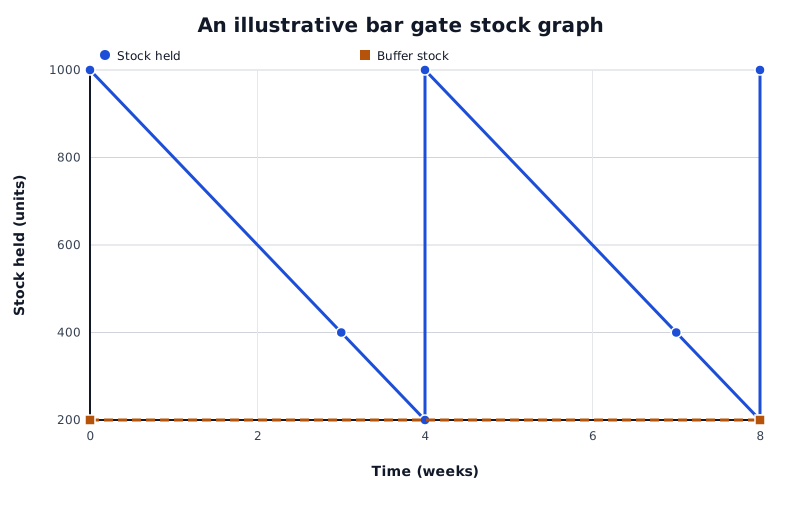
Stock cycle: orders are placed at weeks 3 and 7 when stock reaches 400 units. Deliveries arrive one week later, adding 800 units and restoring stock to 1,000 units. The horizontal line marks the 200-unit buffer.
Data for An illustrative bar gate stock graph
| Series | Time (weeks) | Stock held (units) |
|---|---|---|
| Stock held | 0 | 1000 |
| Stock held | 3 | 400 |
| Stock held | 4 | 200 |
| Stock held | 4 | 1000 |
| Stock held | 7 | 400 |
| Stock held | 8 | 200 |
| Stock held | 8 | 1000 |
| Buffer stock | 0 | 200 |
| Buffer stock | 8 | 200 |
Starting at week 0, stock falls from 1,000 units to the reorder level of 400 units at week 3. The shop places its order then, rather than waiting until its shelves are nearly empty.
During the one-week lead time, another 200 units are sold. At week 4, stock reaches the 200-unit buffer level just before delivery. The delivery raises stock from 200 to 1,000 units, so the reorder quantity is 800 units. Notice that this is different from the 400-unit reorder level.
The horizontal distance from week 3 to week 4 shows the lead time. The vertical jump at week 4 shows the delivery quantity. The cycle then repeats, assuming sales and delivery times remain unchanged.
If sales become faster, the downward line becomes steeper. Keeping the same reorder level could leave too little stock to cover the wait for delivery. The business may need to reorder at a higher level. A longer supplier lead time can also make earlier ordering necessary.
A line reaching zero indicates a stock-out. Falling below the planned buffer level warns that the safety reserve is being used. However, holding a reserve has a cost even when it is not used: the business must weigh that cost against the protection it provides.
Ordering larger quantities less frequently may allow bulk-buying discounts, but means more storage space and more money tied up in stock. There is no single ideal stock level for every business.
Just in time (JIT) aims to have materials and components delivered when they are needed for production, rather than storing large quantities beforehand. For example, a car manufacturer might arrange for components to arrive shortly before they are fitted.
This requires careful coordination between production plans and deliveries. The business needs accurate information about its requirements, close communication with suppliers and dependable deliveries of the correct quantity and quality. With little reserve stock, a late delivery or unusable components can quickly halt production.
JIT reduces stockholding costs and frees storage space for productive use. Less money is tied up in unused stock, which can improve cash flow. Holding fewer goods also reduces exposure to deterioration or obsolescence.
However, frequent smaller orders can increase ordering administration and reduce opportunities for bulk-buying discounts. A sudden rise in demand is harder to meet when there is little spare stock. Disruption to deliveries can stop production and delay customer orders.
JIT is therefore more attractive where demand can be planned and supplies are reliable. Where demand fluctuates sharply or deliveries are uncertain, keeping a buffer may provide valuable protection despite its cost.
Get unlimited access to all revision notes, key terms, and exam tips.
Faster usage or a longer lead time may require a higher reorder level. Zero stock means a stock-out.
More stock protects production and sales, but increases storage costs, ties up cash and risks deterioration. Less stock reduces these costs but increases the risk of shortages.
Materials arrive when needed, with minimal stockholding.
Requires: coordinated production and ordering, accurate requirements, reliable suppliers and correct-quality deliveries.
Benefits: lower storage costs, less cash tied up, space released and less risk of obsolete stock.
Risks: delivery problems can halt production; unexpected demand is harder to meet; frequent ordering adds administration and reduces bulk-buying opportunities.
Read both axes and their scales before identifying stock levels or lead time.
Reorder level is the amount held when an order is placed; reorder quantity is the amount ordered. Find the quantity from the size of the delivery jump.
Measure lead time horizontally from the order being placed to the delivery arriving, not from one delivery to the next.
When evaluating JIT, connect its benefits and risks to the business in the question: consider demand, the type of stock and delivery reliability.
Stock
The materials, partly completed products and finished goods a business holds.
Stock control
Managing the amount and timing of stock held so that a business can meet demand without unnecessary stockholding costs.
Bar gate stock graph
A graph showing how stock levels change over time as stock is used or sold and deliveries arrive.
Maximum stock level
The greatest amount of stock a business plans or is able to hold in normal circumstances.
Reorder level
The stock level at which a business places a new order.
Buffer stock
Reserve stock held to cover unexpected demand or delivery delays; also called the minimum stock level on a stock-control graph.
Lead time
The time between placing an order and receiving its delivery.
Reorder quantity
The amount of stock ordered in a delivery.
Stock-out
A situation in which a business runs out of an item of stock.
Just in time (JIT)
A stock-control system in which materials or components arrive when needed for production, keeping stockholding to a minimum.
Put your knowledge into practice — try past paper questions for Business
Stock
The materials, partly completed products and finished goods a business holds.
Stock control
Managing the amount and timing of stock held so that a business can meet demand without unnecessary stockholding costs.
Bar gate stock graph
A graph showing how stock levels change over time as stock is used or sold and deliveries arrive.
Maximum stock level
The greatest amount of stock a business plans or is able to hold in normal circumstances.
Reorder level
The stock level at which a business places a new order.
Buffer stock
Reserve stock held to cover unexpected demand or delivery delays; also called the minimum stock level on a stock-control graph.
Lead time
The time between placing an order and receiving its delivery.
Reorder quantity
The amount of stock ordered in a delivery.
Stock-out
A situation in which a business runs out of an item of stock.
Just in time (JIT)
A stock-control system in which materials or components arrive when needed for production, keeping stockholding to a minimum.
Get unlimited access to all revision notes, key terms, and exam tips.