Loading…


Loading…
Loading…
Loading…
Edexcel GCSE Business · 1BS0
Edexcel 1BS0 · 2.1.1 Methods of Business Expansion Check the specification (PDF) (opens in a new tab)
Business growth means an increase in the size of a business. A retailer might measure this through its sales or number of shops; another business might focus on its market share. Growth can help a business reach more customers and increase profit, although higher sales do not guarantee higher profit if costs also rise sharply.
There are two main routes. Internal, or organic, growth means expanding the business’s own activities. External, or inorganic, growth means expanding through a merger or takeover involving another business. The distinction is how expansion happens, not whether the business uses its own money or borrows to pay for it.
A business can grow by developing products that give existing customers more reasons to buy, or attract customers it did not previously serve. Innovation means introducing something new or significantly improved. It can help a product stand out from competitors’ offerings.
Research and development (R&D) is the work of investigating ideas and developing or improving products and processes. For a new product, this can involve developing and testing designs before launch. Market research serves a different purpose: it investigates customers and demand. Together, these activities help a business develop a product that works and that customers want.
For example, Google introduced Google Drive alongside its existing search and advertising activities. Developing its own additional products is an organic route to expansion: it broadens what the business offers without requiring it to buy another business.
New products can create additional sources of sales and reduce dependence on one product. However, development takes time and costs money before sales begin. A product may still fail if customers do not want it or if competitors offer something more attractive. Research reduces uncertainty; it does not remove risk.
A new market might be a different group of customers or a new geographical area. A business does not necessarily need an entirely new product to enter it: changing the marketing mix can make an existing product suitable and accessible to different buyers.
The marketing mix combines product, price, place and promotion. A business might adapt the product for another customer group, set a price that suits that group, change its promotional message or use additional distribution channels. These decisions work together: attracting a new audience through promotion achieves little if those customers cannot buy the product.
Expanding distribution can increase access to customers, but an unfamiliar brand may struggle to persuade retailers to stock its products. Retailers risk being left with goods that do not sell.
Technology can support expansion too. Online selling provides a distribution channel through which customers beyond existing shop locations can buy. Investment in production technology can also enable a business to make more products more quickly, helping it meet increased demand. Reaching more customers must be matched by the ability to supply them.
Overseas expansion opens access to customers in other countries. Apple, for example, has expanded by opening its own stores in countries such as China and India and working with telecommunications providers to sell its products. Opening its own overseas outlets is organic growth; overseas expansion is not automatically inorganic.
Foreign markets offer potential additional sales, but customers’ preferences and buying behaviour may differ. The business may need to adapt its marketing mix and distribution arrangements, while managing language differences, different laws and geographically separated teams.
Organic growth builds on a business’s existing strengths, such as its products, brand and staff expertise. Expansion can take place at a manageable pace, giving managers and employees time to adjust. It also avoids the challenge of combining two separate organisations and may be financed using profits kept within the business.
However, organic growth can be slow. Developing products, attracting customers and establishing outlets all take time. The size of the existing market can limit expansion, especially if the business is already the market leader. Entering new markets may overcome that limit, but introduces new costs and risks.
A merger occurs when two or more businesses agree to join together to form a new business. Their operations and resources are combined.
A takeover occurs when one business buys a controlling interest in another. For a company, buying more than half of its voting shares normally gives the buyer control over its operations. The acquired business may continue trading under its existing name, but it is no longer independently controlled. A takeover may be agreed with its management or opposed by it; the latter is a hostile takeover.
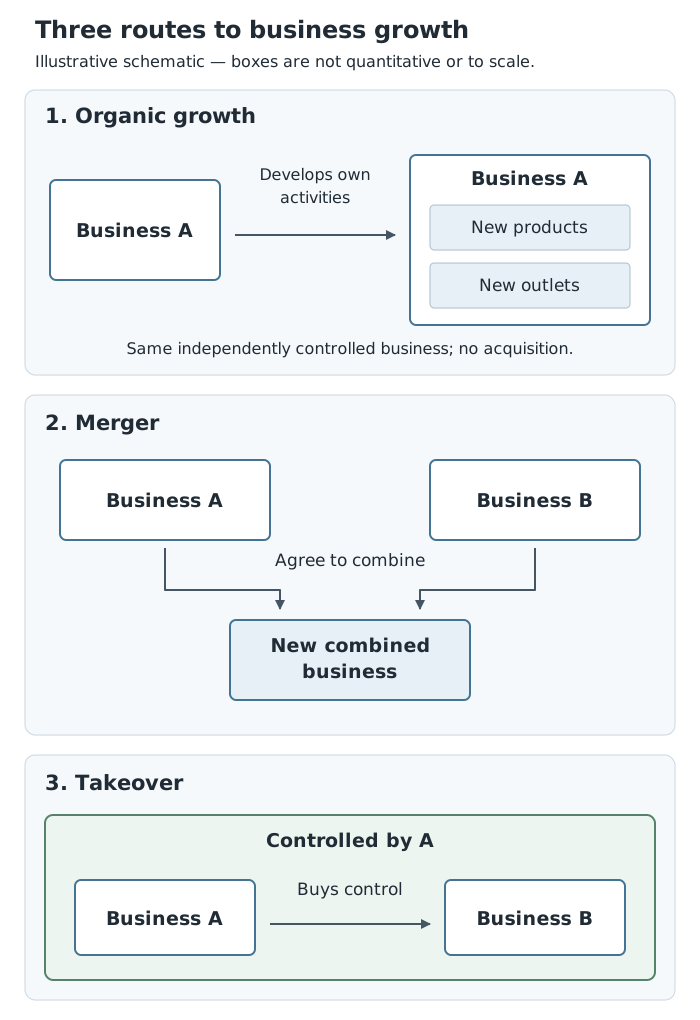
The route to growth depends on whether a business develops its own activities, agrees to combine or buys control of another business.
Businesses may combine with competitors, suppliers, customers or businesses selling different products. For example, Kraft Foods bought Cadbury in 2010 to broaden its product offering and expand sales in the UK. This was a takeover, not organic product development.
External growth is often faster because the business gains established operations, staff, products and customers rather than building everything itself. Buying a competitor can increase market share and reduce competition, strengthening market power. Acquiring a business with different products can spread risk: weak demand for one product may be offset by sales of another.
Combining operations may also reduce costs. For instance, the enlarged business may not need two separate human resources departments. Removing duplicated roles can save money, but may lead to job losses and uncertainty for employees.
A takeover can be expensive, and the enlarged organisation may be difficult to manage. Managers may lack experience of its new activities or scale. Different working cultures and systems can be hard to bring together; international combinations may add language barriers, different laws and different customer expectations. Rapid expansion only benefits the business if it can manage the change effectively.
Organic growth may suit a business that wants controlled expansion based on familiar activities. External growth may suit one that needs rapid access to products, expertise or customers and has the resources to manage the combination.
Businesses can use both methods over time. The choice depends on the opportunity, available finance, desired speed and management capability. Growth also connects the business’s functions: marketing must attract demand, operations must supply it, finance must fund expansion and human resources must prepare staff for change.
Expansion through the business’s own activities:
Benefits: builds on existing strengths; manageable pace; avoids combining separate organisations.
Limitations: often slow; development costs and possible product failure; growth may be limited by market size.
Benefits: rapid expansion; access to established customers, products and expertise; possible increased market share, lower costs and spread of risk.
Limitations: expense; management and culture clashes; duplicated roles may cause job losses. International combinations add language, legal and customer differences.
Compare speed, cost, risk, market opportunity and management capability. Businesses may combine both routes. Expansion overseas can be organic or inorganic, depending on how it is achieved.
Identify the method of growth by what the business does, not where its finance comes from. Borrowing to develop its own new product is still organic growth.
Distinguish a merger, where businesses agree to combine, from a takeover, where one business gains control of another.
Develop impacts as a chain: taking over a competitor may reduce competition, increase market share and strengthen the business’s market power.
When judging a growth method, use the business’s circumstances: available finance, desired speed of growth, demand and management experience. Neither method is always best.
Business growth
An increase in the size of a business, which may be measured using sales, market share or the number of outlets.
Internal (organic) growth
Expansion through developing a business’s own activities, such as launching new products or entering new markets, rather than joining with or buying another business.
Innovation
The introduction of a new or significantly improved product or way of doing something.
Research and development
Work carried out to investigate ideas and develop or improve products and processes.
Marketing mix
The combination of product, price, place and promotion used by a business to meet customers’ needs and encourage sales.
External (inorganic) growth
Expansion through combining with or gaining control of another business, using a merger or takeover.
Merger
An agreement between two or more businesses to join together to form a new business.
Takeover
The purchase of a controlling interest in another business. Buying more than half of a company’s voting shares normally gives control.
Hostile takeover
A takeover opposed by the management of the business being bought.
Market share
The proportion of total sales in a market accounted for by a particular business.
Put your knowledge into practice — try past paper questions for Business
Business growth
An increase in the size of a business, which may be measured using sales, market share or the number of outlets.
Internal (organic) growth
Expansion through developing a business’s own activities, such as launching new products or entering new markets, rather than joining with or buying another business.
Innovation
The introduction of a new or significantly improved product or way of doing something.
Research and development
Work carried out to investigate ideas and develop or improve products and processes.
Marketing mix
The combination of product, price, place and promotion used by a business to meet customers’ needs and encourage sales.
External (inorganic) growth
Expansion through combining with or gaining control of another business, using a merger or takeover.
Merger
An agreement between two or more businesses to join together to form a new business.
Takeover
The purchase of a controlling interest in another business. Buying more than half of a company’s voting shares normally gives control.
Hostile takeover
A takeover opposed by the management of the business being bought.
Market share
The proportion of total sales in a market accounted for by a particular business.