

Loading…
Loading…
Loading…
AQA GCSE Religious Studies B · 8063
AQA 8063 · 3.1.4.3 Sources of Authority on Redemption Check the specification (PDF) (opens in a new tab)
Christians understand redemption as Jesus’s saving work: freeing humanity from sin and restoring its relationship with God. The prescribed passages show different aspects of this work, from Jesus’s death to the Holy Spirit’s empowerment of the disciples.
To identify a theme, connect what happens in a passage with its religious meaning. A torn curtain, for example, is a narrative detail; restored access to God is the redemption theme Christians recognise in it.
Mark’s account of the crucifixion presents Jesus undergoing suffering and death. Christians understand his acceptance of the cross as obedience to God’s will. He is therefore an example of faithfulness even when obedience is costly. Following Jesus means more than admiring him: it involves trying to remain faithful to God in one’s own life.
Jesus is also the restorer of the relationship between God and humanity. At his death, the Temple curtain is torn in two. This curtain separated the holiest part of the Temple from the rest. Its tearing symbolises the removal of the separation between humanity and God: Jesus’s death opens the way to a restored relationship.
Mark also describes darkness over the land while Jesus suffers. Within the Christian understanding of redemption, Jesus enters the suffering and death experienced by human beings rather than remaining distant from them. Christians see him as the victor over sin and death. The crucifixion belongs to this victory, although it is the resurrection that reveals that death has not defeated him.
John’s account begins with Mary Magdalene finding the stone removed from Jesus’s tomb. She initially thinks that his body has been taken away. Peter and the other disciple find the burial cloths inside. The other disciple sees and believes, although the passage says that they do not yet understand the scripture about Jesus rising from the dead. Their understanding develops rather than appearing fully formed immediately.
Mary remains outside, weeping. She sees Jesus but mistakes him for the gardener. When he calls her by name, she recognises him and addresses him as her teacher. Her movement from grief to recognition shows how meeting the risen Jesus transforms her understanding.
For Christians, resurrection means more than returning to ordinary life. Jesus has entered a new, transformed life, revealing victory over death and the possibility of new creation. Mary’s initial failure to recognise him is understood in this light: there is continuity with the Jesus she knew, but also change.
Jesus tells Mary to announce that he is ascending to ‘my Father and your Father’. Christians connect these words with restored relationship: through Jesus, his followers are brought into relationship with the Father. Mary then announces, ‘I have seen the Lord’. She becomes a witness who shares the news rather than keeping the encounter to herself.
Before his ascension, Jesus promises that the disciples will receive power from the Holy Spirit. They are to be his witnesses ‘to the ends of the earth’. Redemption is therefore not presented as a message for one small group alone: the disciples must communicate it so that others can share in it.
Jesus is then taken from their sight. Christians understand the ascension as his entry into heavenly glory, having overcome sin and death. His departure does not end his work; the disciples will continue their mission with the Spirit’s help.
Two men in white robes announce that Jesus will return. This points towards the future completion of redemption. Christians believe that Christ’s victory has already been achieved, while its full fulfilment awaits his return.
At Pentecost, the disciples are gathered together when they hear a sound like a powerful wind. Tongues ‘as of fire’ appear and rest on them. They are filled with the Holy Spirit and begin speaking other languages as the Spirit enables them.
Wind and fire recall biblical signs of God’s presence. Notice that Acts describes a sound like wind and tongues as of fire: the language communicates the power and presence of God.
Pentecost fulfils Jesus’s promise. The Spirit gives the disciples the strength and courage needed to spread the message of redemption. Their ability to speak other languages also connects with the worldwide mission announced in Acts 1: salvation is to be proclaimed beyond the boundaries of their own community.
Scripture provides the accounts of redemption; Christian tradition explores how to understand them. A metaphor explains something through comparison. Salvation metaphors highlight different aspects of Jesus’s saving work rather than describing literal mechanisms.
Irenaeus of Lyon, an early Christian teacher who lived around AD 130–202, compared two trees: the tree of the knowledge of good and evil, and the ‘tree’ of the cross.
In the story of Adam and Eve, eating the forbidden fruit represents disobedience that breaks humanity’s relationship with God and brings death. On the cross, Jesus obeys God and restores that relationship, bringing life. The parallel is a reversal: humanity is lost through one tree and saved through another.
Irenaeus therefore presents Jesus as the new Adam, who succeeds where Adam failed. This understanding is called recapitulation: Christ restores humanity to what God intended it to be.
Anselm, who lived from AD 1033 to 1109 and became Archbishop of Canterbury, was a medieval theologian, not an early Church writer.
His account can be approached through the metaphor of people enslaved to sin and unable to secure their own freedom. A ransom releases someone from captivity; similarly, Jesus achieves the liberation that sinful humanity cannot achieve by itself.
Anselm’s distinctive emphasis is satisfaction. Human sin dishonours God, and humanity cannot make good this offence through its own efforts. Jesus’s complete, freely offered obedience makes satisfaction for human disobedience and restores the relationship with God. His saving sacrifice is not a literal cash payment to a captor.
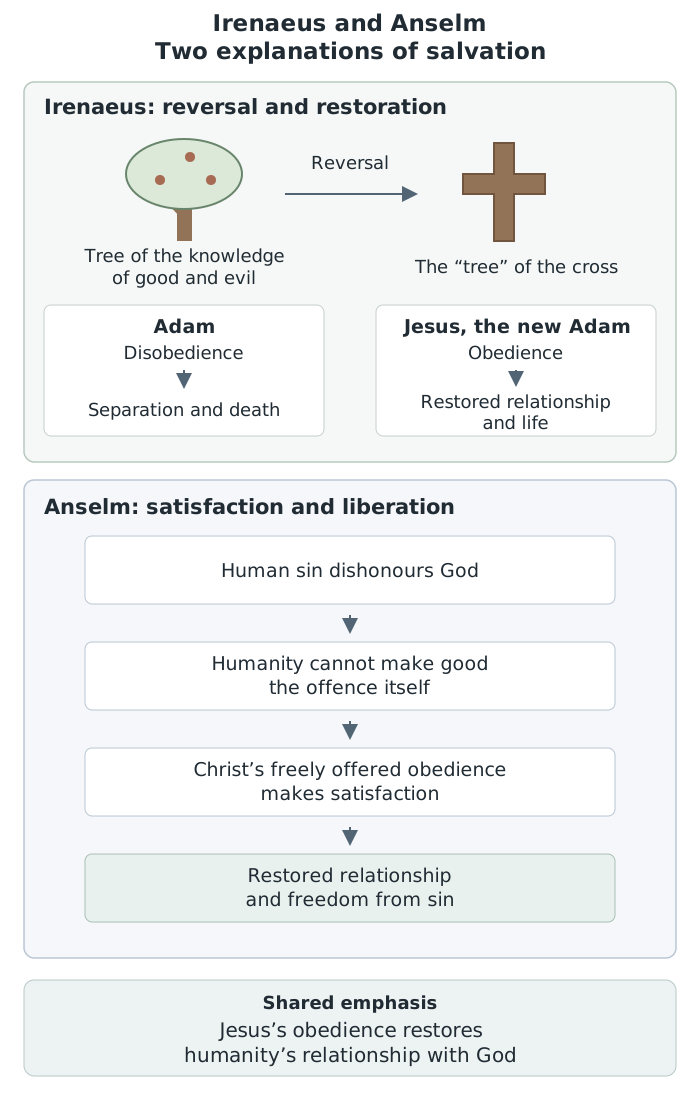
Both metaphors connect Jesus’s obedience with salvation, but emphasise different aspects of restoration.
Both thinkers connect the need for salvation with human disobedience and its remedy with Jesus’s obedience. Both understand salvation as something Christ achieves for humanity, restoring its relationship with God.
Their emphases differ. Irenaeus highlights reversal and restoration: Christ is the new Adam, bringing life where Adam brought death. Anselm highlights an offence made good and liberation secured: Christ accomplishes what humanity cannot accomplish for itself.
Irenaeus’s metaphor makes the connection between the Fall and redemption particularly clear. Some Christians question the way it uses the Adam and Eve story, especially if they understand that story symbolically. Anselm’s approach strongly expresses human dependence on God, but ransom language can mislead if it suggests a literal payment or a power greater than God.
A justified comparison can recognise the value of both without treating either as a complete description of salvation. Irenaeus is especially helpful for explaining restored humanity; Anselm is especially helpful for explaining the seriousness of sin and humanity’s dependence on Christ.
Irenaeus — recapitulation:
Anselm — satisfaction:
Comparison: both emphasise Christ’s obedience restoring humanity’s relationship with God. Irenaeus stresses reversal and restored humanity; Anselm stresses satisfaction and dependence on Christ.
Link a detail from each passage to a redemption theme: for example, the torn Temple curtain represents restored access to God.
Use the full prescribed references: Mark 15:21–39, John 20:1–18, Acts 1:6–11 and Acts 2:1–4.
Compare Irenaeus and Anselm directly: both emphasise Jesus’s obedience, but explain its saving significance differently.
Treat salvation metaphors as explanations, not literal transactions. Anselm’s satisfaction account does not mean that God paid money to the devil.
It can see this note and what your specification asks for.
Answers are free with an account.
1 free note left this week
Get more free notesYour answer sets when this note comes back for review, or marks it complete.
Was this note helpful?
Log in to tell us whether it helped, or to report a problem.
Last updated
Redemption
The saving work of Jesus Christ, through which humanity is freed from sin and its relationship with God is restored.
Salvation
Deliverance from sin and death, enabling human beings to share eternal life with God.
Atonement
The reconciliation of humanity with God through Jesus Christ.
Metaphor
An explanation of one thing through comparison with another, such as describing salvation as release from slavery.
Recapitulation
Irenaeus’s understanding that Christ restores humanity by succeeding where Adam failed, reversing disobedience through obedience.
Satisfaction
Anselm’s explanation that Christ’s freely offered obedience makes good the offence of human sin against God’s honour.
Ransom
A payment securing someone’s release; used as a metaphor for liberation from slavery to sin.
Pentecost
The event described in Acts 2 in which the disciples receive the Holy Spirit, empowering their mission.
Put your knowledge into practice — try past paper questions for Religious Studies B
Redemption
The saving work of Jesus Christ, through which humanity is freed from sin and its relationship with God is restored.
Salvation
Deliverance from sin and death, enabling human beings to share eternal life with God.
Atonement
The reconciliation of humanity with God through Jesus Christ.
Metaphor
An explanation of one thing through comparison with another, such as describing salvation as release from slavery.
Recapitulation
Irenaeus’s understanding that Christ restores humanity by succeeding where Adam failed, reversing disobedience through obedience.
Satisfaction
Anselm’s explanation that Christ’s freely offered obedience makes good the offence of human sin against God’s honour.
Ransom
A payment securing someone’s release; used as a metaphor for liberation from slavery to sin.
Pentecost
The event described in Acts 2 in which the disciples receive the Holy Spirit, empowering their mission.