

Loading…
Loading…
Loading…
AQA GCSE Psychology · 8182
AQA 8182 Check the specification (PDF) (opens in a new tab)
A neuron is a specialised nerve cell that receives and transmits information. Neurons allow you to detect changes, process information and produce responses. Their signals travel electrically along the cells, while communication between neurons usually involves chemical messengers.
The central nervous system (CNS) consists of the brain and spinal cord. The peripheral nervous system (PNS) connects the CNS with the rest of the body. Three types of neuron have different jobs in this communication system:
For example, when you touch something painfully hot, sensory neurons carry information towards the CNS. Relay neurons pass information within the CNS, and motor neurons carry signals to muscles that move your hand away. Each neuron performs a different part of the pathway.
The cell body contains the nucleus and maintains the cell. Branching dendrites receive signals and carry them towards the cell body. An axon carries electrical impulses away from the cell body towards its end branches. These end in terminal buttons, which release chemical messengers to communicate with another cell.
Many nerve fibres have a fatty myelin sheath. This insulates the fibre and helps impulses travel faster. Gaps between sections of myelin are called nodes of Ranvier; these also help rapid transmission.
The three neuron types have characteristic structures. A typical sensory neuron has a long receiving fibre, often called a dendron, and a shorter axon, with its cell body positioned to the side. Motor neurons have short dendrites around the cell body and a long axon extending towards an effector. Relay neurons have short dendrites and a short axon, connecting nearby neurons within the CNS.
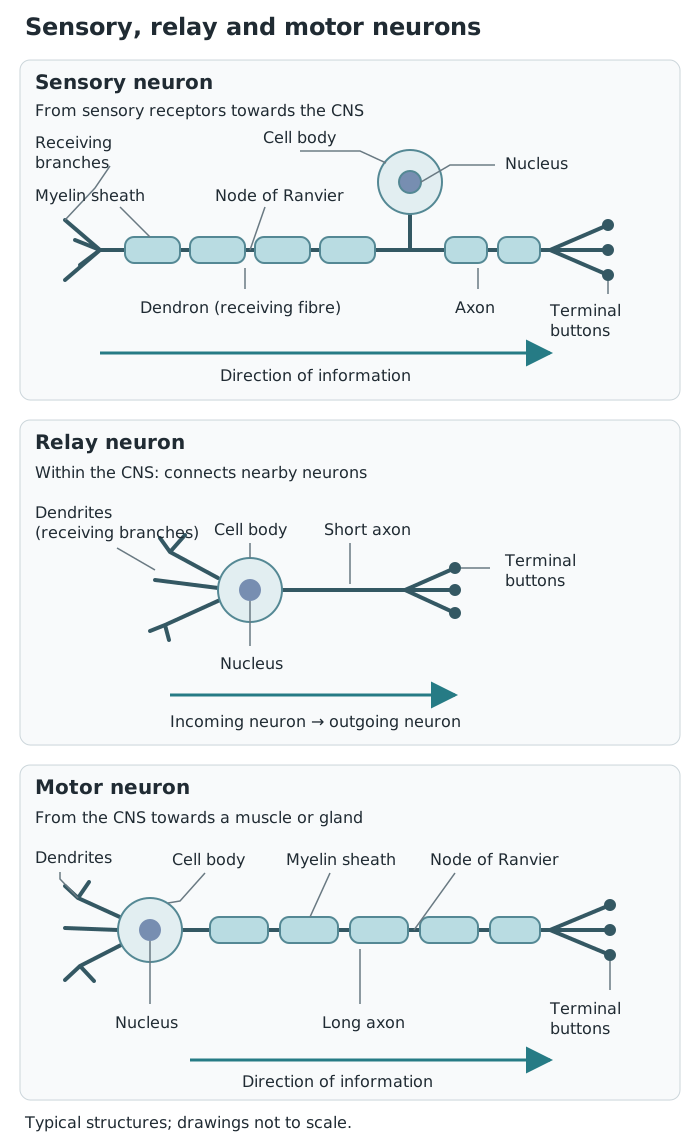
Typical neuron structures and the direction in which each carries information.
Follow the direction arrows in each drawing. Although the shapes differ, information is received, carried through the neuron and passed on at its terminals. The differences in structure suit the different destinations of the signals.
Neurons do not form one continuous wire. At a synapse, there is a tiny gap called the synaptic cleft between the sending and receiving cells. The sending neuron is presynaptic; the receiving neuron is postsynaptic.
An electrical impulse, or action potential, travels along the presynaptic neuron’s axon. When it reaches a terminal button, it triggers the release of neurotransmitters from small storage sacs called vesicles.
The neurotransmitter molecules diffuse across the synaptic cleft and temporarily bind to matching receptor sites on the postsynaptic membrane. This changes the activity of the receiving neuron. If the overall effect is sufficient to make it fire, a new electrical impulse travels along that neuron.
The electrical impulse does not itself cross the gap or turn into a molecule. Instead, it triggers the release of chemical messengers. Communication therefore follows an electrical → chemical → electrical pattern when the receiving neuron fires.
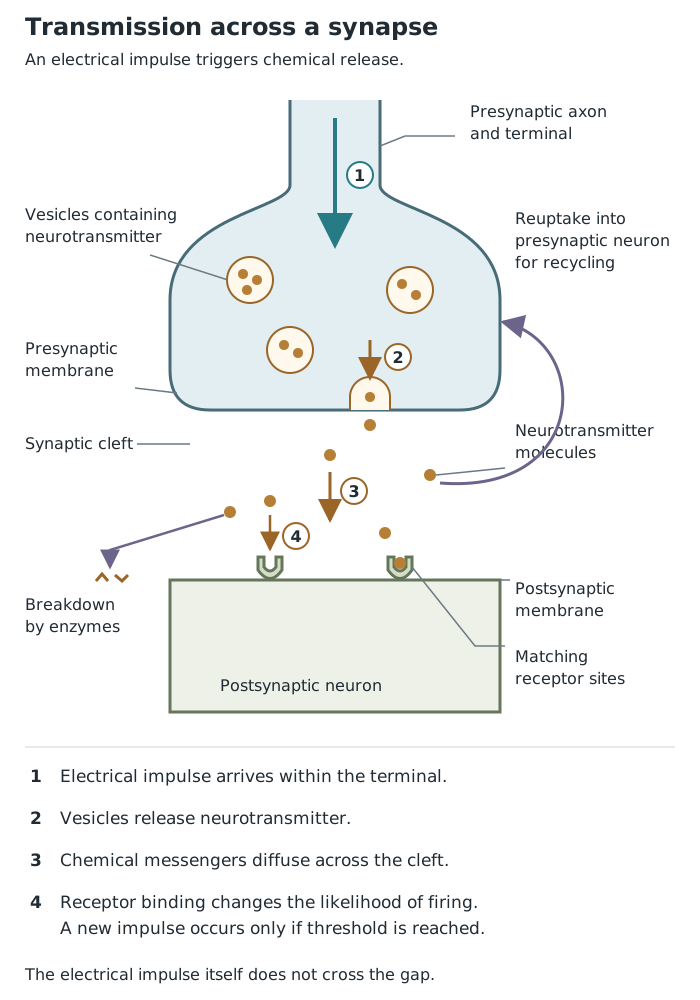
Chemical messengers cross the synaptic cleft; reuptake and breakdown clear them after transmission.
After transmission, neurotransmitters detach from receptors and are cleared from the cleft. Some are taken back into the presynaptic neuron by reuptake, allowing them to be recycled and used again. Others are broken down by enzymes. Clearance prevents the same released neurotransmitter from continuing to affect the postsynaptic neuron indefinitely and allows separate messages to be transmitted.
Binding a neurotransmitter to a receptor does not always produce another impulse. An excitatory effect makes the postsynaptic neuron more likely to fire, moving its electrical state towards the threshold needed for an action potential. An inhibitory effect makes it less likely to fire, moving it away from that threshold.
A neuron can receive many inputs from other neurons. Some encourage firing, while others discourage it. These effects combine through summation. If their combined effect reaches the firing threshold, the neuron produces an action potential. If inhibition offsets excitation sufficiently, it does not fire.
Think of several inputs arriving at once: one excitatory input may be too weak to trigger an impulse, but several together may be sufficient. Adding inhibitory inputs may prevent firing even though excitatory inputs are still arriving. The outcome depends on their combined effect, rather than simply on whether any excitatory neurotransmitter is present.
This interaction allows the nervous system to regulate which signals are passed on. Inhibition is therefore an important part of normal communication, not simply a failure of the system.
Hebb’s theory links psychological learning with physical changes in the brain. It proposes that when neurons repeatedly become active together, the connections between them strengthen. This idea is often summarised as ‘neurons that fire together wire together’.
Repeated activity develops interconnected groups of neurons called cell assemblies. As their connections become stronger, activity passes through the group more efficiently. Hebb linked this neuronal growth to learning: practising a behaviour makes the neural connections supporting it easier to activate.
Consider learning to play the piano. At first, reading the music and coordinating finger movements require considerable concentration. Repeated practice activates the relevant neurons together, strengthening their connections. Playing can then become smoother and more automatic.
An engram is a lasting physical memory trace associated with learning. Further practice can strengthen this trace. If a skill is neglected, its connections may weaken, although the trace need not disappear completely. This helps explain why a previously learnt skill can sometimes be regained more easily than it was first acquired.
These changes are an example of brain plasticity: the brain’s ability to adapt through experience. Neuronal growth here means developing and strengthening connections, not simply producing more neurons.
A strength is that the theory can be investigated using objective scientific methods, including brain scans. Maguire and colleagues (2000) found that grey matter differences in London taxi drivers were associated with their years of navigation experience. This supports the broader idea that experience is linked to changes in brain structure. However, an association does not by itself establish that practice caused the differences or demonstrate Hebb’s exact mechanism of strengthening connections.
The theory also has useful educational applications. Hebb argued that stimulating environments encourage learning and the development of cell assemblies. Rats raised in more stimulating environments performed better in mazes as adults, supporting a relationship between experience and learning. This suggests that varied learning opportunities and repeated practice may help learners, although findings from rats do not automatically establish the same effects in human classrooms.
A limitation is that the theory is reductionist: it explains complex learning mainly in terms of neurons and their connections. Learning also involves thinking, understanding instructions and observing other people. A neural explanation does not fully explain how these cognitive and social influences shape learning.
The theory also does not fully explain why people can need very different amounts of practice to master the same skill. Overall, it offers a useful biological explanation of how practice changes the brain, but it is not a complete explanation of every aspect of learning.
Impulse reaches terminal → vesicles release neurotransmitter → molecules diffuse across cleft → bind to postsynaptic receptors → affect likelihood of firing.
Electrical within neurons; chemical across the cleft.
Reuptake returns neurotransmitter to the presynaptic neuron for reuse. Enzymes can also break it down. Clearance ends its continuing effect.
Repeated activation together → stronger connections → more efficient cell assemblies → learning becomes easier.
Practice strengthens memory traces (engrams); disuse may weaken them. This is brain plasticity.
Support: objective brain research, including Maguire et al. (2000); useful applications to practice and stimulating learning environments.
Limits: brain associations do not prove the precise mechanism; animal findings may not generalise to humans; reductionist; does not fully explain differences in learning speed.
Judgement: useful biological account of learning, but not a complete explanation.
When describing a neuron’s function, state both the direction of the signal and its destination: for example, a motor neuron carries signals from the CNS to an effector.
Identify neuron types using both their structure and their role, rather than relying only on the position of the cell body.
Keep electrical impulses within neurons distinct from chemical transmission across the synaptic cleft.
Explain excitation and inhibition as changes in the likelihood of firing. An excitatory input does not necessarily cause an impulse on its own.
For evaluation, explain why a strength or limitation matters. For example, evidence of brain changes supports plasticity, but does not by itself prove Hebb’s precise mechanism.
It can see this note and what your specification asks for.
Answers are free with an account.
1 free note left this week
Get more free notesYour answer sets when this note comes back for review, or marks it complete.
Was this note helpful?
Log in to tell us whether it helped, or to report a problem.
Last updated
Neuron
A specialised nerve cell that receives and transmits information in the nervous system.
Sensory neuron
A neuron that carries information from sensory receptors towards the central nervous system.
Relay neuron
A neuron within the central nervous system that connects other neurons, including sensory and motor neurons.
Motor neuron
A neuron that carries signals from the central nervous system to an effector, such as a muscle or gland.
Dendrite
A branching extension of a neuron that receives signals and carries them towards its cell body.
Axon
A nerve fibre that carries electrical impulses away from a neuron’s cell body towards its terminals.
Myelin sheath
A fatty insulating covering around some nerve fibres that helps electrical impulses travel faster.
Action potential
An electrical impulse that travels along a neuron when it fires.
Synapse
A junction between neurons, including the sending membrane, the synaptic cleft and the receiving membrane.
Synaptic cleft
The small gap between the sending and receiving neurons at a synapse.
Neurotransmitter
A chemical messenger released by a neuron that crosses a synaptic cleft and binds to receptors on another cell.
Reuptake
The reabsorption of released neurotransmitter into the presynaptic neuron, allowing it to be recycled.
Excitation
An effect on a neuron that makes it more likely to fire an electrical impulse.
Inhibition
An effect on a neuron that makes it less likely to fire an electrical impulse.
Summation
The combining of excitatory and inhibitory inputs received by a neuron, which determines whether it reaches the threshold for firing.
Brain plasticity
The brain’s ability to change its structure and connections in response to learning and experience.
Cell assembly
A group of interconnected neurons whose connections strengthen through repeated activity together, according to Hebb’s theory.
Engram
A lasting physical memory trace in the brain associated with learning.
Neuronal growth
The development and strengthening of connections between neurons associated with learning and experience.
Put your knowledge into practice — try past paper questions for Psychology
Neuron
A specialised nerve cell that receives and transmits information in the nervous system.
Sensory neuron
A neuron that carries information from sensory receptors towards the central nervous system.
Relay neuron
A neuron within the central nervous system that connects other neurons, including sensory and motor neurons.
Motor neuron
A neuron that carries signals from the central nervous system to an effector, such as a muscle or gland.
Dendrite
A branching extension of a neuron that receives signals and carries them towards its cell body.
Axon
A nerve fibre that carries electrical impulses away from a neuron’s cell body towards its terminals.
Myelin sheath
A fatty insulating covering around some nerve fibres that helps electrical impulses travel faster.
Action potential
An electrical impulse that travels along a neuron when it fires.
Synapse
A junction between neurons, including the sending membrane, the synaptic cleft and the receiving membrane.
Synaptic cleft
The small gap between the sending and receiving neurons at a synapse.
Neurotransmitter
A chemical messenger released by a neuron that crosses a synaptic cleft and binds to receptors on another cell.
Reuptake
The reabsorption of released neurotransmitter into the presynaptic neuron, allowing it to be recycled.
Excitation
An effect on a neuron that makes it more likely to fire an electrical impulse.
Inhibition
An effect on a neuron that makes it less likely to fire an electrical impulse.
Summation
The combining of excitatory and inhibitory inputs received by a neuron, which determines whether it reaches the threshold for firing.
Brain plasticity
The brain’s ability to change its structure and connections in response to learning and experience.
Cell assembly
A group of interconnected neurons whose connections strengthen through repeated activity together, according to Hebb’s theory.
Engram
A lasting physical memory trace in the brain associated with learning.
Neuronal growth
The development and strengthening of connections between neurons associated with learning and experience.