

Loading…
Loading…
Loading…
AQA Level 2 Certificate Further Mathematics · 8365
AQA 8365 · 6.5 Check the specification (PDF) (opens in a new tab)
A three-dimensional problem is usually solved through two-dimensional triangles. A triangle may lie on a face of a solid, across its interior or in a cross-section. The important question is not how the triangle looks in perspective, but which lengths and angles are known to be related.
Start with the length or angle you need. Identify a triangle containing it, then work backwards: does that triangle need a length you can find in another triangle? A base diagonal, for example, can become a side of a vertical triangle.
For a right-angled triangle, Pythagoras’ theorem connects its three sides:
Here is the hypotenuse, opposite the right angle. To find a shorter side, rearrange by subtraction: .
The right-angled trigonometric ratios connect an angle with side lengths:
Opposite and adjacent are named relative to the angle being used; the adjacent side here is not the hypotenuse. Use an inverse trigonometric function to recover an angle from a ratio.
For a triangle without a right angle, label side opposite angle , side opposite and side opposite .
For an angle, this rearranges to
These rules also apply to triangles inside larger 2D shapes. For example, two sides of a triangle are cm and cm, with included angle . The third side satisfies
so its exact length is cm. The cosine rule works because the given angle is between the two known sides.
When finding an angle using the sine rule, remember that an acute angle and its supplement have the same sine. If inverse sine gives but the required angle is obtuse, it is . Use the triangle’s angle sum and the given conditions to decide which solution is valid.
Consider a cuboid with base dimensions cm by cm and vertical height cm. Label its base in order, with vertically above .
The base diagonal lies in right-angled triangle :
Now look at triangle . Since is perpendicular to the base plane, it is perpendicular to . The body diagonal is therefore
The base diagonal is an intermediate length, not the body diagonal. Combining the two Pythagoras calculations gives for a cuboid with perpendicular dimensions .
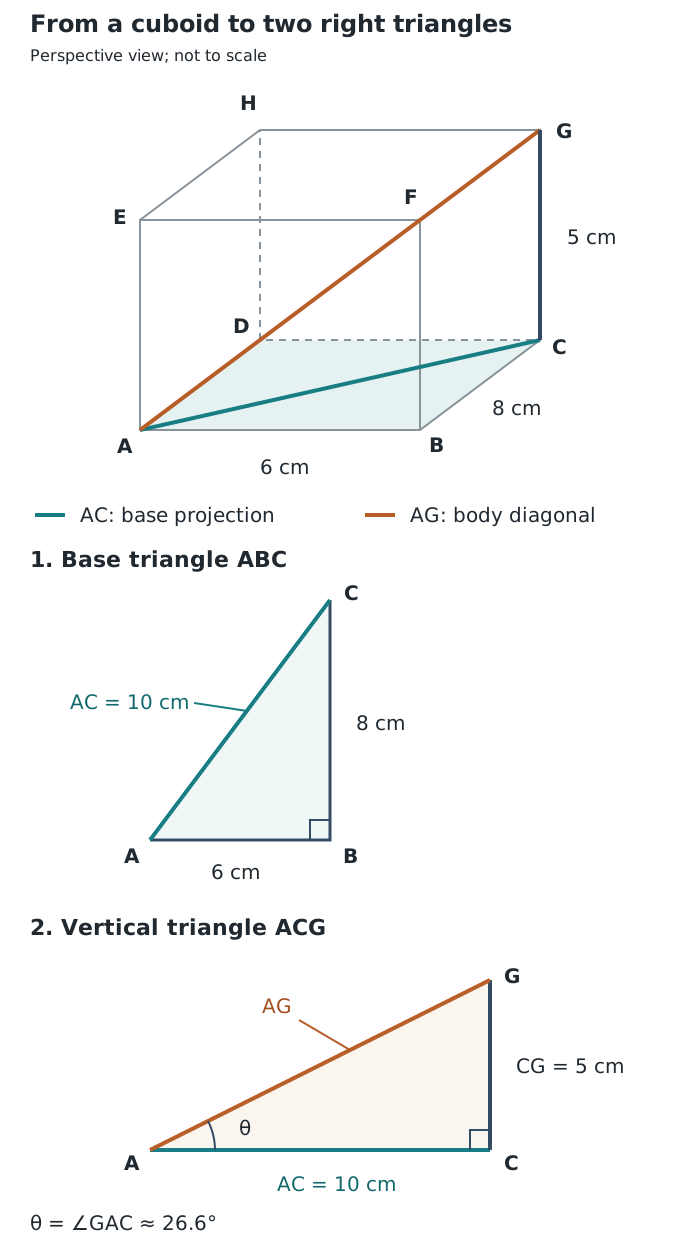
The body diagonal AG projects onto AC. The line–plane angle is therefore ∠GAC.
The angle between a line and a plane is measured between the line and its perpendicular projection onto that plane. The projection is the line’s shadow when projected at right angles to the plane.
For the cuboid, already lies in the base, while projects vertically onto . Therefore, the projection of onto the base is , and the required angle is .
In triangle , the vertical height is opposite this angle and the base diagonal is adjacent:
Thus . This is the angle of the body diagonal above the base, not its angle with a base edge.
More generally, if a sloping line meets a plane at , choose a point on the line and drop a perpendicular to the plane. Triangle is right-angled at , and the line–plane angle is .
Two intersecting planes meet along a straight line. To measure their dihedral angle, take a cross-section perpendicular to that line of intersection. The cross-section cuts each plane in a line; the angle between these two lines is the required plane–plane angle. An oblique cross-section generally gives a different angle.
Consider a triangular wedge with horizontal rectangular base , sloping rectangular faces and , and triangular ends and . Its ridge is parallel to and . The two sloping rectangles are congruent, the base width is cm, and the maximum vertical height is cm.
The base and face meet along . The triangular end is perpendicular to , so the angle between the planes is .
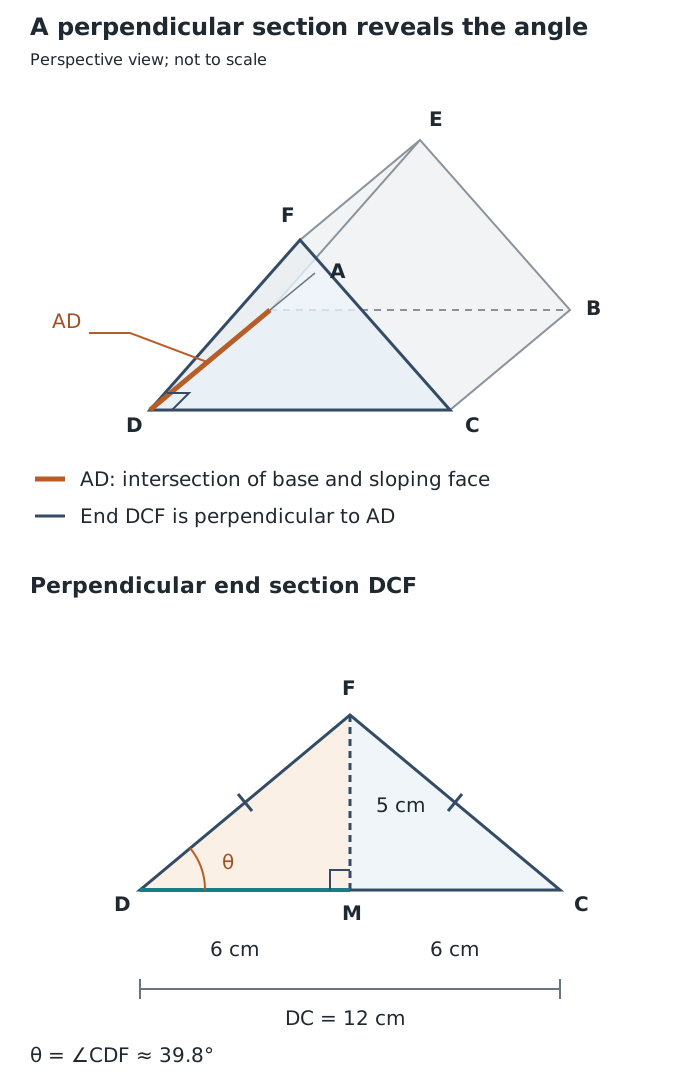
A section perpendicular to AD reveals the plane–plane angle at D; the height splits the 12 cm base into equal halves.
The congruent faces give , making triangle isosceles. Its perpendicular height from meets at its midpoint . Consequently, cm and cm.
In right-angled triangle ,
so the angle between the sloping face and the base is . The full base width would not be the adjacent side of this right-angled triangle.
A useful cross-section need not be right-angled. For example, take a cone whose slant height is cm and whose axial cross-section has apex angle . A cross-section through its axis gives an isosceles triangle: the two sloping sides are each cm and the side opposite the apex angle is the base diameter .
Apply the cosine rule directly:
Using gives
This shows how a spatial problem can lead to an exact algebraic answer. The same approach works when a non-right-angled triangle provides a length needed later in a right-angled one: identify the triangle, choose a rule from its known information, then transfer the result to the next triangle.
Find a face diagonal or projection first, then use it in another triangle. For a cuboid:
Line–plane: angle between the line and its perpendicular projection onto the plane. In the resulting right triangle,
Plane–plane: take a cross-section perpendicular to the planes’ line of intersection; measure the angle between the two cross-section lines.
Retain surds and exact trigonometric values when required. For sine-rule angles, test both and against the stated conditions and the triangle’s angle sum.
Sketch the useful triangles separately from the 3D solid. Label the required angle and explain why any right angle exists.
For a line–plane angle, use the line’s perpendicular projection onto the plane, not a convenient edge.
For a plane–plane angle, take a cross-section perpendicular to the planes’ line of intersection.
Use degree mode and keep exact values or full calculator precision until the final answer.
In the sine rule, match each side with its opposite angle. Check whether an obtuse solution is required.
In the cosine rule and triangle-area formula, the angle must be between the two sides used.
It can see this note and what your specification asks for.
Answers are free with an account.
1 free note left this week
Get more free notesYour answer sets when this note comes back for review, or marks it complete.
Was this note helpful?
Log in to tell us whether it helped, or to report a problem.
Last updated
Hypotenuse
The longest side of a right-angled triangle, opposite its right angle.
Pythagoras’ theorem
The relationship in a right-angled triangle, where is the hypotenuse.
Plane
A flat surface extending indefinitely in every direction within that surface.
Perpendicular projection
The line segment obtained by projecting each endpoint of a segment perpendicularly onto a plane.
Body diagonal
A diagonal joining opposite vertices through the interior of a solid, rather than across one face.
Dihedral angle
The angle between two intersecting planes, measured using lines in the planes that are perpendicular to their common line of intersection.
Included angle
The angle between the two sides being used in a triangle calculation.
Put your knowledge into practice — try past paper questions for Further Mathematics
Hypotenuse
The longest side of a right-angled triangle, opposite its right angle.
Pythagoras’ theorem
The relationship in a right-angled triangle, where is the hypotenuse.
Plane
A flat surface extending indefinitely in every direction within that surface.
Perpendicular projection
The line segment obtained by projecting each endpoint of a segment perpendicularly onto a plane.
Body diagonal
A diagonal joining opposite vertices through the interior of a solid, rather than across one face.
Dihedral angle
The angle between two intersecting planes, measured using lines in the planes that are perpendicular to their common line of intersection.
Included angle
The angle between the two sides being used in a triangle calculation.