

Loading…
Loading…
Loading…
AQA Level 2 Certificate Further Mathematics · 8365
AQA 8365 · 2.5 Check the specification (PDF) (opens in a new tab)
A function takes an input and produces an output. An inverse function reverses that process: it takes the output back to the input that produced it. The inverse of is written , read as ‘f inverse’.
For example, multiplies an input by , then adds . To reverse this, subtract first, then divide by . The operations are undone in reverse order:
Here , so . The inverse takes the original output, , as its input. The superscript names the inverse function; it does not mean taking the reciprocal of the formula.
Reversing operations mentally works well for simple rules. A more general method is to write and rearrange to make the subject. This expresses the original input in terms of the original output. Then exchange the variable labels so that the inverse is written with as its input.
For :
Relabelling gives . Exchanging the labels reflects the exchange of roles: the old output becomes the new input.
You can check the rule by applying it to the original function:
This is the essential inverse relationship: applying the function and then its inverse returns the starting value. Applying them in the other order also returns the starting value, provided it is in the inverse's domain.
The domain is the set of allowed inputs; the range is the set of outputs they produce. For an inverse function to exist, each output must identify just one original input. A function with this property is one-one: different inputs give different outputs.
Consider with all real numbers allowed as inputs. Both and give the output . Reversing this would send to two possible answers, so it would not be a function.
Restricting the domain to removes that ambiguity. Each output now has exactly one original input, and the inverse is . Alternatively, restricting the original domain to gives . The same original formula can therefore have different inverse rules depending on its domain.
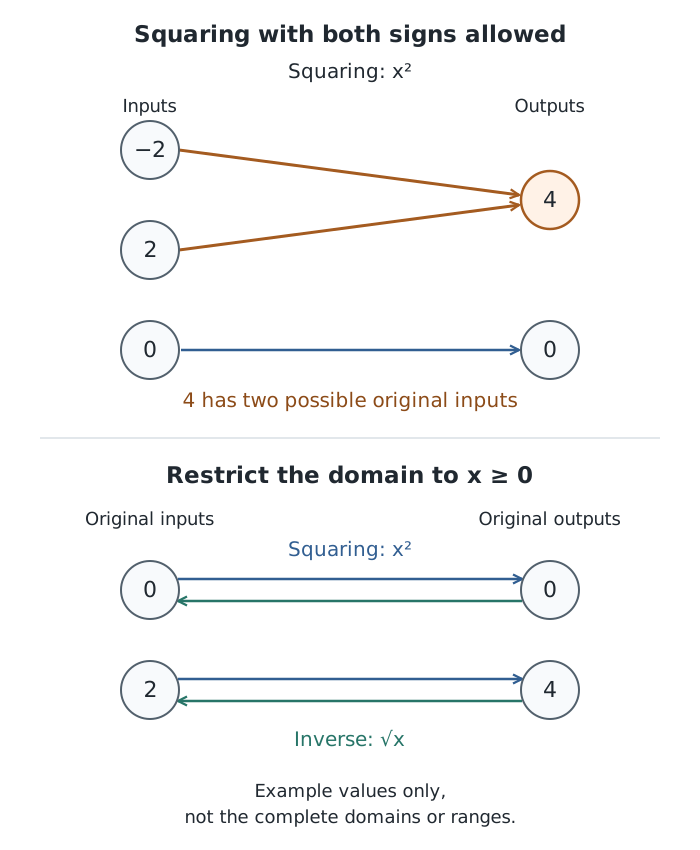
Allowing both signs makes squaring many-to-one. Restricting to non-negative inputs lets the square root reverse it uniquely.
A quadratic is one-one when its domain is restricted to one side of its turning point. In this qualification, domains will be chosen to make the function one-one; use the stated restriction when finding its inverse.
Because an inverse exchanges inputs and outputs, the range of the original function becomes the domain of its inverse, and the original domain becomes the inverse's range.
Suppose
The turning point is at . The domain selects the right-hand side of the quadratic, where each output occurs only once. Since , the greatest output is . As increases, the outputs decrease without a lower bound, so the range is .
Rearrange the equation:
The original domain tells us that , so we take the non-negative square root:
Therefore,
Its domain is the original range, , and its outputs are at least , matching the original domain. If the original domain had instead been , the inverse would have used .
When the variable appears more than once, rearranging requires collecting its terms together. For
write and multiply by :
Collect the terms containing and factorise:
Thus,
The inverse cannot accept , because its denominator would be zero. This matches the original function's missing output: would imply , which is impossible.
reverses ; it is not .
Check:
for inputs in the original domain.
Write the final rule as , using as its input variable.
is not the reciprocal .
Use the original domain to select the correct square-root branch; do not leave in an inverse function.
State any requested inverse domain using the range of the original function, preserving endpoint inequalities.
Check your answer by showing that on the original domain.
It can see this note and what your specification asks for.
Answers are free with an account.
1 free note left this week
Get more free notesYour answer sets when this note comes back for review, or marks it complete.
Was this note helpful?
Log in to tell us whether it helped, or to report a problem.
Last updated
Inverse function
A function that reverses another function, returning each output to its original input. The inverse of is written .
Domain
The set of input values allowed for a function.
Range
The set of output values produced by a function over its domain.
One-one function
A function in which different inputs always give different outputs, so each output comes from exactly one input.
Put your knowledge into practice — try past paper questions for Further Mathematics
Inverse function
A function that reverses another function, returning each output to its original input. The inverse of is written .
Domain
The set of input values allowed for a function.
Range
The set of output values produced by a function over its domain.
One-one function
A function in which different inputs always give different outputs, so each output comes from exactly one input.