

Loading…
Loading…
Loading…
AQA GCSE Mathematics · 8300
AQA 8300 · G24 Check the specification (PDF) (opens in a new tab)
A translation slides a shape to a new position. Every point on the shape moves by exactly the same distance in exactly the same direction. The shape is not turned, reflected or resized, so its side lengths, angles and orientation remain unchanged.
The starting shape is the object and the translated shape is its image. An image may be labelled using a prime: for example, may become .
A translation in two dimensions has a horizontal part and a vertical part. It is described by a column vector
where the top component, , gives the horizontal movement and the bottom component, , gives the vertical movement.
The signs determine the direction:
A zero component means no movement in that direction. For example,
means no horizontal movement and a movement of 4 units down. The entries are written inside curved brackets with no dividing line: a column vector is not a fraction.
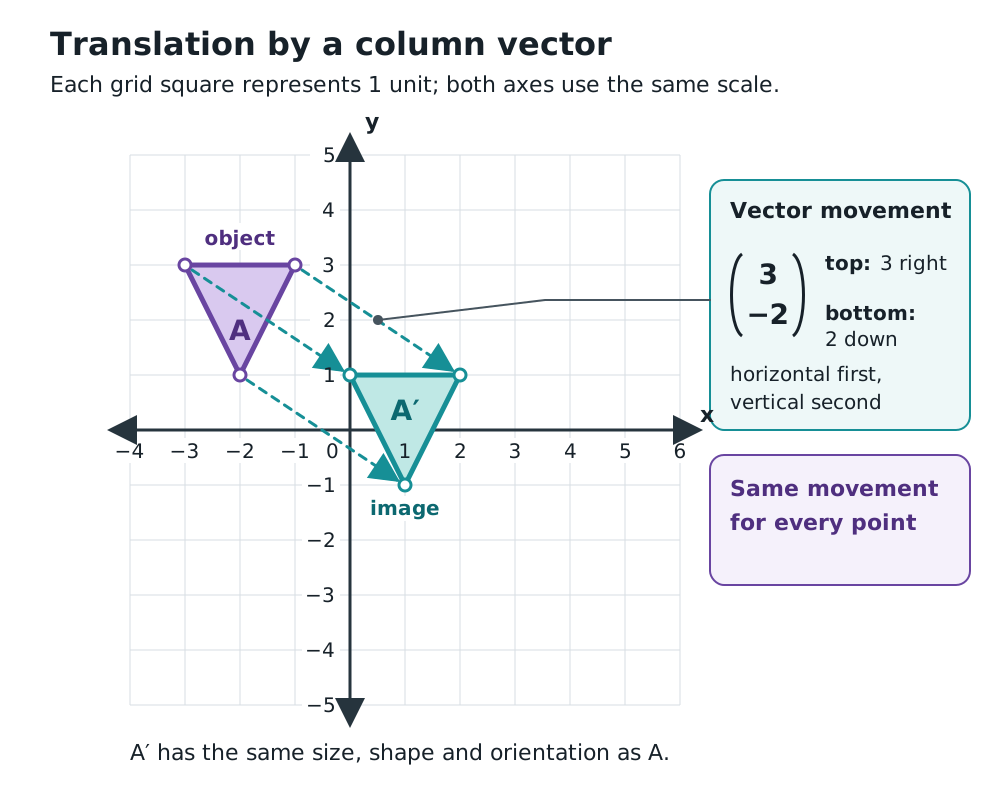
A translation by moves every point 3 units right and 2 units down.
In the diagram, means 3 units right and 2 units down. The same movement carries every vertex of the object to its corresponding vertex on the image.
A point translated by moves to
For example, under the vector , the point moves to
The negative top component causes movement to the left; the positive bottom component causes movement upwards. To translate a whole polygon, apply the same change to every vertex and then join the new vertices in the same order.
Choose one clear point on the object and identify the corresponding point on the image. Count the horizontal movement first and the vertical movement second. Equivalently, subtract the original coordinates from the image coordinates:
If a vertex moves from to , the horizontal change is and the vertical change is . The translation is therefore
Checking a second pair of corresponding vertices should give the same vector. If it does not, the points have been mismatched or the movement has been counted incorrectly.
A vector describes movement in a particular direction. If the translation from shape to shape is
then the translation from back to is
The distance in each direction is unchanged, but both signs reverse.
Apply the same vector to every vertex. A translation preserves size, shape and orientation.
Using corresponding points:
Check the result with another pair of corresponding points.
Reverse both signs. Thus the reverse of is .
To find the vector from an object to its image, compare one pair of corresponding vertices and calculate image coordinate minus object coordinate.
Read and write the horizontal movement first and the vertical movement second.
Include the signs: left and down require negative components.
Use a column vector with curved brackets and no fraction line.
Check the direction named in the question. The translation from the image back to the object has the opposite signs.
It can see this note and what your specification asks for.
Answers are free with an account.
1 free note left this week
Get more free notesYour answer sets when this note comes back for review, or marks it complete.
Was this note helpful?
Log in to tell us whether it helped, or to report a problem.
Last updated
Translation
A transformation that moves every point by the same distance in the same direction, without turning, reflecting or resizing the shape.
Column vector
An ordered pair of numbers written vertically that represents horizontal movement followed by vertical movement.
Object
The original shape before a transformation.
Image
The shape produced by a transformation.
Corresponding points
Points in the same relative position on an object and its image.
Put your knowledge into practice — try past paper questions for Mathematics
Translation
A transformation that moves every point by the same distance in the same direction, without turning, reflecting or resizing the shape.
Column vector
An ordered pair of numbers written vertically that represents horizontal movement followed by vertical movement.
Object
The original shape before a transformation.
Image
The shape produced by a transformation.
Corresponding points
Points in the same relative position on an object and its image.