Loading…


Loading…
Loading…
Loading…
AQA GCSE Design and Technology · 8552
AQA 8552 Check the specification (PDF) (opens in a new tab)
A force is a push or pull. When a product carries a load, its materials must transmit forces without deforming excessively or breaking. These forces create stress within the material: internal force per unit area.
The direction of a force matters as well as its magnitude, or size. Pulling a component, squashing it and twisting it can produce very different effects. Designers therefore consider both the material and the shape of the component. They may resist movement to keep a structure stable, or deliberately use movement to make a product work.
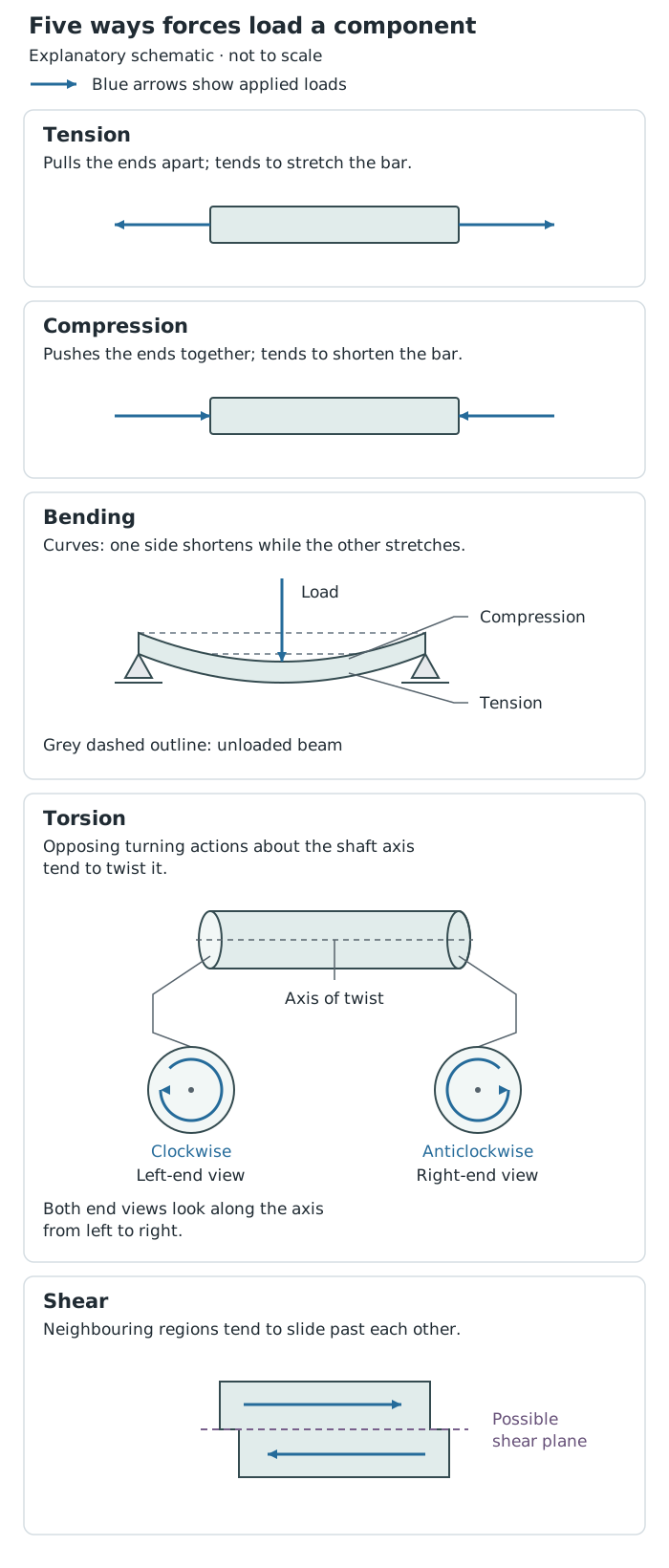
Force direction determines whether a component is pulled, compressed, bent, twisted or sheared. The torsion end views use the same viewing direction to show opposite turning actions.
Tension occurs when forces pull the ends of a material away from one another. It tends to stretch the material. Bridge cables and steel chains carry tensile loads: the pull is transmitted along their length.
A useful adaptation is to place steel reinforcing bars inside concrete. Concrete resists compression well but is relatively weak in tension. The steel reinforcement carries tensile loads, helping the combined structure resist cracking and failure. This shows why choosing a material that is strong under one type of loading does not automatically make it suitable for every force.
Compression occurs when forces push towards one another, tending to squash or shorten a material. Building columns and pillars carry compressive loads.
Chair legs provide another example. The sitter's weight pushes down through the chair, while the floor pushes upwards against the legs. These opposing forces compress each leg. A leg must carry this load without crushing or becoming unstable.
A composite panel can have a honeycomb core sandwiched between its outer faces to resist compression. The core supports the faces and helps prevent them being pushed together, while keeping the panel relatively lightweight. Its internal structure contributes to its performance, rather than relying only on a large mass of solid material.
Bending makes an object curve. A shelf or horizontal beam supported at both ends bends downwards when a load is placed on it. As it curves, its upper side becomes shorter and is compressed, while its lower side becomes longer and is in tension. Bending therefore involves both compression and tension within the same component.
Steel beams often have an I-shaped cross-section to resist bending. The broad upper and lower parts, called flanges, place material away from the centre of the beam, where it is effective at resisting bending. The connecting vertical web holds these parts apart. Changing the cross-sectional shape allows the beam to resist bending efficiently without making the entire section solid.
Bending can also be useful. Leaning against a chair backrest applies a bending load; a design may allow some controlled flex rather than requiring the backrest to remain completely rigid.
Torsion is a twisting action. It occurs when one end of a component is turned while the other end resists, or when the ends are turned in opposite directions.
A screwdriver works with torsion: the handle is turned, and the shaft transmits the turning action to the screw. The shaft must resist excessive twisting while carrying that action.
A tower crane, by contrast, needs to resist unwanted twisting. Diagonal bracing helps stabilise its framework against torsion. Adding braces changes how forces pass through the structure, rather than simply increasing the thickness of every member.
Shear occurs when opposing forces tend to make neighbouring parts of a material slide past each other. Unlike tension, which pulls along a component, shear acts across a section of it.
Scissors deliberately use shear. Their blades move past each other and apply opposing forces to the material between them, causing it to separate.
In a joint, shear can be unwanted. If connected parts try to slide relative to one another, the bolt holding them together can be sheared across its section. Bolts can be hardened to improve resistance. Positioning the smooth, unthreaded shank across the loaded joint also avoids placing the reduced section at the thread roots where shearing could occur.
Increasing a load's magnitude generally increases the demands on the component. Changing its direction can change the type of loading: a length of material pulled along its length experiences tension, but turning its ends relative to each other produces torsion.
An adaptation does not necessarily reduce the external load. An I-section still carries the applied load, but its shape helps it resist bending. Steel reinforcement and diagonal braces similarly change how a product carries forces. A sound design explanation therefore connects three things: the loading action, the relevant feature, and how that feature helps the product resist or use the force.
Get unlimited access to all revision notes, key terms, and exam tips.
For a beam supported at both ends and bending downwards: top in compression, bottom in tension.
Structures resist unwanted deformation; screwdrivers transmit torsion and scissors use shear to cut.
Consider both magnitude and direction. Changing a component's shape can improve resistance without reducing its external load.
Get unlimited access to all revision notes, key terms, and exam tips.
Identify a force from its direction and effect, not just from the name of the object: one product can experience several forces.
For shear, describe neighbouring parts sliding past one another. For tension, describe the material being pulled apart along its length.
When explaining a design adaptation, link the feature to the force it resists and the resulting benefit.
The top of a beam is compressed and the bottom stretched when a beam supported at both ends bends downwards; this is not true of every bending arrangement.
Tension
A pulling action transmitted through a material when forces pull its ends away from each other.
Compression
A pushing action that tends to squash or shorten a material.
Bending
An action that causes a material or object to curve, stretching one side and compressing the other.
Torsion
A twisting action produced when turning forces act in opposite directions on a material or object.
Shear
An action in which opposing forces tend to make neighbouring parts of a material slide past each other.
Stress
The internal force per unit area within a material caused by loading.
Put your knowledge into practice — try past paper questions for Design and Technology
Tension
A pulling action transmitted through a material when forces pull its ends away from each other.
Compression
A pushing action that tends to squash or shorten a material.
Bending
An action that causes a material or object to curve, stretching one side and compressing the other.
Torsion
A twisting action produced when turning forces act in opposite directions on a material or object.
Shear
An action in which opposing forces tend to make neighbouring parts of a material slide past each other.
Stress
The internal force per unit area within a material caused by loading.