Loading…


Loading…
Loading…
Loading…
AQA GCSE Design and Technology · 8552
AQA 8552 Check the specification (PDF) (opens in a new tab)
Generating design ideas means exploring possible ways to satisfy a want or need. A creative idea should offer a useful solution, not simply look unusual. Whether a product is intended for home, school, work or leisure, it must be suitable for its users and intended use.
Design strategies help designers move beyond their first thoughts. They can be combined: working with others may suggest new possibilities, users can help judge those possibilities, and testing can reveal what needs to change.
Consider a problem: a pupil needs somewhere to keep equipment on a crowded desk. A freestanding organiser, a hanging holder and a holder that attaches to the desk are genuinely different starting ideas. Exploring these alternatives gives the designer more possibilities than immediately choosing one organiser and changing its appearance.
Collaboration means working with others to solve a design problem. Designers can discuss ideas with other designers, clients, users and people involved in making the product. Different people contribute different knowledge and may notice problems or possibilities that one person misses.
For the desk-storage example, the pupil could explain which equipment needs to be easy to reach, while someone involved in making the product could comment on how its parts might be constructed. Sharing and discussing these views can generate ideas that are both useful and practical.
Collaboration is most valuable when communication continues rather than happening only at the beginning. Feedback should influence decisions: the designer considers suggestions, explores alternatives and explains why particular changes are appropriate.
User-centred design places users’ needs at the centre of decisions throughout the design process. Rather than assuming what people want, the designer gathers information through interviews and questionnaires, discusses ideas with users and asks them to try models.
In the storage example, a user trying a model might find that equipment is difficult to reach. This gives the designer a reason to reconsider the arrangement or opening, rather than choosing a shape only because it looks attractive. Watching how someone uses a model can reveal difficulties that a conversation alone might miss.
Regular involvement produces relevant feedback and helps the product meet genuine needs. However, it takes time, and concentrating on one client can overlook the wider target market. A client’s views should therefore be considered alongside feedback from other intended users.
Users are also only one group of stakeholders. Manufacturers, retailers and people who maintain or repair the product may have relevant interests. Their input can help the designer recognise requirements beyond immediate use.
A systems approach considers how parts work together to achieve an overall function. It is particularly useful for electronic products, where a designer can organise the function as input → process → output.
The input supplies a signal, the process acts on that signal, and the output produces the required response. Planning this relationship helps the designer decide what each part must do and how the parts connect before concentrating on the product’s appearance.
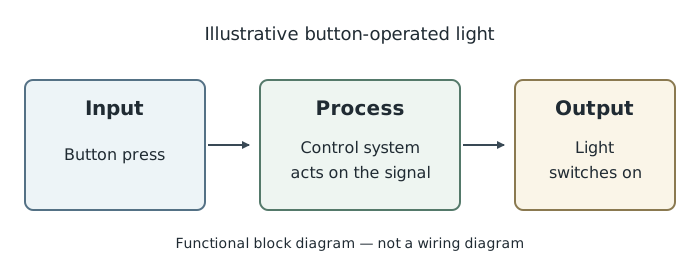
A functional plan: the input is processed to produce the required output.
For a button-operated light, pressing the button supplies an input, the control system processes that input, and the light provides the output. This functional plan leaves room to explore different layouts and forms while keeping the intended operation clear. It is a block diagram of what the product does, not a wiring diagram.
Iterative design means repeating design, testing, evaluation and redesign. An initial idea is a starting point, not a final answer. Sketches, CAD or simple models can be used to explore possibilities, with testing and feedback guiding the next version.
For the storage concept, a model could reveal that the proposed arrangement does not suit the user. The designer changes it and checks again. Each cycle should have a purpose: identifying a difficulty, exploring an alternative or checking whether a change improves the solution.
This approach takes time, but it allows ideas to develop in response to evidence rather than relying entirely on the designer’s first assumptions.
Design fixation occurs when a designer becomes attached to an idea too early and stops considering other options. It can prevent useful feedback from influencing the solution.
To avoid it, generate a varied range of initial ideas, explore different options for individual parts, and use models and testing to compare possibilities. Listen to client and target-market feedback and act on relevant findings.
For the desk-storage problem, this means considering hanging, attaching and freestanding solutions before committing to one. Later, the designer can still reconsider individual features. The aim is not endless change: it is choosing and improving ideas because they meet the need, rather than because they were thought of first.
Get unlimited access to all revision notes, key terms, and exam tips.
Generate different solutions, explore alternatives for individual parts, model and test ideas, and respond to client and target-market feedback. Select ideas for how well they meet the need, not because they came first.
Get unlimited access to all revision notes, key terms, and exam tips.
When explaining a strategy, link what the designer does to how it improves the design: for example, user testing reveals difficulties that can guide changes.
A range of ideas should explore different solutions, not just different colours for the same solution.
Distinguish collaboration from user-centred design: collaboration involves working with others; user-centred design keeps users’ needs central throughout the process.
For a systems approach, identify the input, process and output in the correct order.
Design strategy
A method used to generate, explore or improve ideas for solving a design problem.
Collaboration
Working with other people to share ideas, knowledge and feedback when solving a design problem.
User-centred design
An approach that places users’ needs at the centre of design decisions throughout the design process.
Systems approach
An approach that plans how connected parts work together, often by identifying inputs, processes and outputs.
Iterative design
A repeating process of designing, testing, evaluating and changing a design to improve how well it meets a need.
Design fixation
Becoming attached to an idea too early and failing to consider alternatives or respond to evidence.
Stakeholder
A person or group with an interest in, influence over, or involvement with a product, or who is affected by it.
Target market
The group of people a product is intended to appeal to and be used by.
Put your knowledge into practice — try past paper questions for Design and Technology
Design strategy
A method used to generate, explore or improve ideas for solving a design problem.
Collaboration
Working with other people to share ideas, knowledge and feedback when solving a design problem.
User-centred design
An approach that places users’ needs at the centre of design decisions throughout the design process.
Systems approach
An approach that plans how connected parts work together, often by identifying inputs, processes and outputs.
Iterative design
A repeating process of designing, testing, evaluating and changing a design to improve how well it meets a need.
Design fixation
Becoming attached to an idea too early and failing to consider alternatives or respond to evidence.
Stakeholder
A person or group with an interest in, influence over, or involvement with a product, or who is affected by it.
Target market
The group of people a product is intended to appeal to and be used by.